

472
24 Water and Aqueous Solutions
The full–frequency Raman spectra reveal that charge injection derives no vibration
signatures unless the excessive feature at 3610 cm
−1 due solute HO
− contraction.
Charge injection and thermal excitation do relax the H–O bond and the O:H nonbond
cooperatively.
Further computational refinement [11] in Fig. 24.2 shows that Y
+ cation occupies
the interstitial hollow site while the OH
− replaces the center H 2 O and turns the
H 2 O:4H 2 O into an OH
− :4H 2 O, which transits an O:H–O bond into the O:⇔:O
super–HB. The cation forms the Y
+ ·4H 2 O motif without any regular bond formation.
The ideal Y
+ :O
2− distance is d Y-O = d O-O = 2.695 Å =
√
3a/2 and the Y
+ to the
six next-nearest O neighbors is d Y-O = a (a = 2d O-O /
√
3 = 3.119 Å at 4 °C). Being
different from conventional expectation, the nearest oriented H 2 O molecules create
an electric field in the hollow sites and the Y
+ is subject to the Y
+ :O
2− attraction in one
side and Y
+
↔H
+ repulsion in the opposite. The Y
+ :O
2− attraction shortens itself but
lengthens the H–O bond opposing to the Y
+ :O
2− , while the Y
+
↔H
+ repulsion does
it contrastingly because of the O:H–O cooperativity. As the O:H–O configuration
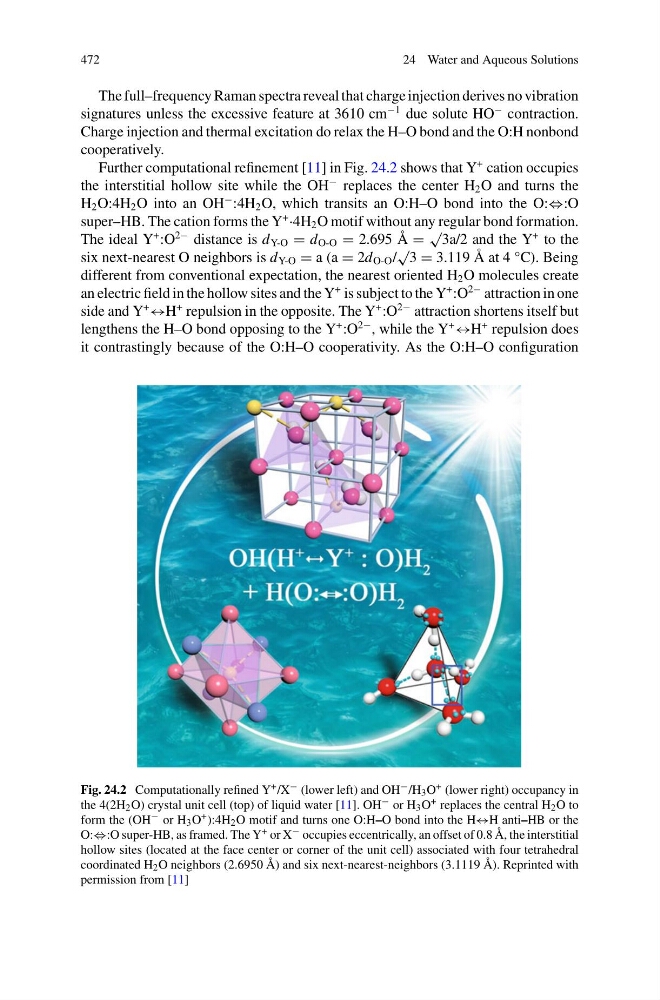
Fig. 24.2 Computationally refined Y + /X − (lower left) and OH − /H 3 O + (lower right) occupancy in
the 4(2H 2 O) crystal unit cell (top) of liquid water [11]. OH − or H 3 O + replaces the central H 2 O to
form the (OH − or H 3 O + ):4H 2 O motif and turns one O:H–O bond into the H↔H anti–HB or the
O:⇔:O super-HB, as framed. The Y + or X − occupies eccentrically, an offset of 0.8 Å, the interstitial
hollow sites (located at the face center or corner of the unit cell) associated with four tetrahedral
coordinated H 2 O neighbors (2.6950 Å) and six next-nearest-neighbors (3.1119 Å). Reprinted with
permission from [11]
24 Water and Aqueous Solutions
The full–frequency Raman spectra reveal that charge injection derives no vibration
signatures unless the excessive feature at 3610 cm
−1 due solute HO
− contraction.
Charge injection and thermal excitation do relax the H–O bond and the O:H nonbond
cooperatively.
Further computational refinement [11] in Fig. 24.2 shows that Y
+ cation occupies
the interstitial hollow site while the OH
− replaces the center H 2 O and turns the
H 2 O:4H 2 O into an OH
− :4H 2 O, which transits an O:H–O bond into the O:⇔:O
super–HB. The cation forms the Y
+ ·4H 2 O motif without any regular bond formation.
The ideal Y
+ :O
2− distance is d Y-O = d O-O = 2.695 Å =
√
3a/2 and the Y
+ to the
six next-nearest O neighbors is d Y-O = a (a = 2d O-O /
√
3 = 3.119 Å at 4 °C). Being
different from conventional expectation, the nearest oriented H 2 O molecules create
an electric field in the hollow sites and the Y
+ is subject to the Y
+ :O
2− attraction in one
side and Y
+
↔H
+ repulsion in the opposite. The Y
+ :O
2− attraction shortens itself but
lengthens the H–O bond opposing to the Y
+ :O
2− , while the Y
+
↔H
+ repulsion does
it contrastingly because of the O:H–O cooperativity. As the O:H–O configuration
Fig. 24.2 Computationally refined Y + /X − (lower left) and OH − /H 3 O + (lower right) occupancy in
the 4(2H 2 O) crystal unit cell (top) of liquid water [11]. OH − or H 3 O + replaces the central H 2 O to
form the (OH − or H 3 O + ):4H 2 O motif and turns one O:H–O bond into the H↔H anti–HB or the
O:⇔:O super-HB, as framed. The Y + or X − occupies eccentrically, an offset of 0.8 Å, the interstitial
hollow sites (located at the face center or corner of the unit cell) associated with four tetrahedral
coordinated H 2 O neighbors (2.6950 Å) and six next-nearest-neighbors (3.1119 Å). Reprinted with
permission from [11]