

24.1 Water and Aqueous Solutions
471
H 2 O
HCl
HBr
HI
Intensity (a.u.)
ω(cm
-1
)
Intensity (a.u.)
H 2 O
LiOH
NaOH
KOH
(b)
(a)
(c)
(d)
Intensity (a.u.)
ω(cm
-1 )
H 2 O
NaCl
NaBr
NaI
200
400
2800
3200 3600
200
400
2800 3200 3600
200 400 600 2800 3200 3600
200
400
2800
3200
3600
Intensity (a.u.)
ω(cm
-1 )
278 K
368 K
H-O
O:H
ω(cm
-1
)
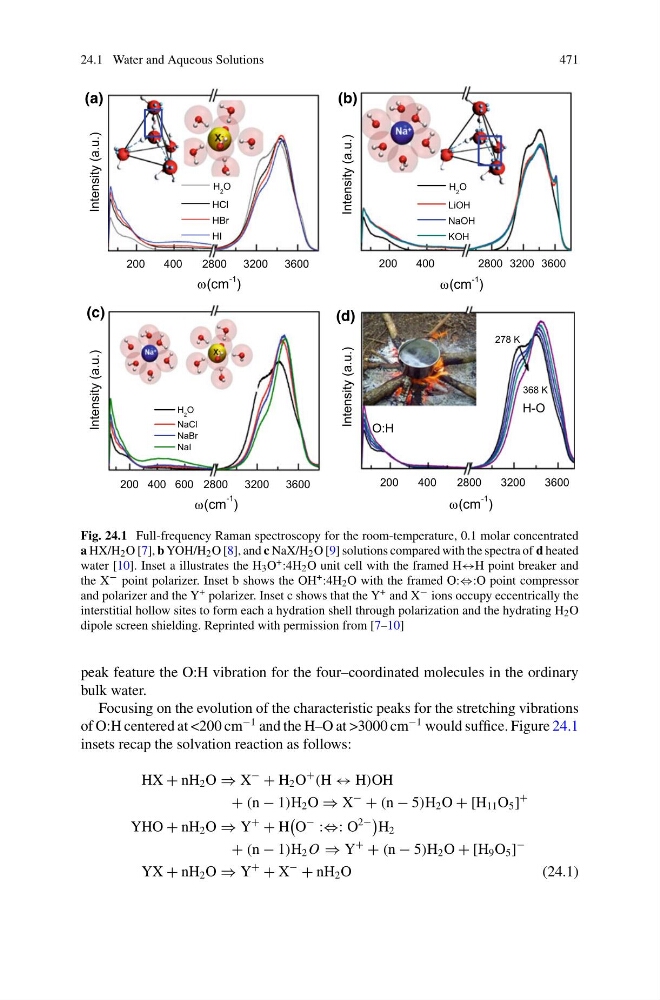
Fig. 24.1 Full-frequency Raman spectroscopy for the room-temperature, 0.1 molar concentrated
a HX/H 2 O [7], b YOH/H 2 O [8], and c NaX/H 2 O [9] solutions compared with the spectra of d heated
water [10]. Inset a illustrates the H 3 O + :4H 2 O unit cell with the framed H↔H point breaker and
the X − point polarizer. Inset b shows the OH + :4H 2 O with the framed O:⇔:O point compressor
and polarizer and the Y + polarizer. Inset c shows that the Y + and X − ions occupy eccentrically the
interstitial hollow sites to form each a hydration shell through polarization and the hydrating H 2 O
dipole screen shielding. Reprinted with permission from [7–10]
peak feature the O:H vibration for the four–coordinated molecules in the ordinary
bulk water.
Focusing on the evolution of the characteristic peaks for the stretching vibrations
of O:H centered at <200 cm
−1 and the H–O at >3000 cm
−1 would suffice. Figure 24.1
insets recap the solvation reaction as follows:
HX + nH 2 O ⇒ X
−
+ H 2 O
+
(H ↔ H)OH
+ (n − 1)H 2 O ⇒ X
−
+ (n − 5)H 2 O + [H 11 O 5 ]
+
YHO + nH 2 O ⇒ Y
+
+ H
O
−
:⇔: O
2−
H 2
+ (n − 1)H 2 O ⇒ Y
+
+ (n − 5)H 2 O + [H 9 O 5 ]
−
YX + nH 2 O ⇒ Y
+
+ X
−
+ nH 2 O
(24.1)
471
H 2 O
HCl
HBr
HI
Intensity (a.u.)
ω(cm
-1
)
Intensity (a.u.)
H 2 O
LiOH
NaOH
KOH
(b)
(a)
(c)
(d)
Intensity (a.u.)
ω(cm
-1 )
H 2 O
NaCl
NaBr
NaI
200
400
2800
3200 3600
200
400
2800 3200 3600
200 400 600 2800 3200 3600
200
400
2800
3200
3600
Intensity (a.u.)
ω(cm
-1 )
278 K
368 K
H-O
O:H
ω(cm
-1
)
Fig. 24.1 Full-frequency Raman spectroscopy for the room-temperature, 0.1 molar concentrated
a HX/H 2 O [7], b YOH/H 2 O [8], and c NaX/H 2 O [9] solutions compared with the spectra of d heated
water [10]. Inset a illustrates the H 3 O + :4H 2 O unit cell with the framed H↔H point breaker and
the X − point polarizer. Inset b shows the OH + :4H 2 O with the framed O:⇔:O point compressor
and polarizer and the Y + polarizer. Inset c shows that the Y + and X − ions occupy eccentrically the
interstitial hollow sites to form each a hydration shell through polarization and the hydrating H 2 O
dipole screen shielding. Reprinted with permission from [7–10]
peak feature the O:H vibration for the four–coordinated molecules in the ordinary
bulk water.
Focusing on the evolution of the characteristic peaks for the stretching vibrations
of O:H centered at <200 cm
−1 and the H–O at >3000 cm
−1 would suffice. Figure 24.1
insets recap the solvation reaction as follows:
HX + nH 2 O ⇒ X
−
+ H 2 O
+
(H ↔ H)OH
+ (n − 1)H 2 O ⇒ X
−
+ (n − 5)H 2 O + [H 11 O 5 ]
+
YHO + nH 2 O ⇒ Y
+
+ H
O
−
:⇔: O
2−
H 2
+ (n − 1)H 2 O ⇒ Y
+
+ (n − 5)H 2 O + [H 9 O 5 ]
−
YX + nH 2 O ⇒ Y
+
+ X
−
+ nH 2 O
(24.1)