

462
23 Sized Crystals
0
50 100 150 200 250 300 350
160
170
180
302
304
306
308
310
CdS (Nano)
CdS (Bulk)
Sb 2 Te 3
Bi 2 Se 3
Δω (cm
-1
)
T (K)
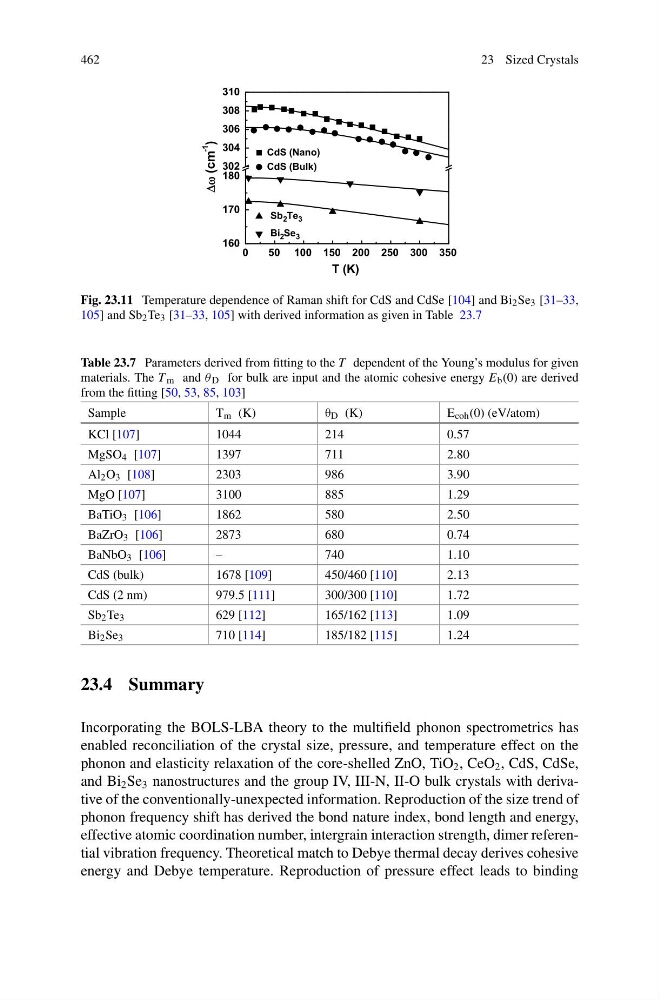
Fig. 23.11 Temperature dependence of Raman shift for CdS and CdSe [104] and Bi 2 Se 3 [31–33,
105] and Sb 2 Te 3 [31–33, 105] with derived information as given in Table 23.7
Table 23.7 Parameters derived from fitting to the T dependent of the Young’s modulus for given
materials. The T m and θ D for bulk are input and the atomic cohesive energy E b (0) are derived
from the fitting [50, 53, 85, 103]
Sample
T m (K)
θ D (K)
E coh (0) (eV/atom)
KCl [107]
1044
214
0.57
MgSO 4 [107]
1397
711
2.80
Al 2 O 3 [108]
2303
986
3.90
MgO [107]
3100
885
1.29
BaTiO 3 [106]
1862
580
2.50
BaZrO 3 [106]
2873
680
0.74
BaNbO 3 [106]
–
740
1.10
CdS (bulk)
1678 [109]
450/460 [110]
2.13
CdS (2 nm)
979.5 [111]
300/300 [110]
1.72
Sb 2 Te 3
629 [112]
165/162 [113]
1.09
Bi 2 Se 3
710 [114]
185/182 [115]
1.24
23.4 Summary
Incorporating the BOLS-LBA theory to the multifield phonon spectrometrics has
enabled reconciliation of the crystal size, pressure, and temperature effect on the
phonon and elasticity relaxation of the core-shelled ZnO, TiO 2 , CeO 2 , CdS, CdSe,
and Bi 2 Se 3 nanostructures and the group IV, III-N, II-O bulk crystals with derivative of the conventionally-unexpected information. Reproduction of the size trend of
phonon frequency shift has derived the bond nature index, bond length and energy,
effective atomic coordination number, intergrain interaction strength, dimer referential vibration frequency. Theoretical match to Debye thermal decay derives cohesive
energy and Debye temperature. Reproduction of pressure effect leads to binding
23 Sized Crystals
0
50 100 150 200 250 300 350
160
170
180
302
304
306
308
310
CdS (Nano)
CdS (Bulk)
Sb 2 Te 3
Bi 2 Se 3
Δω (cm
-1
)
T (K)
Fig. 23.11 Temperature dependence of Raman shift for CdS and CdSe [104] and Bi 2 Se 3 [31–33,
105] and Sb 2 Te 3 [31–33, 105] with derived information as given in Table 23.7
Table 23.7 Parameters derived from fitting to the T dependent of the Young’s modulus for given
materials. The T m and θ D for bulk are input and the atomic cohesive energy E b (0) are derived
from the fitting [50, 53, 85, 103]
Sample
T m (K)
θ D (K)
E coh (0) (eV/atom)
KCl [107]
1044
214
0.57
MgSO 4 [107]
1397
711
2.80
Al 2 O 3 [108]
2303
986
3.90
MgO [107]
3100
885
1.29
BaTiO 3 [106]
1862
580
2.50
BaZrO 3 [106]
2873
680
0.74
BaNbO 3 [106]
–
740
1.10
CdS (bulk)
1678 [109]
450/460 [110]
2.13
CdS (2 nm)
979.5 [111]
300/300 [110]
1.72
Sb 2 Te 3
629 [112]
165/162 [113]
1.09
Bi 2 Se 3
710 [114]
185/182 [115]
1.24
23.4 Summary
Incorporating the BOLS-LBA theory to the multifield phonon spectrometrics has
enabled reconciliation of the crystal size, pressure, and temperature effect on the
phonon and elasticity relaxation of the core-shelled ZnO, TiO 2 , CeO 2 , CdS, CdSe,
and Bi 2 Se 3 nanostructures and the group IV, III-N, II-O bulk crystals with derivative of the conventionally-unexpected information. Reproduction of the size trend of
phonon frequency shift has derived the bond nature index, bond length and energy,
effective atomic coordination number, intergrain interaction strength, dimer referential vibration frequency. Theoretical match to Debye thermal decay derives cohesive
energy and Debye temperature. Reproduction of pressure effect leads to binding