

456
23 Sized Crystals
23.2.5 Vibration Amplitude and Frequency of the Skin Atom
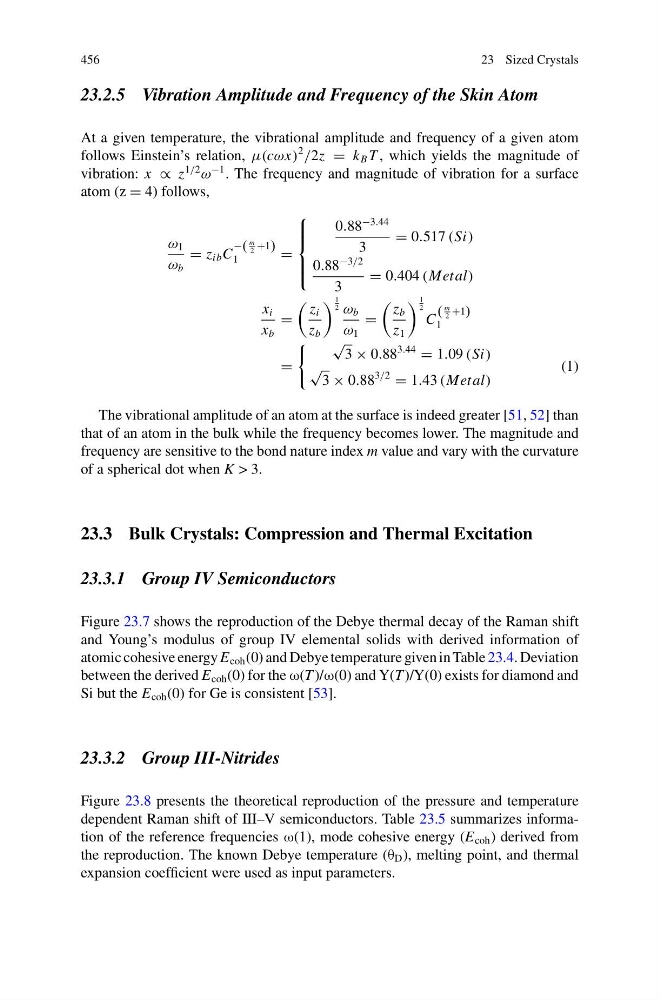
At a given temperature, the vibrational amplitude and frequency of a given atom
follows Einstein’s relation, μ(cωx)
2
/2z = k B T , which yields the magnitude of
vibration: x ∝ z
1/2
ω
−1 . The frequency and magnitude of vibration for a surface
atom (z = 4) follows,
ω 1
ω b
= z ib C
−(
m
2 +1)
1
=
⎧
⎪ ⎪ ⎨
⎪ ⎪ ⎩
0.88
−3.44
3
= 0.517 (Si)
0.88
−3/2
3
= 0.404 (Metal)
x i
x b
=
z i
z b
1
2 ω b
ω 1
=
z b
z 1
1
2
C
(
m
2 +1)
1
=
√
3 × 0.88
3.44
= 1.09 (Si)
√
3 × 0.88
3/2
= 1.43 (Metal)
(1)
The vibrational amplitude of an atom at the surface is indeed greater [51, 52] than
that of an atom in the bulk while the frequency becomes lower. The magnitude and
frequency are sensitive to the bond nature index m value and vary with the curvature
of a spherical dot when K > 3.
23.3 Bulk Crystals: Compression and Thermal Excitation
23.3.1 Group IV Semiconductors
Figure 23.7 shows the reproduction of the Debye thermal decay of the Raman shift
and Young’s modulus of group IV elemental solids with derived information of
atomic cohesive energy E coh (0) and Debye temperature given in Table 23.4. Deviation
between the derived E coh (0) for the ω(T )/ω(0) and Y(T )/Y(0) exists for diamond and
Si but the E coh (0) for Ge is consistent [53].
23.3.2 Group III-Nitrides
Figure 23.8 presents the theoretical reproduction of the pressure and temperature
dependent Raman shift of III–V semiconductors. Table 23.5 summarizes information of the reference frequencies ω(1), mode cohesive energy (E coh ) derived from
the reproduction. The known Debye temperature (θ D ), melting point, and thermal
expansion coefficient were used as input parameters.
23 Sized Crystals
23.2.5 Vibration Amplitude and Frequency of the Skin Atom
At a given temperature, the vibrational amplitude and frequency of a given atom
follows Einstein’s relation, μ(cωx)
2
/2z = k B T , which yields the magnitude of
vibration: x ∝ z
1/2
ω
−1 . The frequency and magnitude of vibration for a surface
atom (z = 4) follows,
ω 1
ω b
= z ib C
−(
m
2 +1)
1
=
⎧
⎪ ⎪ ⎨
⎪ ⎪ ⎩
0.88
−3.44
3
= 0.517 (Si)
0.88
−3/2
3
= 0.404 (Metal)
x i
x b
=
z i
z b
1
2 ω b
ω 1
=
z b
z 1
1
2
C
(
m
2 +1)
1
=
√
3 × 0.88
3.44
= 1.09 (Si)
√
3 × 0.88
3/2
= 1.43 (Metal)
(1)
The vibrational amplitude of an atom at the surface is indeed greater [51, 52] than
that of an atom in the bulk while the frequency becomes lower. The magnitude and
frequency are sensitive to the bond nature index m value and vary with the curvature
of a spherical dot when K > 3.
23.3 Bulk Crystals: Compression and Thermal Excitation
23.3.1 Group IV Semiconductors
Figure 23.7 shows the reproduction of the Debye thermal decay of the Raman shift
and Young’s modulus of group IV elemental solids with derived information of
atomic cohesive energy E coh (0) and Debye temperature given in Table 23.4. Deviation
between the derived E coh (0) for the ω(T )/ω(0) and Y(T )/Y(0) exists for diamond and
Si but the E coh (0) for Ge is consistent [53].
23.3.2 Group III-Nitrides
Figure 23.8 presents the theoretical reproduction of the pressure and temperature
dependent Raman shift of III–V semiconductors. Table 23.5 summarizes information of the reference frequencies ω(1), mode cohesive energy (E coh ) derived from
the reproduction. The known Debye temperature (θ D ), melting point, and thermal
expansion coefficient were used as input parameters.