

23.1 Skin Thickness of the Core-Shelled Structures
449
the skin bond stiffness gain and the redshift is associated with the undercoordinationinduced subjective polarization of the surface electrons that screen and split the
local potentials [5]. The CeO 2 skin covering sheets show both redshift and blueshift
dominated by the bond contraction (blueshift) and the electron polarization (redshift).
However, water droplets show only the D-O bond contraction featured at 2500 cm
−1
as the polarization softens the O:H phonons in the THz regime, from 200 to 75 cm
−1
[6]. The polarization on the high-frequency D–O bond is indistinguishable.
An integration of the DPS peak is the number/volume fraction of bonds transiting
from the bulk to the skin covering shell of the nanostructures. For a spherical structure
of D across, the f (D) = V/V = 3R/R = 6R/D, which gives rise to the shell
thickness R of 0.5 nm for the CeO 2 nanocrystals and 0.09 nm for the H 2 O droplets.
The 0.5 nm is two atomic diameters and 0.09 nm is the length of the H–O dangling
bond that is 10% shorter than it is in the bulk water [3]. The direct measure of the
skin-shell thickness is beyond the scope of any available methods, which proves for
the universal core-shelled configured liquid and solid nanostructures. The unusual
performance of bonds and electrons in the skin-shells and the varied skin/volume
ratio dictate the size dependency of nanostructures in their performance [4].
23.2 Nanocrystals: Size and Thermal Effects
23.2.1 Raman Shift of the Core-Shelled Crystals
Based on the proven core-shell configuration of nanostructures, one can derive the
size-induced phonon relaxation in a spherical nanostructure of the dimensionless
form of size K that is the number of atoms of d across lined along the radius of a
spherical dot. Measurements show that the Raman shift ω(K) − ω(∞) changes with
the inverse of crystal size AK
−1 . The A is the slope. A > 0 or <0 corresponds to the
phonon frequency a blueshift or a redshift.
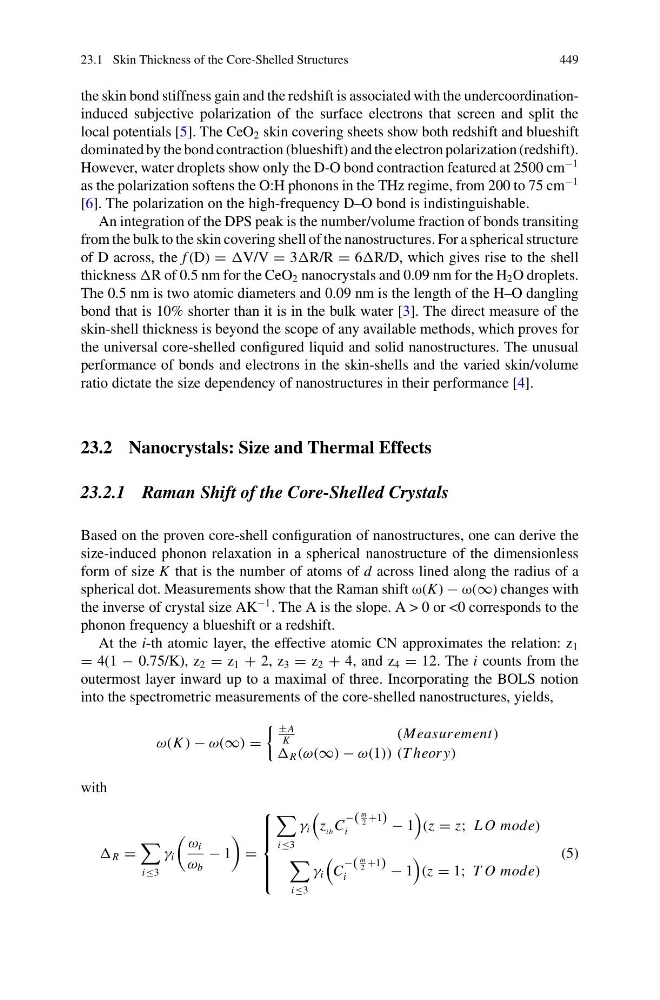
At the i-th atomic layer, the effective atomic CN approximates the relation: z 1
= 4(1 − 0.75/K), z 2 = z 1 + 2, z 3 = z 2 + 4, and z 4 = 12. The i counts from the
outermost layer inward up to a maximal of three. Incorporating the BOLS notion
into the spectrometric measurements of the core-shelled nanostructures, yields,
ω(K ) − ω(∞) =
±A
K
(Measurement)
R (ω(∞) − ω(1)) (T heor y)
with
R =
i≤3
γ i
ω i
ω b
− 1
=
⎧
⎪ ⎪ ⎪ ⎨
⎪ ⎪ ⎪ ⎩
i≤3
γ i
z ib C
−(
m
2 +1)
i
− 1
(z = z; L O mode)
i≤3
γ i
C
−(
m
2 +1)
i
− 1
(z = 1; T O mode)
(5)
449
the skin bond stiffness gain and the redshift is associated with the undercoordinationinduced subjective polarization of the surface electrons that screen and split the
local potentials [5]. The CeO 2 skin covering sheets show both redshift and blueshift
dominated by the bond contraction (blueshift) and the electron polarization (redshift).
However, water droplets show only the D-O bond contraction featured at 2500 cm
−1
as the polarization softens the O:H phonons in the THz regime, from 200 to 75 cm
−1
[6]. The polarization on the high-frequency D–O bond is indistinguishable.
An integration of the DPS peak is the number/volume fraction of bonds transiting
from the bulk to the skin covering shell of the nanostructures. For a spherical structure
of D across, the f (D) = V/V = 3R/R = 6R/D, which gives rise to the shell
thickness R of 0.5 nm for the CeO 2 nanocrystals and 0.09 nm for the H 2 O droplets.
The 0.5 nm is two atomic diameters and 0.09 nm is the length of the H–O dangling
bond that is 10% shorter than it is in the bulk water [3]. The direct measure of the
skin-shell thickness is beyond the scope of any available methods, which proves for
the universal core-shelled configured liquid and solid nanostructures. The unusual
performance of bonds and electrons in the skin-shells and the varied skin/volume
ratio dictate the size dependency of nanostructures in their performance [4].
23.2 Nanocrystals: Size and Thermal Effects
23.2.1 Raman Shift of the Core-Shelled Crystals
Based on the proven core-shell configuration of nanostructures, one can derive the
size-induced phonon relaxation in a spherical nanostructure of the dimensionless
form of size K that is the number of atoms of d across lined along the radius of a
spherical dot. Measurements show that the Raman shift ω(K) − ω(∞) changes with
the inverse of crystal size AK
−1 . The A is the slope. A > 0 or <0 corresponds to the
phonon frequency a blueshift or a redshift.
At the i-th atomic layer, the effective atomic CN approximates the relation: z 1
= 4(1 − 0.75/K), z 2 = z 1 + 2, z 3 = z 2 + 4, and z 4 = 12. The i counts from the
outermost layer inward up to a maximal of three. Incorporating the BOLS notion
into the spectrometric measurements of the core-shelled nanostructures, yields,
ω(K ) − ω(∞) =
±A
K
(Measurement)
R (ω(∞) − ω(1)) (T heor y)
with
R =
i≤3
γ i
ω i
ω b
− 1
=
⎧
⎪ ⎪ ⎪ ⎨
⎪ ⎪ ⎪ ⎩
i≤3
γ i
z ib C
−(
m
2 +1)
i
− 1
(z = z; L O mode)
i≤3
γ i
C
−(
m
2 +1)
i
− 1
(z = 1; T O mode)
(5)