

436
22 Layered Structures
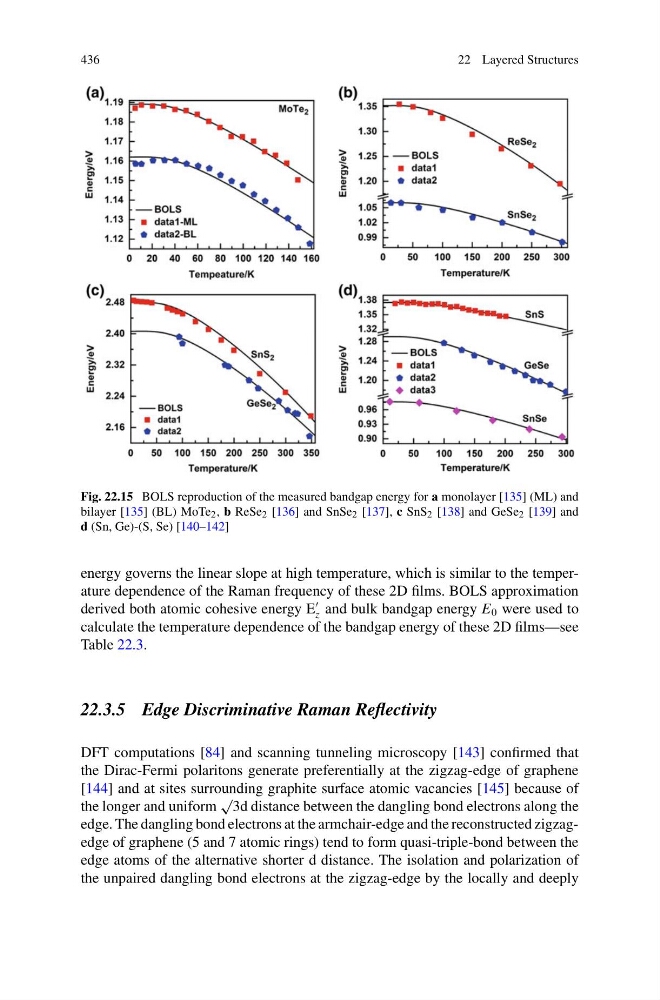
Fig. 22.15 BOLS reproduction of the measured bandgap energy for a monolayer [135] (ML) and
bilayer [135] (BL) MoTe 2 , b ReSe 2 [136] and SnSe 2 [137], c SnS 2 [138] and GeSe 2 [139] and
d (Sn, Ge)-(S, Se) [140–142]
energy governs the linear slope at high temperature, which is similar to the temperature dependence of the Raman frequency of these 2D films. BOLS approximation
derived both atomic cohesive energy E
z and bulk bandgap energy E 0 were used to
calculate the temperature dependence of the bandgap energy of these 2D films—see
Table 22.3.
22.3.5 Edge Discriminative Raman Reflectivity
DFT computations [84] and scanning tunneling microscopy [143] confirmed that
the Dirac-Fermi polaritons generate preferentially at the zigzag-edge of graphene
[144] and at sites surrounding graphite surface atomic vacancies [145] because of
the longer and uniform
√
3d distance between the dangling bond electrons along the
edge. The dangling bond electrons at the armchair-edge and the reconstructed zigzagedge of graphene (5 and 7 atomic rings) tend to form quasi-triple-bond between the
edge atoms of the alternative shorter d distance. The isolation and polarization of
the unpaired dangling bond electrons at the zigzag-edge by the locally and deeply
22 Layered Structures
Fig. 22.15 BOLS reproduction of the measured bandgap energy for a monolayer [135] (ML) and
bilayer [135] (BL) MoTe 2 , b ReSe 2 [136] and SnSe 2 [137], c SnS 2 [138] and GeSe 2 [139] and
d (Sn, Ge)-(S, Se) [140–142]
energy governs the linear slope at high temperature, which is similar to the temperature dependence of the Raman frequency of these 2D films. BOLS approximation
derived both atomic cohesive energy E
z and bulk bandgap energy E 0 were used to
calculate the temperature dependence of the bandgap energy of these 2D films—see
Table 22.3.
22.3.5 Edge Discriminative Raman Reflectivity
DFT computations [84] and scanning tunneling microscopy [143] confirmed that
the Dirac-Fermi polaritons generate preferentially at the zigzag-edge of graphene
[144] and at sites surrounding graphite surface atomic vacancies [145] because of
the longer and uniform
√
3d distance between the dangling bond electrons along the
edge. The dangling bond electrons at the armchair-edge and the reconstructed zigzagedge of graphene (5 and 7 atomic rings) tend to form quasi-triple-bond between the
edge atoms of the alternative shorter d distance. The isolation and polarization of
the unpaired dangling bond electrons at the zigzag-edge by the locally and deeply