

432
22 Layered Structures
1560
1570
1580
1590
1600
-1
T (K)
Graphite
Graphite
CNB
SWCNT
C60
SWCNT
Graphene
1575
1600
1625
1650
(cm)
P (GPa)
Graphite
Graphene
2680
2700
2720
2740
2760
(cm
-1
)
(cm )
P (GPa)
Graphene
0
200
400
600
800 1000
0
2
4
6
8
10
12
0
1
2
3
4
5
0
5
10
15
20
25
30
1325
1350
1375
1400
1600
1650
1700
1750
P (GPa)
Diamond-D
SWCNT-G
(cm)
(a)
(b)
(c)
(d)
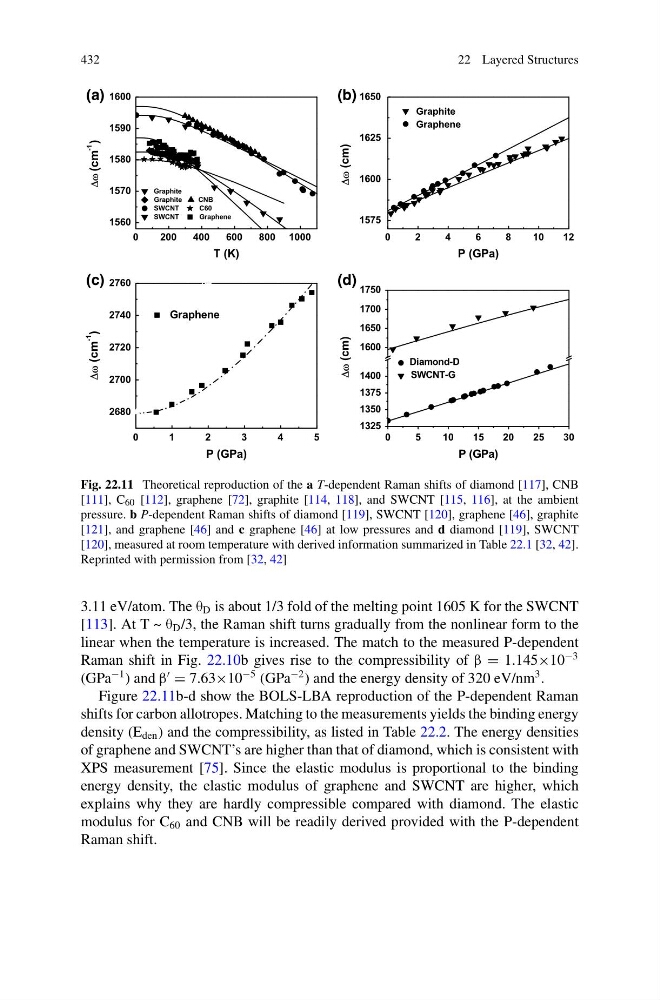
Fig. 22.11 Theoretical reproduction of the a T-dependent Raman shifts of diamond [117], CNB
[111], C 60 [112], graphene [72], graphite [114, 118], and SWCNT [115, 116], at the ambient
pressure. b P-dependent Raman shifts of diamond [119], SWCNT [120], graphene [46], graphite
[121], and graphene [46] and c graphene [46] at low pressures and d diamond [119], SWCNT
[120], measured at room temperature with derived information summarized in Table 22.1 [32, 42].
Reprinted with permission from [32, 42]
3.11 eV/atom. The θ D is about 1/3 fold of the melting point 1605 K for the SWCNT
[113]. At T ~ θ D /3, the Raman shift turns gradually from the nonlinear form to the
linear when the temperature is increased. The match to the measured P-dependent
Raman shift in Fig. 22.10b gives rise to the compressibility of β = 1.145×10
−3
(GPa
−1 ) and β
= 7.63×10
−5 (GPa
−2 ) and the energy density of 320 eV/nm
3 .
Figure 22.11b-d show the BOLS-LBA reproduction of the P-dependent Raman
shifts for carbon allotropes. Matching to the measurements yields the binding energy
density (E den ) and the compressibility, as listed in Table 22.2. The energy densities
of graphene and SWCNT’s are higher than that of diamond, which is consistent with
XPS measurement [75]. Since the elastic modulus is proportional to the binding
energy density, the elastic modulus of graphene and SWCNT are higher, which
explains why they are hardly compressible compared with diamond. The elastic
modulus for C 60 and CNB will be readily derived provided with the P-dependent
Raman shift.
22 Layered Structures
1560
1570
1580
1590
1600
-1
T (K)
Graphite
Graphite
CNB
SWCNT
C60
SWCNT
Graphene
1575
1600
1625
1650
(cm)
P (GPa)
Graphite
Graphene
2680
2700
2720
2740
2760
(cm
-1
)
(cm )
P (GPa)
Graphene
0
200
400
600
800 1000
0
2
4
6
8
10
12
0
1
2
3
4
5
0
5
10
15
20
25
30
1325
1350
1375
1400
1600
1650
1700
1750
P (GPa)
Diamond-D
SWCNT-G
(cm)
(a)
(b)
(c)
(d)
Fig. 22.11 Theoretical reproduction of the a T-dependent Raman shifts of diamond [117], CNB
[111], C 60 [112], graphene [72], graphite [114, 118], and SWCNT [115, 116], at the ambient
pressure. b P-dependent Raman shifts of diamond [119], SWCNT [120], graphene [46], graphite
[121], and graphene [46] and c graphene [46] at low pressures and d diamond [119], SWCNT
[120], measured at room temperature with derived information summarized in Table 22.1 [32, 42].
Reprinted with permission from [32, 42]
3.11 eV/atom. The θ D is about 1/3 fold of the melting point 1605 K for the SWCNT
[113]. At T ~ θ D /3, the Raman shift turns gradually from the nonlinear form to the
linear when the temperature is increased. The match to the measured P-dependent
Raman shift in Fig. 22.10b gives rise to the compressibility of β = 1.145×10
−3
(GPa
−1 ) and β
= 7.63×10
−5 (GPa
−2 ) and the energy density of 320 eV/nm
3 .
Figure 22.11b-d show the BOLS-LBA reproduction of the P-dependent Raman
shifts for carbon allotropes. Matching to the measurements yields the binding energy
density (E den ) and the compressibility, as listed in Table 22.2. The energy densities
of graphene and SWCNT’s are higher than that of diamond, which is consistent with
XPS measurement [75]. Since the elastic modulus is proportional to the binding
energy density, the elastic modulus of graphene and SWCNT are higher, which
explains why they are hardly compressible compared with diamond. The elastic
modulus for C 60 and CNB will be readily derived provided with the P-dependent
Raman shift.