

22.3 Numerical Reproduction of Phonon Relaxation
425
353
354
355
418
420
E
1
2g
A 1g
1/K
(cm
-1
)
WS 2
(a)
382
383
384
404
406
408
E
1
2g
A 1g
(b)
MoS 2
247
248
249
257
258
259
260
A 1g
E
1
2g
(c)
A 1g
WSe 2
0.0 0.2
0.0 0.2
0.0 0.2
0.0 0.2
240
241
242
284
285
286
287
(d)
E
1
2g
MoSe 2
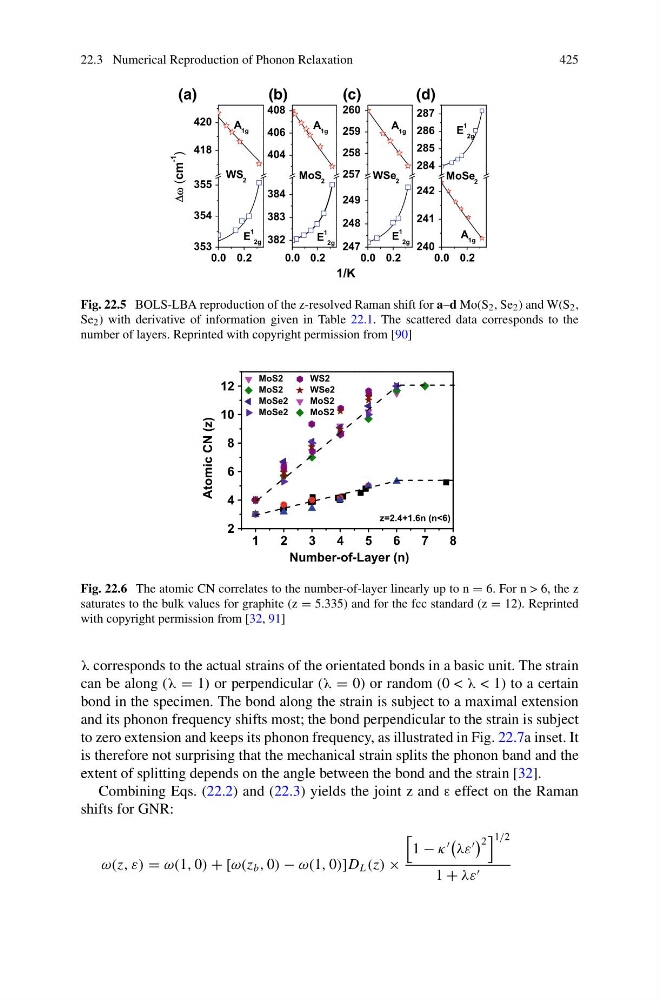
Fig. 22.5 BOLS-LBA reproduction of the z-resolved Raman shift for a–d Mo(S 2 , Se 2 ) and W(S 2 ,
Se 2 ) with derivative of information given in Table 22.1. The scattered data corresponds to the
number of layers. Reprinted with copyright permission from [90]
1
2
3
4
5
6
7
8
2
4
6
8
10
12
MoS2
WS2
MoS2
WSe2
MoSe2
MoS2
MoSe2
MoS2
z=2.4+1.6n (n<6)
Atomic CN (z)
Number-of-Layer (n)
Fig. 22.6 The atomic CN correlates to the number-of-layer linearly up to n = 6. For n > 6, the z
saturates to the bulk values for graphite (z = 5.335) and for the fcc standard (z = 12). Reprinted
with copyright permission from [32, 91]
λ corresponds to the actual strains of the orientated bonds in a basic unit. The strain
can be along (λ = 1) or perpendicular (λ = 0) or random (0 < λ < 1) to a certain
bond in the specimen. The bond along the strain is subject to a maximal extension
and its phonon frequency shifts most; the bond perpendicular to the strain is subject
to zero extension and keeps its phonon frequency, as illustrated in Fig. 22.7a inset. It
is therefore not surprising that the mechanical strain splits the phonon band and the
extent of splitting depends on the angle between the bond and the strain [32].
Combining Eqs. (22.2) and (22.3) yields the joint z and ε effect on the Raman
shifts for GNR:
ω(z, ε) = ω(1, 0) + [ω(z b , 0) − ω(1, 0)]D L (z) ×
1 − κ
λε
2
1/2
1 + λε
425
353
354
355
418
420
E
1
2g
A 1g
1/K
(cm
-1
)
WS 2
(a)
382
383
384
404
406
408
E
1
2g
A 1g
(b)
MoS 2
247
248
249
257
258
259
260
A 1g
E
1
2g
(c)
A 1g
WSe 2
0.0 0.2
0.0 0.2
0.0 0.2
0.0 0.2
240
241
242
284
285
286
287
(d)
E
1
2g
MoSe 2
Fig. 22.5 BOLS-LBA reproduction of the z-resolved Raman shift for a–d Mo(S 2 , Se 2 ) and W(S 2 ,
Se 2 ) with derivative of information given in Table 22.1. The scattered data corresponds to the
number of layers. Reprinted with copyright permission from [90]
1
2
3
4
5
6
7
8
2
4
6
8
10
12
MoS2
WS2
MoS2
WSe2
MoSe2
MoS2
MoSe2
MoS2
z=2.4+1.6n (n<6)
Atomic CN (z)
Number-of-Layer (n)
Fig. 22.6 The atomic CN correlates to the number-of-layer linearly up to n = 6. For n > 6, the z
saturates to the bulk values for graphite (z = 5.335) and for the fcc standard (z = 12). Reprinted
with copyright permission from [32, 91]
λ corresponds to the actual strains of the orientated bonds in a basic unit. The strain
can be along (λ = 1) or perpendicular (λ = 0) or random (0 < λ < 1) to a certain
bond in the specimen. The bond along the strain is subject to a maximal extension
and its phonon frequency shifts most; the bond perpendicular to the strain is subject
to zero extension and keeps its phonon frequency, as illustrated in Fig. 22.7a inset. It
is therefore not surprising that the mechanical strain splits the phonon band and the
extent of splitting depends on the angle between the bond and the strain [32].
Combining Eqs. (22.2) and (22.3) yields the joint z and ε effect on the Raman
shifts for GNR:
ω(z, ε) = ω(1, 0) + [ω(z b , 0) − ω(1, 0)]D L (z) ×
1 − κ
λε
2
1/2
1 + λε