

22.3 Numerical Reproduction of Phonon Relaxation
423
E
1
2g blueshift, which are the same to the D/2D mode and the G mode of graphene,
respectively.
With the known ω(n = ∞) for the bulk and ω(n = 1) as input parameters, one can
derive information show in Table 22.1 for the layered MX 2 by repeating the same
calculation iteration of graphene [91]. Figure 22.5 shows the BOLS-LBA matching to
the phonon frequency shift of the layered MX 2 with the derive m and ω L (1) tabulated
in Table 22.1. Theoretical reproduction of the n-dependence of Raman shift verifies
that the dimer bond interaction dictates the E
1
2g mode blueshift but the collective
interaction of an atom with its z-neighbors governs the A 1g mode redshift.
22.3.1.4 Atomic-CN Versus the Number-of-Layer
The scattered data in Figs. 22.3 and 22.5 correspond to different numbers of layers
while the lateral axis is the effective atomic CN, which gives rise to the z − n
correlation as shown in Fig. 22.6. When the n is greater than 6, the z saturates at the
bulk value of 5.335 (z = 2.55 + 0.45n) for graphite and the bulk value of 12 (z = 2.4
+ 1.6n) for the layered MX 2 . Consistency between predictions and measurements
of the z-dependent Raman shifts and the z-n transformation function evidence the
essentiality and appropriateness of the BOLS framework for the lattice vibration in
these 2D structures.
22.3.2 Strain-Induced Phonon Softening and Band Splitting
The data of tensile strain for the monolayer graphene [68] and MoS 2 [94] enabled
the derived information of the average-bond force constant and the relative direction
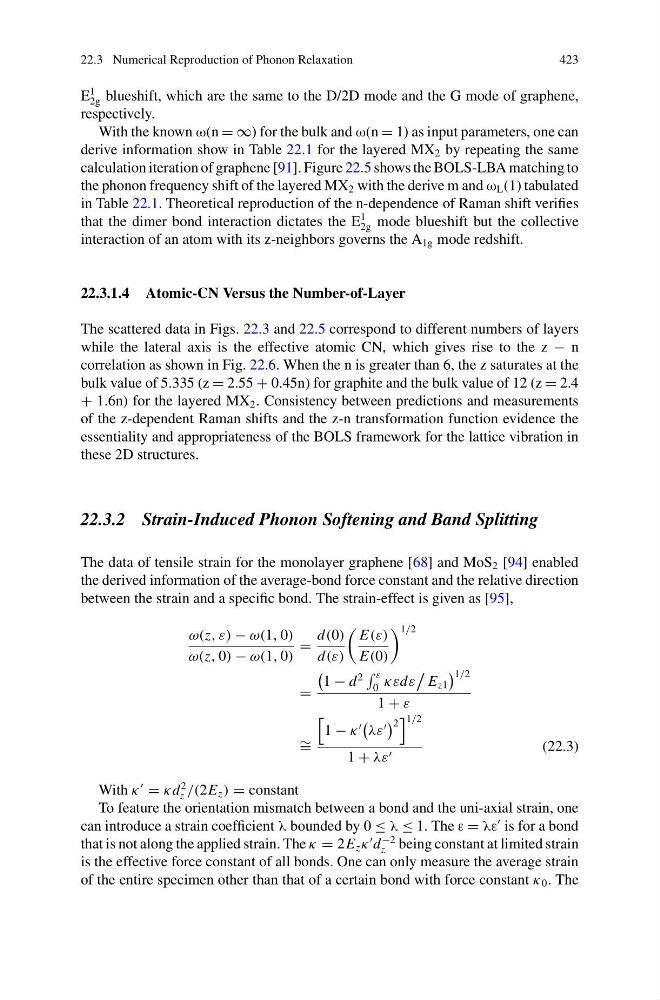
between the strain and a specific bond. The strain-effect is given as [95],
ω(z, ε) − ω(1, 0)
ω(z, 0) − ω(1, 0)
=
d(0)
d(ε)
E(ε)
E(0)
1/2
=
1 − d
2
ε
0 κεdε
E z1
1/2
1 + ε
∼ =
1 − κ
λε
2
1/2
1 + λε
(22.3)
With κ
= κd
2
z /(2E z ) = constant
To feature the orientation mismatch between a bond and the uni-axial strain, one
can introduce a strain coefficient λ bounded by 0 ≤ λ ≤ 1. The ε = λε
is for a bond
that is not along the applied strain. The κ = 2E z κ
d
−2
z being constant at limited strain
is the effective force constant of all bonds. One can only measure the average strain
of the entire specimen other than that of a certain bond with force constant κ 0 . The
423
E
1
2g blueshift, which are the same to the D/2D mode and the G mode of graphene,
respectively.
With the known ω(n = ∞) for the bulk and ω(n = 1) as input parameters, one can
derive information show in Table 22.1 for the layered MX 2 by repeating the same
calculation iteration of graphene [91]. Figure 22.5 shows the BOLS-LBA matching to
the phonon frequency shift of the layered MX 2 with the derive m and ω L (1) tabulated
in Table 22.1. Theoretical reproduction of the n-dependence of Raman shift verifies
that the dimer bond interaction dictates the E
1
2g mode blueshift but the collective
interaction of an atom with its z-neighbors governs the A 1g mode redshift.
22.3.1.4 Atomic-CN Versus the Number-of-Layer
The scattered data in Figs. 22.3 and 22.5 correspond to different numbers of layers
while the lateral axis is the effective atomic CN, which gives rise to the z − n
correlation as shown in Fig. 22.6. When the n is greater than 6, the z saturates at the
bulk value of 5.335 (z = 2.55 + 0.45n) for graphite and the bulk value of 12 (z = 2.4
+ 1.6n) for the layered MX 2 . Consistency between predictions and measurements
of the z-dependent Raman shifts and the z-n transformation function evidence the
essentiality and appropriateness of the BOLS framework for the lattice vibration in
these 2D structures.
22.3.2 Strain-Induced Phonon Softening and Band Splitting
The data of tensile strain for the monolayer graphene [68] and MoS 2 [94] enabled
the derived information of the average-bond force constant and the relative direction
between the strain and a specific bond. The strain-effect is given as [95],
ω(z, ε) − ω(1, 0)
ω(z, 0) − ω(1, 0)
=
d(0)
d(ε)
E(ε)
E(0)
1/2
=
1 − d
2
ε
0 κεdε
E z1
1/2
1 + ε
∼ =
1 − κ
λε
2
1/2
1 + λε
(22.3)
With κ
= κd
2
z /(2E z ) = constant
To feature the orientation mismatch between a bond and the uni-axial strain, one
can introduce a strain coefficient λ bounded by 0 ≤ λ ≤ 1. The ε = λε
is for a bond
that is not along the applied strain. The κ = 2E z κ
d
−2
z being constant at limited strain
is the effective force constant of all bonds. One can only measure the average strain
of the entire specimen other than that of a certain bond with force constant κ 0 . The