

382
20 Wonders of Multifield Lattice Oscillation
in the films. When the size is decreased, the rule of momentum conservation will be
relaxed and the Raman active modes will not be limited to the center of the Brillouin
zone [93]. The large surface-to-volume ratio of a nanodot strongly affects the optical
properties mainly due to introducing surface polarization states [100].
Particle size reduction softens the phonons for all glasses including CdSe
nanograins. Models based on assumptions that the materials are homogeneous and
isotropic are valid only in the long-wavelength limit. When the size of the nanosolid
is in the range of a few nanometers, the continuum dielectric models are faced
limitations.
Hwang et al. [101] consider the effect of lattice contraction in explaining the
versatile phonon redshifts of nanosolid CdSe embedded in different glass matrices.
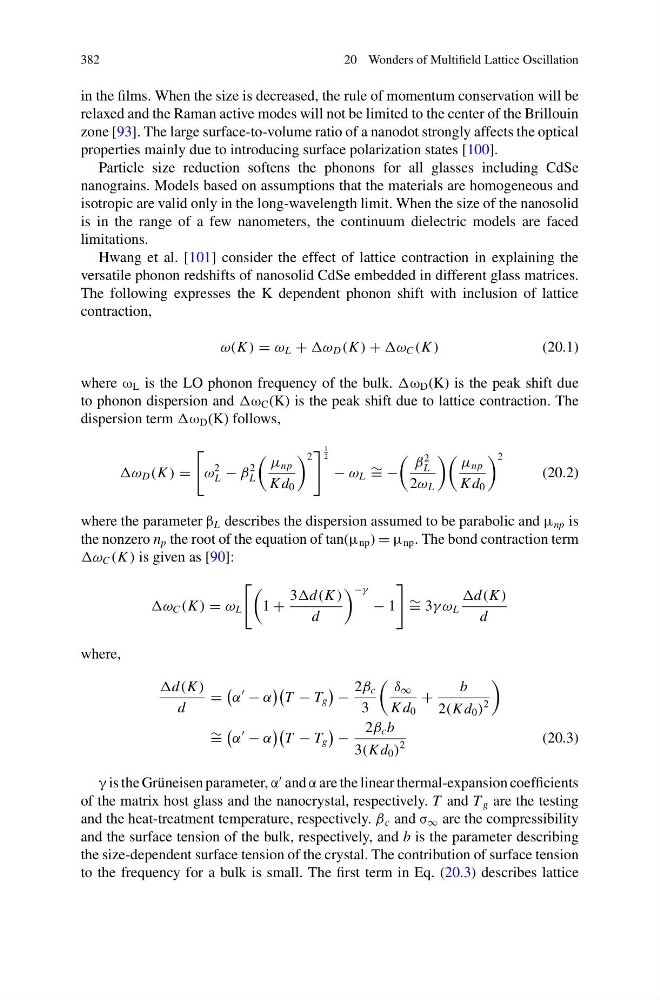
The following expresses the K dependent phonon shift with inclusion of lattice
contraction,
ω(K ) = ω L + ω D (K ) + ω C (K )
(20.1)
where ω L is the LO phonon frequency of the bulk. ω D (K) is the peak shift due
to phonon dispersion and ω C (K) is the peak shift due to lattice contraction. The
dispersion term ω D (K) follows,
ω D (K ) =
ω
2
L − β
2
L
μ np
K d 0
2
1
2
− ω L ∼ = −
β
2
L
2ω L
μ np
K d 0
2
(20.2)
where the parameter β L describes the dispersion assumed to be parabolic and μ np is
the nonzero n p the root of the equation of tan(μ np ) = μ np . The bond contraction term
ω C (K ) is given as [90]:
ω C (K ) = ω L
1 +
3d(K )
d
−γ
− 1
∼ = 3γ ω L
d(K )
d
where,
d(K )
d
=
α
− α
T − T g
−
2β c
3
δ ∞
K d 0
+
b
2(K d 0 )
2
∼ =
α
− α
T − T g
−
2β c b
3(K d 0 )
2
(20.3)
γ is the Grüneisen parameter, α
and α are the linear thermal-expansion coefficients
of the matrix host glass and the nanocrystal, respectively. T and T g are the testing
and the heat-treatment temperature, respectively. β c and σ ∞ are the compressibility
and the surface tension of the bulk, respectively, and b is the parameter describing
the size-dependent surface tension of the crystal. The contribution of surface tension
to the frequency for a bulk is small. The first term in Eq. (20.3) describes lattice
20 Wonders of Multifield Lattice Oscillation
in the films. When the size is decreased, the rule of momentum conservation will be
relaxed and the Raman active modes will not be limited to the center of the Brillouin
zone [93]. The large surface-to-volume ratio of a nanodot strongly affects the optical
properties mainly due to introducing surface polarization states [100].
Particle size reduction softens the phonons for all glasses including CdSe
nanograins. Models based on assumptions that the materials are homogeneous and
isotropic are valid only in the long-wavelength limit. When the size of the nanosolid
is in the range of a few nanometers, the continuum dielectric models are faced
limitations.
Hwang et al. [101] consider the effect of lattice contraction in explaining the
versatile phonon redshifts of nanosolid CdSe embedded in different glass matrices.
The following expresses the K dependent phonon shift with inclusion of lattice
contraction,
ω(K ) = ω L + ω D (K ) + ω C (K )
(20.1)
where ω L is the LO phonon frequency of the bulk. ω D (K) is the peak shift due
to phonon dispersion and ω C (K) is the peak shift due to lattice contraction. The
dispersion term ω D (K) follows,
ω D (K ) =
ω
2
L − β
2
L
μ np
K d 0
2
1
2
− ω L ∼ = −
β
2
L
2ω L
μ np
K d 0
2
(20.2)
where the parameter β L describes the dispersion assumed to be parabolic and μ np is
the nonzero n p the root of the equation of tan(μ np ) = μ np . The bond contraction term
ω C (K ) is given as [90]:
ω C (K ) = ω L
1 +
3d(K )
d
−γ
− 1
∼ = 3γ ω L
d(K )
d
where,
d(K )
d
=
α
− α
T − T g
−
2β c
3
δ ∞
K d 0
+
b
2(K d 0 )
2
∼ =
α
− α
T − T g
−
2β c b
3(K d 0 )
2
(20.3)
γ is the Grüneisen parameter, α
and α are the linear thermal-expansion coefficients
of the matrix host glass and the nanocrystal, respectively. T and T g are the testing
and the heat-treatment temperature, respectively. β c and σ ∞ are the compressibility
and the surface tension of the bulk, respectively, and b is the parameter describing
the size-dependent surface tension of the crystal. The contribution of surface tension
to the frequency for a bulk is small. The first term in Eq. (20.3) describes lattice