

18.3 Four-Stage Cu 3 O 2 Bonding and Band Forming Kinetics
353
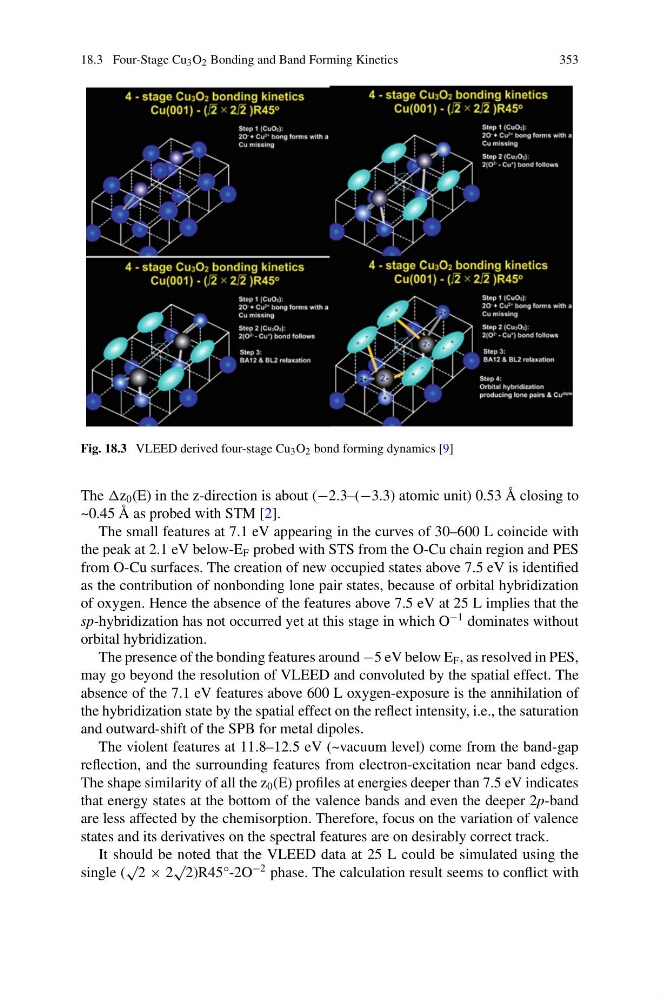
Fig. 18.3 VLEED derived four-stage Cu 3 O 2 bond forming dynamics [9]
The z 0 (E) in the z-direction is about (−2.3–(−3.3) atomic unit) 0.53 Å closing to
~0.45 Å as probed with STM [2].
The small features at 7.1 eV appearing in the curves of 30–600 L coincide with
the peak at 2.1 eV below-E F probed with STS from the O-Cu chain region and PES
from O-Cu surfaces. The creation of new occupied states above 7.5 eV is identified
as the contribution of nonbonding lone pair states, because of orbital hybridization
of oxygen. Hence the absence of the features above 7.5 eV at 25 L implies that the
sp-hybridization has not occurred yet at this stage in which O
−1 dominates without
orbital hybridization.
The presence of the bonding features around −5 eV below E F , as resolved in PES,
may go beyond the resolution of VLEED and convoluted by the spatial effect. The
absence of the 7.1 eV features above 600 L oxygen-exposure is the annihilation of
the hybridization state by the spatial effect on the reflect intensity, i.e., the saturation
and outward-shift of the SPB for metal dipoles.
The violent features at 11.8–12.5 eV (~vacuum level) come from the band-gap
reflection, and the surrounding features from electron-excitation near band edges.
The shape similarity of all the z 0 (E) profiles at energies deeper than 7.5 eV indicates
that energy states at the bottom of the valence bands and even the deeper 2p-band
are less affected by the chemisorption. Therefore, focus on the variation of valence
states and its derivatives on the spectral features are on desirably correct track.
It should be noted that the VLEED data at 25 L could be simulated using the
single (
√
2 × 2
√
2)R45°-2O
−2 phase. The calculation result seems to conflict with
353
Fig. 18.3 VLEED derived four-stage Cu 3 O 2 bond forming dynamics [9]
The z 0 (E) in the z-direction is about (−2.3–(−3.3) atomic unit) 0.53 Å closing to
~0.45 Å as probed with STM [2].
The small features at 7.1 eV appearing in the curves of 30–600 L coincide with
the peak at 2.1 eV below-E F probed with STS from the O-Cu chain region and PES
from O-Cu surfaces. The creation of new occupied states above 7.5 eV is identified
as the contribution of nonbonding lone pair states, because of orbital hybridization
of oxygen. Hence the absence of the features above 7.5 eV at 25 L implies that the
sp-hybridization has not occurred yet at this stage in which O
−1 dominates without
orbital hybridization.
The presence of the bonding features around −5 eV below E F , as resolved in PES,
may go beyond the resolution of VLEED and convoluted by the spatial effect. The
absence of the 7.1 eV features above 600 L oxygen-exposure is the annihilation of
the hybridization state by the spatial effect on the reflect intensity, i.e., the saturation
and outward-shift of the SPB for metal dipoles.
The violent features at 11.8–12.5 eV (~vacuum level) come from the band-gap
reflection, and the surrounding features from electron-excitation near band edges.
The shape similarity of all the z 0 (E) profiles at energies deeper than 7.5 eV indicates
that energy states at the bottom of the valence bands and even the deeper 2p-band
are less affected by the chemisorption. Therefore, focus on the variation of valence
states and its derivatives on the spectral features are on desirably correct track.
It should be noted that the VLEED data at 25 L could be simulated using the
single (
√
2 × 2
√
2)R45°-2O
−2 phase. The calculation result seems to conflict with