

338
17 Blouin Zones, Effective Mass, Muffin-tin Potential…
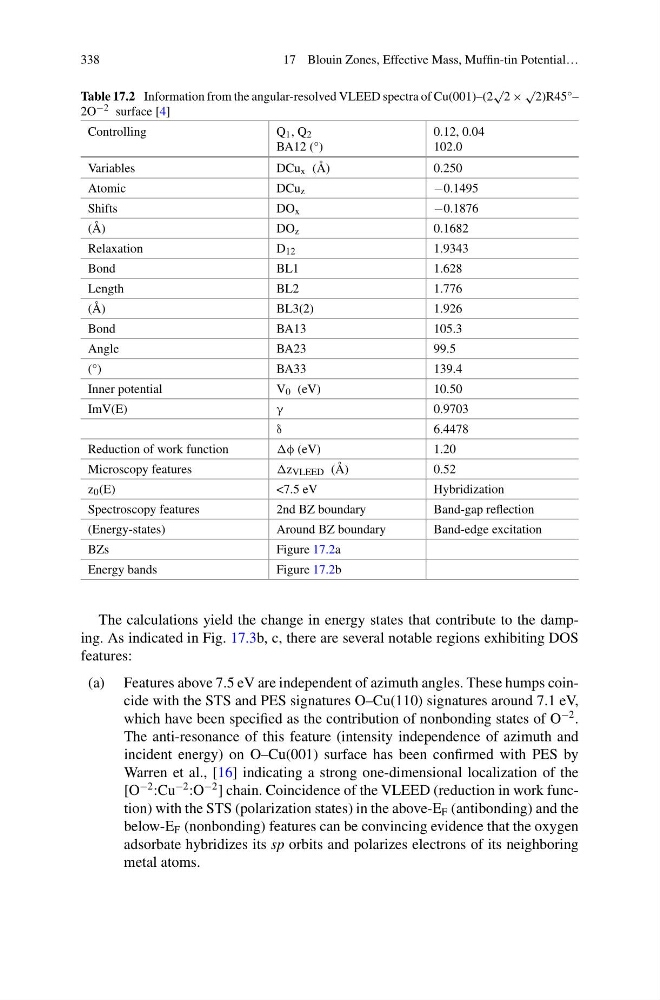
Table 17.2 Information from the angular-resolved VLEED spectra of Cu(001)–(2
√
2 ×
√
2)R45°–
2O −2 surface [4]
Controlling
Q 1 , Q 2
BA12 (°)
0.12, 0.04
102.0
Variables
DCu x (Å)
0.250
Atomic
DCu z
−0.1495
Shifts
DO x
−0.1876
(Å)
DO z
0.1682
Relaxation
D 12
1.9343
Bond
BL1
1.628
Length
BL2
1.776
(Å)
BL3(2)
1.926
Bond
BA13
105.3
Angle
BA23
99.5
(°)
BA33
139.4
Inner potential
V 0 (eV)
10.50
ImV(E)
γ
0.9703
δ
6.4478
Reduction of work function
φ (eV)
1.20
Microscopy features
z VLEED (Å)
0.52
z 0 (E)
<7.5 eV
Hybridization
Spectroscopy features
2nd BZ boundary
Band-gap reflection
(Energy-states)
Around BZ boundary
Band-edge excitation
BZs
Figure 17.2a
Energy bands
Figure 17.2b
The calculations yield the change in energy states that contribute to the damping. As indicated in Fig. 17.3b, c, there are several notable regions exhibiting DOS
features:
(a) Features above 7.5 eV are independent of azimuth angles. These humps coincide with the STS and PES signatures O–Cu(110) signatures around 7.1 eV,
which have been specified as the contribution of nonbonding states of O
−2 .
The anti-resonance of this feature (intensity independence of azimuth and
incident energy) on O–Cu(001) surface has been confirmed with PES by
Warren et al., [16] indicating a strong one-dimensional localization of the
[O
−2 :Cu
−2 :O
−2 ] chain. Coincidence of the VLEED (reduction in work function) with the STS (polarization states) in the above-E F (antibonding) and the
below-E F (nonbonding) features can be convincing evidence that the oxygen
adsorbate hybridizes its sp orbits and polarizes electrons of its neighboring
metal atoms.
17 Blouin Zones, Effective Mass, Muffin-tin Potential…
Table 17.2 Information from the angular-resolved VLEED spectra of Cu(001)–(2
√
2 ×
√
2)R45°–
2O −2 surface [4]
Controlling
Q 1 , Q 2
BA12 (°)
0.12, 0.04
102.0
Variables
DCu x (Å)
0.250
Atomic
DCu z
−0.1495
Shifts
DO x
−0.1876
(Å)
DO z
0.1682
Relaxation
D 12
1.9343
Bond
BL1
1.628
Length
BL2
1.776
(Å)
BL3(2)
1.926
Bond
BA13
105.3
Angle
BA23
99.5
(°)
BA33
139.4
Inner potential
V 0 (eV)
10.50
ImV(E)
γ
0.9703
δ
6.4478
Reduction of work function
φ (eV)
1.20
Microscopy features
z VLEED (Å)
0.52
z 0 (E)
<7.5 eV
Hybridization
Spectroscopy features
2nd BZ boundary
Band-gap reflection
(Energy-states)
Around BZ boundary
Band-edge excitation
BZs
Figure 17.2a
Energy bands
Figure 17.2b
The calculations yield the change in energy states that contribute to the damping. As indicated in Fig. 17.3b, c, there are several notable regions exhibiting DOS
features:
(a) Features above 7.5 eV are independent of azimuth angles. These humps coincide with the STS and PES signatures O–Cu(110) signatures around 7.1 eV,
which have been specified as the contribution of nonbonding states of O
−2 .
The anti-resonance of this feature (intensity independence of azimuth and
incident energy) on O–Cu(001) surface has been confirmed with PES by
Warren et al., [16] indicating a strong one-dimensional localization of the
[O
−2 :Cu
−2 :O
−2 ] chain. Coincidence of the VLEED (reduction in work function) with the STS (polarization states) in the above-E F (antibonding) and the
below-E F (nonbonding) features can be convincing evidence that the oxygen
adsorbate hybridizes its sp orbits and polarizes electrons of its neighboring
metal atoms.