

14.4 Energy-Dependent 3D-SPB
293
M
X - Distance (a.u.)
z 0
z
z 0M
1M
z
z 1m
z 1
OL
SL
+
-
+
-
-z
VACUUM
0m
z
0
x
BULK
BARRIER
=
A
V
>
A
A
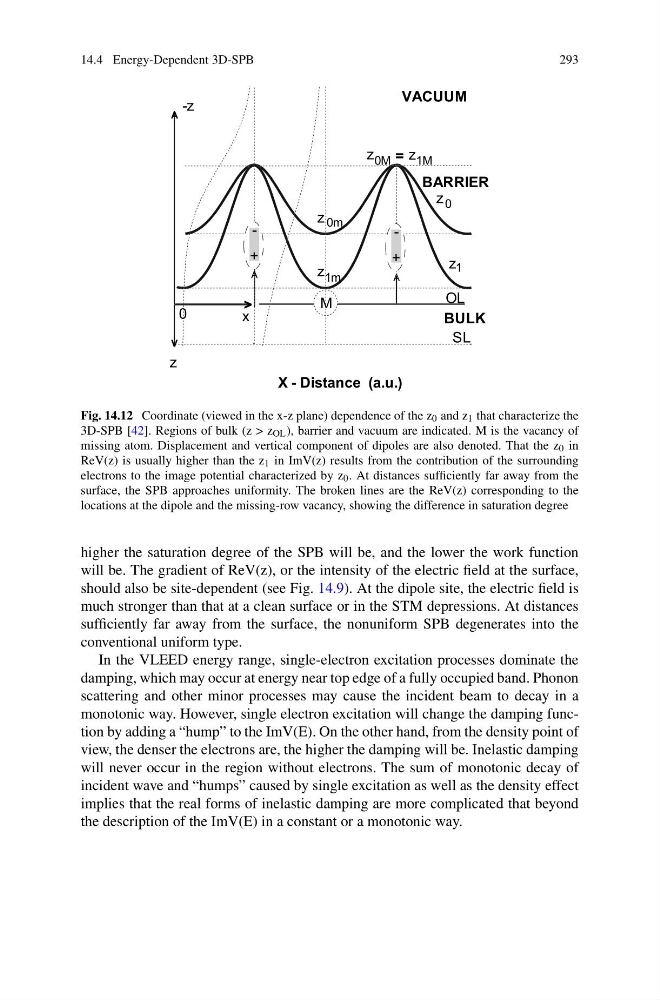
Fig. 14.12 Coordinate (viewed in the x-z plane) dependence of the z 0 and z 1 that characterize the
3D-SPB [42]. Regions of bulk (z > z OL ), barrier and vacuum are indicated. M is the vacancy of
missing atom. Displacement and vertical component of dipoles are also denoted. That the z 0 in
ReV(z) is usually higher than the z 1 in ImV(z) results from the contribution of the surrounding
electrons to the image potential characterized by z 0 . At distances sufficiently far away from the
surface, the SPB approaches uniformity. The broken lines are the ReV(z) corresponding to the
locations at the dipole and the missing-row vacancy, showing the difference in saturation degree
higher the saturation degree of the SPB will be, and the lower the work function
will be. The gradient of ReV(z), or the intensity of the electric field at the surface,
should also be site-dependent (see Fig. 14.9). At the dipole site, the electric field is
much stronger than that at a clean surface or in the STM depressions. At distances
sufficiently far away from the surface, the nonuniform SPB degenerates into the
conventional uniform type.
In the VLEED energy range, single-electron excitation processes dominate the
damping, which may occur at energy near top edge of a fully occupied band. Phonon
scattering and other minor processes may cause the incident beam to decay in a
monotonic way. However, single electron excitation will change the damping function by adding a “hump” to the ImV(E). On the other hand, from the density point of
view, the denser the electrons are, the higher the damping will be. Inelastic damping
will never occur in the region without electrons. The sum of monotonic decay of
incident wave and “humps” caused by single excitation as well as the density effect
implies that the real forms of inelastic damping are more complicated that beyond
the description of the ImV(E) in a constant or a monotonic way.
293
M
X - Distance (a.u.)
z 0
z
z 0M
1M
z
z 1m
z 1
OL
SL
+
-
+
-
-z
VACUUM
0m
z
0
x
BULK
BARRIER
=
A
V
>
A
A
Fig. 14.12 Coordinate (viewed in the x-z plane) dependence of the z 0 and z 1 that characterize the
3D-SPB [42]. Regions of bulk (z > z OL ), barrier and vacuum are indicated. M is the vacancy of
missing atom. Displacement and vertical component of dipoles are also denoted. That the z 0 in
ReV(z) is usually higher than the z 1 in ImV(z) results from the contribution of the surrounding
electrons to the image potential characterized by z 0 . At distances sufficiently far away from the
surface, the SPB approaches uniformity. The broken lines are the ReV(z) corresponding to the
locations at the dipole and the missing-row vacancy, showing the difference in saturation degree
higher the saturation degree of the SPB will be, and the lower the work function
will be. The gradient of ReV(z), or the intensity of the electric field at the surface,
should also be site-dependent (see Fig. 14.9). At the dipole site, the electric field is
much stronger than that at a clean surface or in the STM depressions. At distances
sufficiently far away from the surface, the nonuniform SPB degenerates into the
conventional uniform type.
In the VLEED energy range, single-electron excitation processes dominate the
damping, which may occur at energy near top edge of a fully occupied band. Phonon
scattering and other minor processes may cause the incident beam to decay in a
monotonic way. However, single electron excitation will change the damping function by adding a “hump” to the ImV(E). On the other hand, from the density point of
view, the denser the electrons are, the higher the damping will be. Inelastic damping
will never occur in the region without electrons. The sum of monotonic decay of
incident wave and “humps” caused by single excitation as well as the density effect
implies that the real forms of inelastic damping are more complicated that beyond
the description of the ImV(E) in a constant or a monotonic way.