

292
14 Principles: Bond-Band-Barrier Correlation
η
Z
V
ImV(E)
ImV(E)
c
d
b
a
ρ(z)
VACUUM
β ImV(E)
ImV(z) = (z)
ρ
∇ 2
ρ
[Re V(z)] = - (z)
∇[Re V(z)] = - ε
BARRIER
BULK
z 0
z 1 OL SL
z
z
0
>
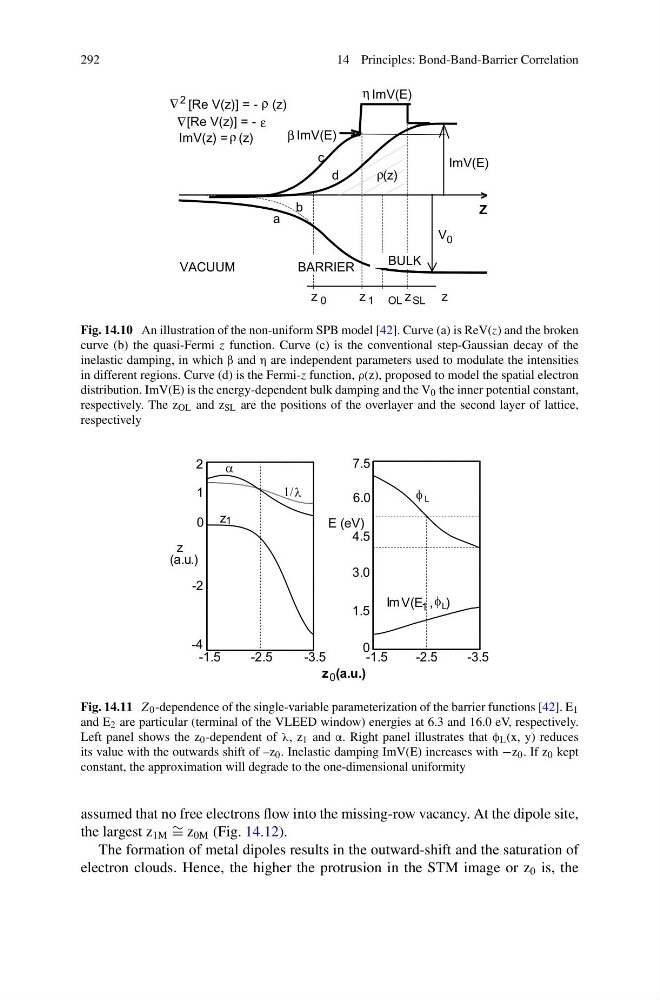
Fig. 14.10 An illustration of the non-uniform SPB model [42]. Curve (a) is ReV(z) and the broken
curve (b) the quasi-Fermi z function. Curve (c) is the conventional step-Gaussian decay of the
inelastic damping, in which β and η are independent parameters used to modulate the intensities
in different regions. Curve (d) is the Fermi-z function, ρ(z), proposed to model the spatial electron
distribution. ImV(E) is the energy-dependent bulk damping and the V 0 the inner potential constant,
respectively. The z OL and z SL are the positions of the overlayer and the second layer of lattice,
respectively
z 1
2
0
-2
-4
-1.5
-2.5
-3.5
0
z (a.u.)
1
Im
7.5
6.0
3.0
1.5
0
-1.5
-2.5
-3.5
L
4.5
E (eV)
z
(a.u.)
1 L
V(E , )
Fig. 14.11 Z 0 -dependence of the single-variable parameterization of the barrier functions [42]. E 1
and E 2 are particular (terminal of the VLEED window) energies at 6.3 and 16.0 eV, respectively.
Left panel shows the z 0 -dependent of λ, z 1 and α. Right panel illustrates that φ L (x, y) reduces
its value with the outwards shift of –z 0 . Inelastic damping ImV(E) increases with −z 0 . If z 0 kept
constant, the approximation will degrade to the one-dimensional uniformity
assumed that no free electrons flow into the missing-row vacancy. At the dipole site,
the largest z 1M ∼ = z 0M (Fig. 14.12).
The formation of metal dipoles results in the outward-shift and the saturation of
electron clouds. Hence, the higher the protrusion in the STM image or z 0 is, the
14 Principles: Bond-Band-Barrier Correlation
η
Z
V
ImV(E)
ImV(E)
c
d
b
a
ρ(z)
VACUUM
β ImV(E)
ImV(z) = (z)
ρ
∇ 2
ρ
[Re V(z)] = - (z)
∇[Re V(z)] = - ε
BARRIER
BULK
z 0
z 1 OL SL
z
z
0
>
Fig. 14.10 An illustration of the non-uniform SPB model [42]. Curve (a) is ReV(z) and the broken
curve (b) the quasi-Fermi z function. Curve (c) is the conventional step-Gaussian decay of the
inelastic damping, in which β and η are independent parameters used to modulate the intensities
in different regions. Curve (d) is the Fermi-z function, ρ(z), proposed to model the spatial electron
distribution. ImV(E) is the energy-dependent bulk damping and the V 0 the inner potential constant,
respectively. The z OL and z SL are the positions of the overlayer and the second layer of lattice,
respectively
z 1
2
0
-2
-4
-1.5
-2.5
-3.5
0
z (a.u.)
1
Im
7.5
6.0
3.0
1.5
0
-1.5
-2.5
-3.5
L
4.5
E (eV)
z
(a.u.)
1 L
V(E , )
Fig. 14.11 Z 0 -dependence of the single-variable parameterization of the barrier functions [42]. E 1
and E 2 are particular (terminal of the VLEED window) energies at 6.3 and 16.0 eV, respectively.
Left panel shows the z 0 -dependent of λ, z 1 and α. Right panel illustrates that φ L (x, y) reduces
its value with the outwards shift of –z 0 . Inelastic damping ImV(E) increases with −z 0 . If z 0 kept
constant, the approximation will degrade to the one-dimensional uniformity
assumed that no free electrons flow into the missing-row vacancy. At the dipole site,
the largest z 1M ∼ = z 0M (Fig. 14.12).
The formation of metal dipoles results in the outward-shift and the saturation of
electron clouds. Hence, the higher the protrusion in the STM image or z 0 is, the