

14.4 Energy-Dependent 3D-SPB
289
14.4.5 Parameterization and Functionalization
14.4.5.1 Local DOS and Work Function
Instead of the complex form of ρ(z) derived from the Poisson equation, we may
define a Fermi z function to describe the spatial decay ImV(z) and electron spatial
distribution (Fig. 14.9d) [42]:
ρ(z) =
V 0
1 + exp
−
(z−z1)
α
(14.7)
ρ(z), characterized by z 1 and α, is constrained by ρ(z 0 ) ≈ 0. The z-directional
integration of ρ(z) outside a certain atomic layer of the lattice is therefore proportional
to the occupied local DOS, n(x, y). The region of integration was determined in
VLEED as just within one atomic layer on the basis that the inelastic damping
dominates in this region [58].
The work function changes with oxygen adsorption in a localization manner.
STM images of oxygen-metal surfaces show pronounced corrugations on the atomic
scale, whereas, the measured work function is an average over large areas. Thus, it
is necessary to introduce the concept of local work function φ L (x, y). The φ L (x, y)
depends on [n(x, y)]
2/3 . The n(x, y) is an integration of the Fermi z function (14.6).
Although the Fermi decay of ImV(E, z) represents the spatial distribution of
electrons it is difficult to calibrate the integration because the ImV(z, E) varies with
energy. Fortunately, the local work function is such a convenient variable that is
used to link the ReV(z) and the ImV(z, E). The surface local DOS is proportional
to the integration of the Fermi z function ρ(z) from a position inside the crystal to
infinitely far away. Letting n(x, y) and n 0 be the DOS for oxygen-added and clean
metal surfaces, respectively, then
n(x, y) =
−∞
D 12
ρ(z, V 0 , z 0 (x, y), λ(z 0 ))dz
n 0 =
−∞
D 12
ρ(z, 11.56, −2.5, 0.9)dz
(14.8)
Therefore, the localized work function varies with atomic coordinates and energy
in the form,
φ L (x, y) = E 0 − E F
n(x, y)
n 0
2/3
(14.9)
289
14.4.5 Parameterization and Functionalization
14.4.5.1 Local DOS and Work Function
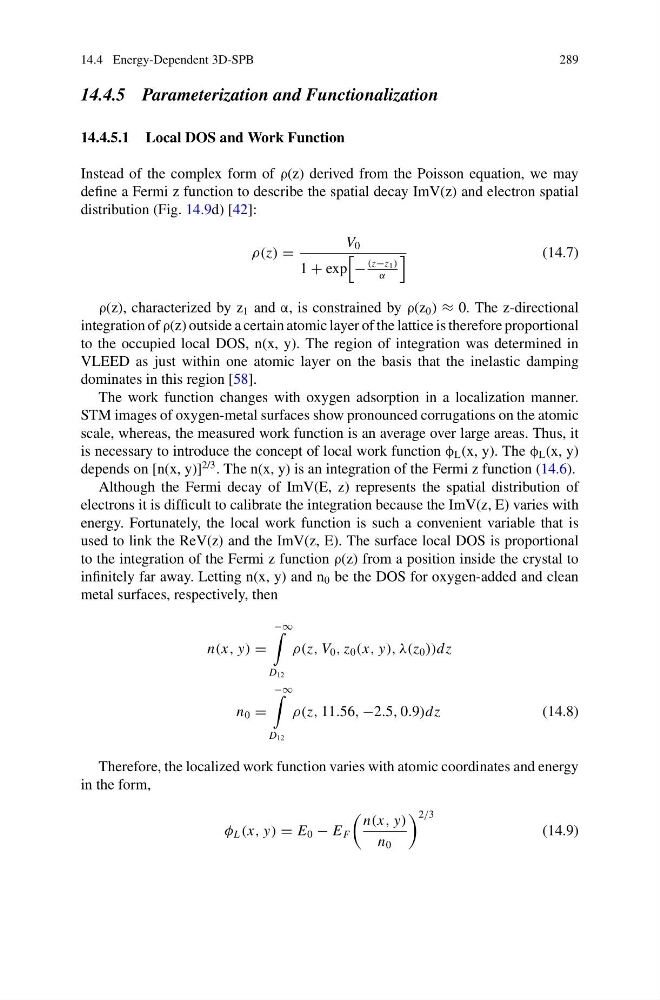
Instead of the complex form of ρ(z) derived from the Poisson equation, we may
define a Fermi z function to describe the spatial decay ImV(z) and electron spatial
distribution (Fig. 14.9d) [42]:
ρ(z) =
V 0
1 + exp
−
(z−z1)
α
(14.7)
ρ(z), characterized by z 1 and α, is constrained by ρ(z 0 ) ≈ 0. The z-directional
integration of ρ(z) outside a certain atomic layer of the lattice is therefore proportional
to the occupied local DOS, n(x, y). The region of integration was determined in
VLEED as just within one atomic layer on the basis that the inelastic damping
dominates in this region [58].
The work function changes with oxygen adsorption in a localization manner.
STM images of oxygen-metal surfaces show pronounced corrugations on the atomic
scale, whereas, the measured work function is an average over large areas. Thus, it
is necessary to introduce the concept of local work function φ L (x, y). The φ L (x, y)
depends on [n(x, y)]
2/3 . The n(x, y) is an integration of the Fermi z function (14.6).
Although the Fermi decay of ImV(E, z) represents the spatial distribution of
electrons it is difficult to calibrate the integration because the ImV(z, E) varies with
energy. Fortunately, the local work function is such a convenient variable that is
used to link the ReV(z) and the ImV(z, E). The surface local DOS is proportional
to the integration of the Fermi z function ρ(z) from a position inside the crystal to
infinitely far away. Letting n(x, y) and n 0 be the DOS for oxygen-added and clean
metal surfaces, respectively, then
n(x, y) =
−∞
D 12
ρ(z, V 0 , z 0 (x, y), λ(z 0 ))dz
n 0 =
−∞
D 12
ρ(z, 11.56, −2.5, 0.9)dz
(14.8)
Therefore, the localized work function varies with atomic coordinates and energy
in the form,
φ L (x, y) = E 0 − E F
n(x, y)
n 0
2/3
(14.9)