

288
14 Principles: Bond-Band-Barrier Correlation
v
φ 0
v
-E
E f
V 0
E g
CB
VB
CB
V 0
(a) metal
(b) oxygen
O-2p states
v
φ
φ 0
1
v
-E
-
-
A
E f
V 0
E g
CB
VB
v
Antibonding
v
O-p states
v
φ
φ 0
1
-
-
A
E f
V 0
E g
CB
VB
v sp bonding
3
Antibonding
v -
v
Nonbonding
(c) O effect
(d) O effect
-1
-2
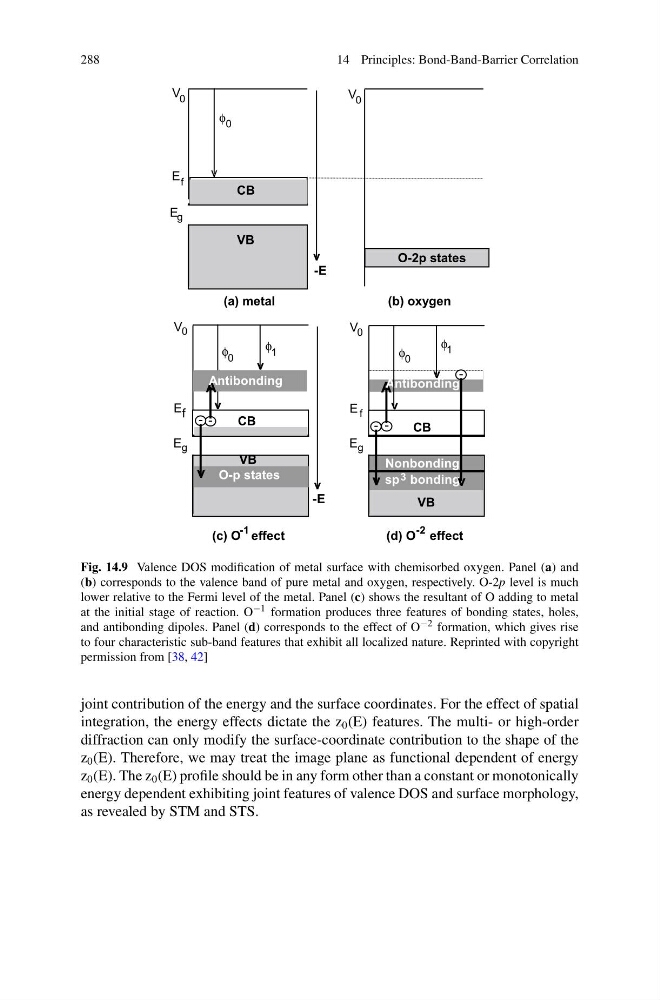
Fig. 14.9 Valence DOS modification of metal surface with chemisorbed oxygen. Panel (a) and
(b) corresponds to the valence band of pure metal and oxygen, respectively. O-2p level is much
lower relative to the Fermi level of the metal. Panel (c) shows the resultant of O adding to metal
at the initial stage of reaction. O −1 formation produces three features of bonding states, holes,
and antibonding dipoles. Panel (d) corresponds to the effect of O −2 formation, which gives rise
to four characteristic sub-band features that exhibit all localized nature. Reprinted with copyright
permission from [38, 42]
joint contribution of the energy and the surface coordinates. For the effect of spatial
integration, the energy effects dictate the z 0 (E) features. The multi- or high-order
diffraction can only modify the surface-coordinate contribution to the shape of the
z 0 (E). Therefore, we may treat the image plane as functional dependent of energy
z 0 (E). The z 0 (E) profile should be in any form other than a constant or monotonically
energy dependent exhibiting joint features of valence DOS and surface morphology,
as revealed by STM and STS.
14 Principles: Bond-Band-Barrier Correlation
v
φ 0
v
-E
E f
V 0
E g
CB
VB
CB
V 0
(a) metal
(b) oxygen
O-2p states
v
φ
φ 0
1
v
-E
-
-
A
E f
V 0
E g
CB
VB
v
Antibonding
v
O-p states
v
φ
φ 0
1
-
-
A
E f
V 0
E g
CB
VB
v sp bonding
3
Antibonding
v -
v
Nonbonding
(c) O effect
(d) O effect
-1
-2
Fig. 14.9 Valence DOS modification of metal surface with chemisorbed oxygen. Panel (a) and
(b) corresponds to the valence band of pure metal and oxygen, respectively. O-2p level is much
lower relative to the Fermi level of the metal. Panel (c) shows the resultant of O adding to metal
at the initial stage of reaction. O −1 formation produces three features of bonding states, holes,
and antibonding dipoles. Panel (d) corresponds to the effect of O −2 formation, which gives rise
to four characteristic sub-band features that exhibit all localized nature. Reprinted with copyright
permission from [38, 42]
joint contribution of the energy and the surface coordinates. For the effect of spatial
integration, the energy effects dictate the z 0 (E) features. The multi- or high-order
diffraction can only modify the surface-coordinate contribution to the shape of the
z 0 (E). Therefore, we may treat the image plane as functional dependent of energy
z 0 (E). The z 0 (E) profile should be in any form other than a constant or monotonically
energy dependent exhibiting joint features of valence DOS and surface morphology,
as revealed by STM and STS.