

278
14 Principles: Bond-Band-Barrier Correlation
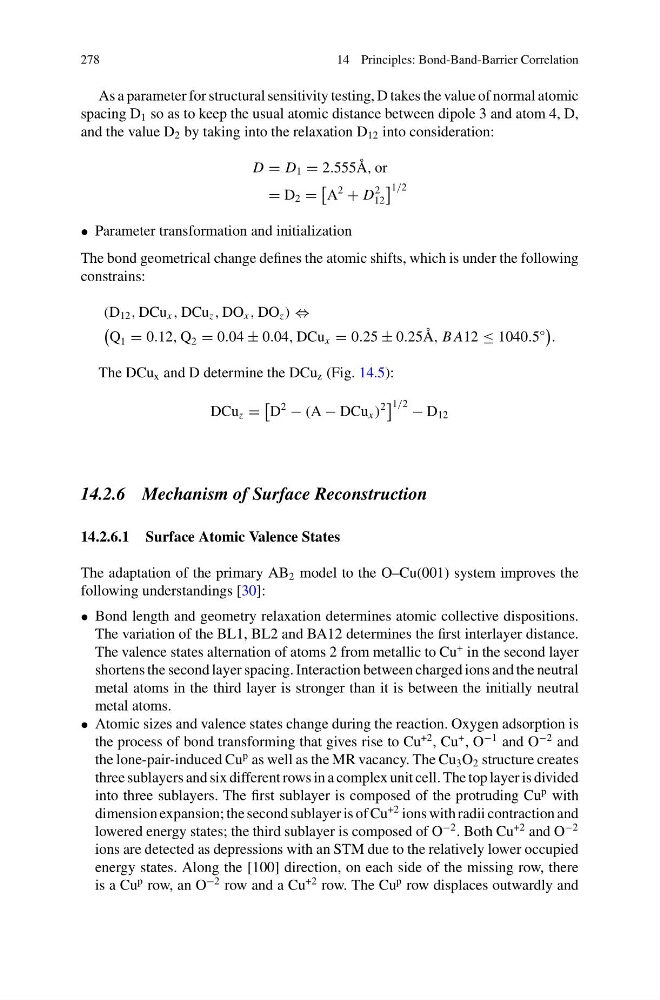
As a parameter for structural sensitivity testing, D takes the value of normal atomic
spacing D 1 so as to keep the usual atomic distance between dipole 3 and atom 4, D,
and the value D 2 by taking into the relaxation D 12 into consideration:
D = D 1 = 2.555Å, or
= D 2 =
A
2
+ D
2
12
1/2
• Parameter transformation and initialization
The bond geometrical change defines the atomic shifts, which is under the following
constrains:
(D 12 , DCu x , DCu z , DO x , DO z ) ⇔
Q 1 = 0.12, Q 2 = 0.04 ± 0.04, DCu x = 0.25 ± 0.25Å, B A12 ≤ 1040.5
◦
.
The DCu x and D determine the DCu z (Fig. 14.5):
DCu z =
D
2
− (A − DCu x )
2
1/2 − D 12
14.2.6 Mechanism of Surface Reconstruction
14.2.6.1 Surface Atomic Valence States
The adaptation of the primary AB 2 model to the O–Cu(001) system improves the
following understandings [30]:
• Bond length and geometry relaxation determines atomic collective dispositions.
The variation of the BL1, BL2 and BA12 determines the first interlayer distance.
The valence states alternation of atoms 2 from metallic to Cu
+ in the second layer
shortens the second layer spacing. Interaction between charged ions and the neutral
metal atoms in the third layer is stronger than it is between the initially neutral
metal atoms.
• Atomic sizes and valence states change during the reaction. Oxygen adsorption is
the process of bond transforming that gives rise to Cu
+2 , Cu
+ , O
−1 and O
−2 and
the lone-pair-induced Cu
p as well as the MR vacancy. The Cu 3 O 2 structure creates
three sublayers and six different rows in a complex unit cell. The top layer is divided
into three sublayers. The first sublayer is composed of the protruding Cu
p with
dimension expansion; the second sublayer is of Cu
+2 ions with radii contraction and
lowered energy states; the third sublayer is composed of O
−2 . Both Cu
+2 and O
−2
ions are detected as depressions with an STM due to the relatively lower occupied
energy states. Along the [100] direction, on each side of the missing row, there
is a Cu
p row, an O
−2 row and a Cu
+2 row. The Cu
p row displaces outwardly and
14 Principles: Bond-Band-Barrier Correlation
As a parameter for structural sensitivity testing, D takes the value of normal atomic
spacing D 1 so as to keep the usual atomic distance between dipole 3 and atom 4, D,
and the value D 2 by taking into the relaxation D 12 into consideration:
D = D 1 = 2.555Å, or
= D 2 =
A
2
+ D
2
12
1/2
• Parameter transformation and initialization
The bond geometrical change defines the atomic shifts, which is under the following
constrains:
(D 12 , DCu x , DCu z , DO x , DO z ) ⇔
Q 1 = 0.12, Q 2 = 0.04 ± 0.04, DCu x = 0.25 ± 0.25Å, B A12 ≤ 1040.5
◦
.
The DCu x and D determine the DCu z (Fig. 14.5):
DCu z =
D
2
− (A − DCu x )
2
1/2 − D 12
14.2.6 Mechanism of Surface Reconstruction
14.2.6.1 Surface Atomic Valence States
The adaptation of the primary AB 2 model to the O–Cu(001) system improves the
following understandings [30]:
• Bond length and geometry relaxation determines atomic collective dispositions.
The variation of the BL1, BL2 and BA12 determines the first interlayer distance.
The valence states alternation of atoms 2 from metallic to Cu
+ in the second layer
shortens the second layer spacing. Interaction between charged ions and the neutral
metal atoms in the third layer is stronger than it is between the initially neutral
metal atoms.
• Atomic sizes and valence states change during the reaction. Oxygen adsorption is
the process of bond transforming that gives rise to Cu
+2 , Cu
+ , O
−1 and O
−2 and
the lone-pair-induced Cu
p as well as the MR vacancy. The Cu 3 O 2 structure creates
three sublayers and six different rows in a complex unit cell. The top layer is divided
into three sublayers. The first sublayer is composed of the protruding Cu
p with
dimension expansion; the second sublayer is of Cu
+2 ions with radii contraction and
lowered energy states; the third sublayer is composed of O
−2 . Both Cu
+2 and O
−2
ions are detected as depressions with an STM due to the relatively lower occupied
energy states. Along the [100] direction, on each side of the missing row, there
is a Cu
p row, an O
−2 row and a Cu
+2 row. The Cu
p row displaces outwardly and