

272
14 Principles: Bond-Band-Barrier Correlation
O
3
1
2
3
3
-2
atomic spacing
atomic spacing
The shortest
The second shortest
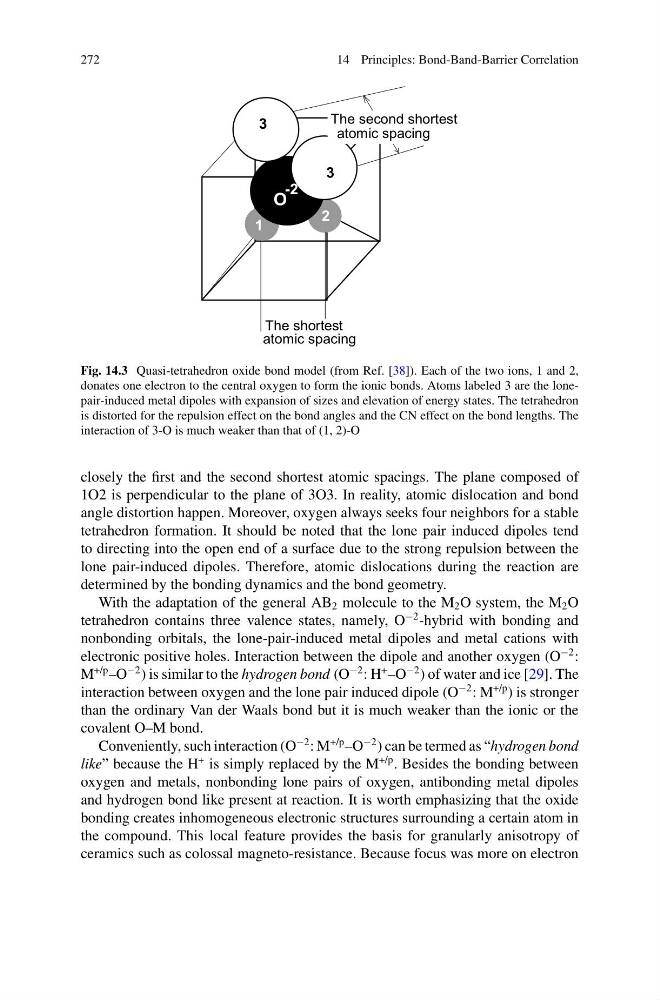
Fig. 14.3 Quasi-tetrahedron oxide bond model (from Ref. [38]). Each of the two ions, 1 and 2,
donates one electron to the central oxygen to form the ionic bonds. Atoms labeled 3 are the lonepair-induced metal dipoles with expansion of sizes and elevation of energy states. The tetrahedron
is distorted for the repulsion effect on the bond angles and the CN effect on the bond lengths. The
interaction of 3-O is much weaker than that of (1, 2)-O
closely the first and the second shortest atomic spacings. The plane composed of
1O2 is perpendicular to the plane of 3O3. In reality, atomic dislocation and bond
angle distortion happen. Moreover, oxygen always seeks four neighbors for a stable
tetrahedron formation. It should be noted that the lone pair induced dipoles tend
to directing into the open end of a surface due to the strong repulsion between the
lone pair-induced dipoles. Therefore, atomic dislocations during the reaction are
determined by the bonding dynamics and the bond geometry.
With the adaptation of the general AB 2 molecule to the M 2 O system, the M 2 O
tetrahedron contains three valence states, namely, O
−2 -hybrid with bonding and
nonbonding orbitals, the lone-pair-induced metal dipoles and metal cations with
electronic positive holes. Interaction between the dipole and another oxygen (O
−2 :
M
+/p –O
−2 ) is similar to the hydrogen bond (O
−2 : H
+ –O
−2 ) of water and ice [29]. The
interaction between oxygen and the lone pair induced dipole (O
−2 : M
+/p ) is stronger
than the ordinary Van der Waals bond but it is much weaker than the ionic or the
covalent O–M bond.
Conveniently, such interaction (O
−2 : M
+/p –O
−2 ) can be termed as “hydrogen bond
like” because the H
+ is simply replaced by the M
+/p . Besides the bonding between
oxygen and metals, nonbonding lone pairs of oxygen, antibonding metal dipoles
and hydrogen bond like present at reaction. It is worth emphasizing that the oxide
bonding creates inhomogeneous electronic structures surrounding a certain atom in
the compound. This local feature provides the basis for granularly anisotropy of
ceramics such as colossal magneto-resistance. Because focus was more on electron
14 Principles: Bond-Band-Barrier Correlation
O
3
1
2
3
3
-2
atomic spacing
atomic spacing
The shortest
The second shortest
Fig. 14.3 Quasi-tetrahedron oxide bond model (from Ref. [38]). Each of the two ions, 1 and 2,
donates one electron to the central oxygen to form the ionic bonds. Atoms labeled 3 are the lonepair-induced metal dipoles with expansion of sizes and elevation of energy states. The tetrahedron
is distorted for the repulsion effect on the bond angles and the CN effect on the bond lengths. The
interaction of 3-O is much weaker than that of (1, 2)-O
closely the first and the second shortest atomic spacings. The plane composed of
1O2 is perpendicular to the plane of 3O3. In reality, atomic dislocation and bond
angle distortion happen. Moreover, oxygen always seeks four neighbors for a stable
tetrahedron formation. It should be noted that the lone pair induced dipoles tend
to directing into the open end of a surface due to the strong repulsion between the
lone pair-induced dipoles. Therefore, atomic dislocations during the reaction are
determined by the bonding dynamics and the bond geometry.
With the adaptation of the general AB 2 molecule to the M 2 O system, the M 2 O
tetrahedron contains three valence states, namely, O
−2 -hybrid with bonding and
nonbonding orbitals, the lone-pair-induced metal dipoles and metal cations with
electronic positive holes. Interaction between the dipole and another oxygen (O
−2 :
M
+/p –O
−2 ) is similar to the hydrogen bond (O
−2 : H
+ –O
−2 ) of water and ice [29]. The
interaction between oxygen and the lone pair induced dipole (O
−2 : M
+/p ) is stronger
than the ordinary Van der Waals bond but it is much weaker than the ionic or the
covalent O–M bond.
Conveniently, such interaction (O
−2 : M
+/p –O
−2 ) can be termed as “hydrogen bond
like” because the H
+ is simply replaced by the M
+/p . Besides the bonding between
oxygen and metals, nonbonding lone pairs of oxygen, antibonding metal dipoles
and hydrogen bond like present at reaction. It is worth emphasizing that the oxide
bonding creates inhomogeneous electronic structures surrounding a certain atom in
the compound. This local feature provides the basis for granularly anisotropy of
ceramics such as colossal magneto-resistance. Because focus was more on electron