

14.2 Oxide Tetrahedron Bond Formation
271
octagonal CuO 6 structure) bond length is shortened with the increase of dopant-hole
concentration. The reduction of the O–Cu distance is as high as 0.26 Å (about 14%
contraction) in La–Sr–Cu–O superconducting materials. Hence, besides the atomic
radius alternation due to the change of valence state, atomic undercoordination further
shortens the surface bonds, which is independent of the bond nature [31]. Compared
with Pauling’s notion that is specific atomic radius dependent, Goldschmidt scheme
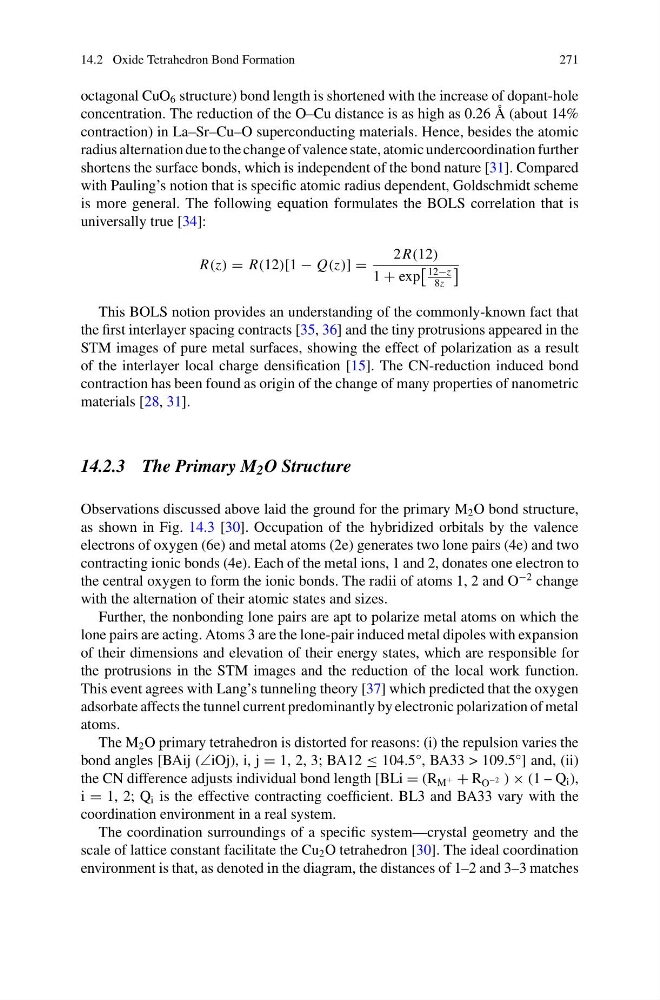
is more general. The following equation formulates the BOLS correlation that is
universally true [34]:
R(z) = R(12)[1 − Q(z)] =
2R(12)
1 + exp
12−z
8z
This BOLS notion provides an understanding of the commonly-known fact that
the first interlayer spacing contracts [35, 36] and the tiny protrusions appeared in the
STM images of pure metal surfaces, showing the effect of polarization as a result
of the interlayer local charge densification [15]. The CN-reduction induced bond
contraction has been found as origin of the change of many properties of nanometric
materials [28, 31].
14.2.3 The Primary M 2 O Structure
Observations discussed above laid the ground for the primary M 2 O bond structure,
as shown in Fig. 14.3 [30]. Occupation of the hybridized orbitals by the valence
electrons of oxygen (6e) and metal atoms (2e) generates two lone pairs (4e) and two
contracting ionic bonds (4e). Each of the metal ions, 1 and 2, donates one electron to
the central oxygen to form the ionic bonds. The radii of atoms 1, 2 and O
−2 change
with the alternation of their atomic states and sizes.
Further, the nonbonding lone pairs are apt to polarize metal atoms on which the
lone pairs are acting. Atoms 3 are the lone-pair induced metal dipoles with expansion
of their dimensions and elevation of their energy states, which are responsible for
the protrusions in the STM images and the reduction of the local work function.
This event agrees with Lang’s tunneling theory [37] which predicted that the oxygen
adsorbate affects the tunnel current predominantly by electronic polarization of metal
atoms.
The M 2 O primary tetrahedron is distorted for reasons: (i) the repulsion varies the
bond angles [BAij (∠iOj), i, j = 1, 2, 3; BA12 ≤ 104.5°, BA33 > 109.5°] and, (ii)
the CN difference adjusts individual bond length [BLi = (R M
+ + R O
−2 ) × (1 – Q i ),
i = 1, 2; Q i is the effective contracting coefficient. BL3 and BA33 vary with the
coordination environment in a real system.
The coordination surroundings of a specific system—crystal geometry and the
scale of lattice constant facilitate the Cu 2 O tetrahedron [30]. The ideal coordination
environment is that, as denoted in the diagram, the distances of 1–2 and 3–3 matches
271
octagonal CuO 6 structure) bond length is shortened with the increase of dopant-hole
concentration. The reduction of the O–Cu distance is as high as 0.26 Å (about 14%
contraction) in La–Sr–Cu–O superconducting materials. Hence, besides the atomic
radius alternation due to the change of valence state, atomic undercoordination further
shortens the surface bonds, which is independent of the bond nature [31]. Compared
with Pauling’s notion that is specific atomic radius dependent, Goldschmidt scheme
is more general. The following equation formulates the BOLS correlation that is
universally true [34]:
R(z) = R(12)[1 − Q(z)] =
2R(12)
1 + exp
12−z
8z
This BOLS notion provides an understanding of the commonly-known fact that
the first interlayer spacing contracts [35, 36] and the tiny protrusions appeared in the
STM images of pure metal surfaces, showing the effect of polarization as a result
of the interlayer local charge densification [15]. The CN-reduction induced bond
contraction has been found as origin of the change of many properties of nanometric
materials [28, 31].
14.2.3 The Primary M 2 O Structure
Observations discussed above laid the ground for the primary M 2 O bond structure,
as shown in Fig. 14.3 [30]. Occupation of the hybridized orbitals by the valence
electrons of oxygen (6e) and metal atoms (2e) generates two lone pairs (4e) and two
contracting ionic bonds (4e). Each of the metal ions, 1 and 2, donates one electron to
the central oxygen to form the ionic bonds. The radii of atoms 1, 2 and O
−2 change
with the alternation of their atomic states and sizes.
Further, the nonbonding lone pairs are apt to polarize metal atoms on which the
lone pairs are acting. Atoms 3 are the lone-pair induced metal dipoles with expansion
of their dimensions and elevation of their energy states, which are responsible for
the protrusions in the STM images and the reduction of the local work function.
This event agrees with Lang’s tunneling theory [37] which predicted that the oxygen
adsorbate affects the tunnel current predominantly by electronic polarization of metal
atoms.
The M 2 O primary tetrahedron is distorted for reasons: (i) the repulsion varies the
bond angles [BAij (∠iOj), i, j = 1, 2, 3; BA12 ≤ 104.5°, BA33 > 109.5°] and, (ii)
the CN difference adjusts individual bond length [BLi = (R M
+ + R O
−2 ) × (1 – Q i ),
i = 1, 2; Q i is the effective contracting coefficient. BL3 and BA33 vary with the
coordination environment in a real system.
The coordination surroundings of a specific system—crystal geometry and the
scale of lattice constant facilitate the Cu 2 O tetrahedron [30]. The ideal coordination
environment is that, as denoted in the diagram, the distances of 1–2 and 3–3 matches