

230
11 Liquid Phase
ordinary bulk water and peak 2 at 3450 cm
−1 to the skin ω H mode. At the ambient
temperature, ionic polarization shifts the 3200 cm
−1 up to overlap the 3450 cm
−1 .
Heating and polarization enhance each other to shorten and stiffen the H–O bond
at different rates, depending on the solute concentration. In the liquid phase below
373 K, the ω H shifts with temperature and more with the solute concentration. The
ω H shifts further as the temperature increases, but the increasing rate reverts with
solute concentration. At 373 K and above, the liquid partially becomes vapor up to
the saturation pressure of 100 MPa. The thermal reversion of the ω H shift between
373 and 473 K shows that the hydrating H–O bonds are thermally more stable than
that of the deionized water in liquid and vapor phases. The polarization distorted
H–O bonds are hardly further deformed.
11.4.4.2 Solution XAS: Polarization Dominance
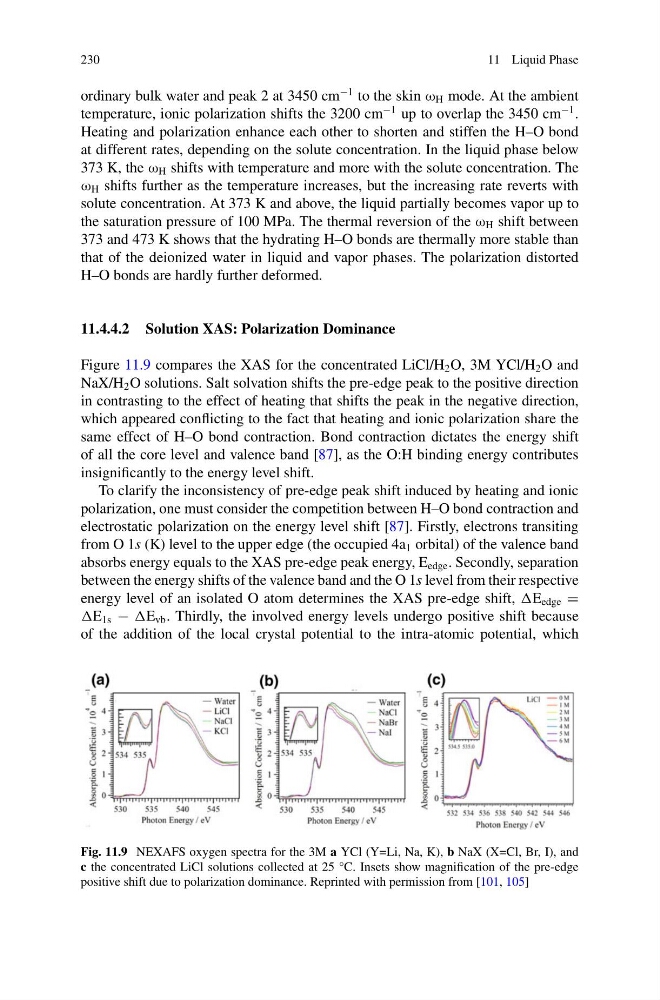
Figure 11.9 compares the XAS for the concentrated LiCl/H 2 O, 3M YCl/H 2 O and
NaX/H 2 O solutions. Salt solvation shifts the pre-edge peak to the positive direction
in contrasting to the effect of heating that shifts the peak in the negative direction,
which appeared conflicting to the fact that heating and ionic polarization share the
same effect of H–O bond contraction. Bond contraction dictates the energy shift
of all the core level and valence band [87], as the O:H binding energy contributes
insignificantly to the energy level shift.
To clarify the inconsistency of pre-edge peak shift induced by heating and ionic
polarization, one must consider the competition between H–O bond contraction and
electrostatic polarization on the energy level shift [87]. Firstly, electrons transiting
from O 1s (K) level to the upper edge (the occupied 4a 1 orbital) of the valence band
absorbs energy equals to the XAS pre-edge peak energy, E edge . Secondly, separation
between the energy shifts of the valence band and the O 1s level from their respective
energy level of an isolated O atom determines the XAS pre-edge shift, E edge =
E 1s − E vb . Thirdly, the involved energy levels undergo positive shift because
of the addition of the local crystal potential to the intra-atomic potential, which
Fig. 11.9 NEXAFS oxygen spectra for the 3M a YCl (Y=Li, Na, K), b NaX (X=Cl, Br, I), and
c the concentrated LiCl solutions collected at 25 °C. Insets show magnification of the pre-edge
positive shift due to polarization dominance. Reprinted with permission from [101, 105]
11 Liquid Phase
ordinary bulk water and peak 2 at 3450 cm
−1 to the skin ω H mode. At the ambient
temperature, ionic polarization shifts the 3200 cm
−1 up to overlap the 3450 cm
−1 .
Heating and polarization enhance each other to shorten and stiffen the H–O bond
at different rates, depending on the solute concentration. In the liquid phase below
373 K, the ω H shifts with temperature and more with the solute concentration. The
ω H shifts further as the temperature increases, but the increasing rate reverts with
solute concentration. At 373 K and above, the liquid partially becomes vapor up to
the saturation pressure of 100 MPa. The thermal reversion of the ω H shift between
373 and 473 K shows that the hydrating H–O bonds are thermally more stable than
that of the deionized water in liquid and vapor phases. The polarization distorted
H–O bonds are hardly further deformed.
11.4.4.2 Solution XAS: Polarization Dominance
Figure 11.9 compares the XAS for the concentrated LiCl/H 2 O, 3M YCl/H 2 O and
NaX/H 2 O solutions. Salt solvation shifts the pre-edge peak to the positive direction
in contrasting to the effect of heating that shifts the peak in the negative direction,
which appeared conflicting to the fact that heating and ionic polarization share the
same effect of H–O bond contraction. Bond contraction dictates the energy shift
of all the core level and valence band [87], as the O:H binding energy contributes
insignificantly to the energy level shift.
To clarify the inconsistency of pre-edge peak shift induced by heating and ionic
polarization, one must consider the competition between H–O bond contraction and
electrostatic polarization on the energy level shift [87]. Firstly, electrons transiting
from O 1s (K) level to the upper edge (the occupied 4a 1 orbital) of the valence band
absorbs energy equals to the XAS pre-edge peak energy, E edge . Secondly, separation
between the energy shifts of the valence band and the O 1s level from their respective
energy level of an isolated O atom determines the XAS pre-edge shift, E edge =
E 1s − E vb . Thirdly, the involved energy levels undergo positive shift because
of the addition of the local crystal potential to the intra-atomic potential, which
Fig. 11.9 NEXAFS oxygen spectra for the 3M a YCl (Y=Li, Na, K), b NaX (X=Cl, Br, I), and
c the concentrated LiCl solutions collected at 25 °C. Insets show magnification of the pre-edge
positive shift due to polarization dominance. Reprinted with permission from [101, 105]