

11.4 Electron Spectrometrics
227
0.00
0.02
0.04
0.06
0.08
0.10
-2.4
-2.0
-1.6
-1.2
-0.8
-0.4
0.1
0.2
0.3
0.4
0.5
3520
3540
3560
ω
Η
(cm
−1
)
1/N
E
b
(eV)
N
-1/3
Internal
surface
(a)
(b)
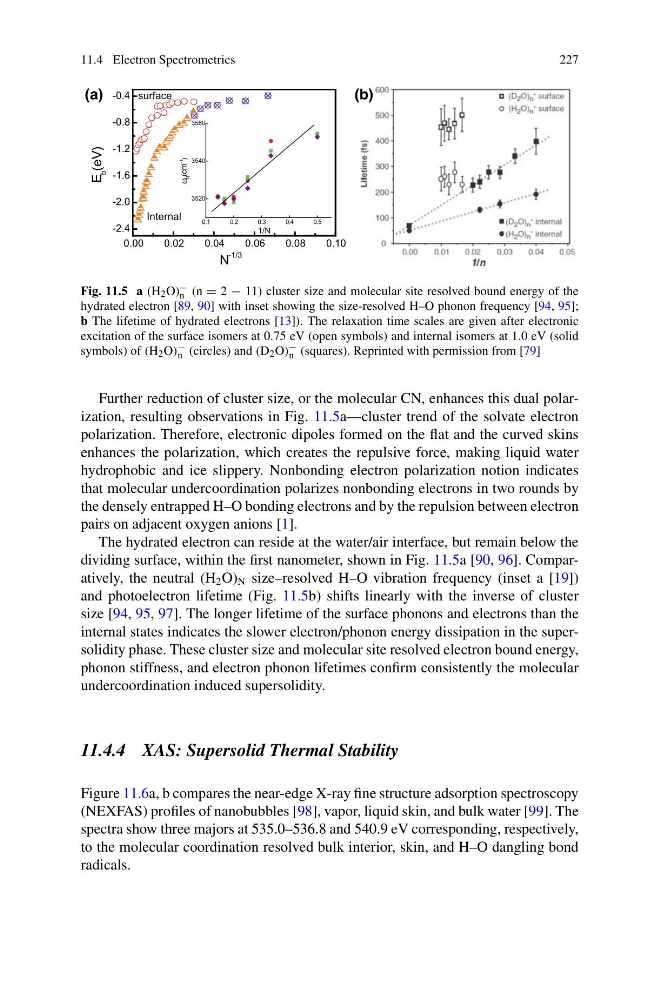
Fig. 11.5 a (H 2 O) −
n (n = 2 − 11) cluster size and molecular site resolved bound energy of the
hydrated electron [89, 90] with inset showing the size-resolved H–O phonon frequency [94, 95];
b The lifetime of hydrated electrons [13]). The relaxation time scales are given after electronic
excitation of the surface isomers at 0.75 eV (open symbols) and internal isomers at 1.0 eV (solid
symbols) of (H 2 O) −
n (circles) and (D 2 O)
−
n (squares). Reprinted with permission from [79]
Further reduction of cluster size, or the molecular CN, enhances this dual polarization, resulting observations in Fig. 11.5a—cluster trend of the solvate electron
polarization. Therefore, electronic dipoles formed on the flat and the curved skins
enhances the polarization, which creates the repulsive force, making liquid water
hydrophobic and ice slippery. Nonbonding electron polarization notion indicates
that molecular undercoordination polarizes nonbonding electrons in two rounds by
the densely entrapped H–O bonding electrons and by the repulsion between electron
pairs on adjacent oxygen anions [1].
The hydrated electron can reside at the water/air interface, but remain below the
dividing surface, within the first nanometer, shown in Fig. 11.5a [90, 96]. Comparatively, the neutral (H 2 O) N size–resolved H–O vibration frequency (inset a [19])
and photoelectron lifetime (Fig. 11.5b) shifts linearly with the inverse of cluster
size [94, 95, 97]. The longer lifetime of the surface phonons and electrons than the
internal states indicates the slower electron/phonon energy dissipation in the supersolidity phase. These cluster size and molecular site resolved electron bound energy,
phonon stiffness, and electron phonon lifetimes confirm consistently the molecular
undercoordination induced supersolidity.
11.4.4 XAS: Supersolid Thermal Stability
Figure 11.6a, b compares the near-edge X-ray fine structure adsorption spectroscopy
(NEXFAS) profiles of nanobubbles [98], vapor, liquid skin, and bulk water [99]. The
spectra show three majors at 535.0–536.8 and 540.9 eV corresponding, respectively,
to the molecular coordination resolved bulk interior, skin, and H–O dangling bond
radicals.
227
0.00
0.02
0.04
0.06
0.08
0.10
-2.4
-2.0
-1.6
-1.2
-0.8
-0.4
0.1
0.2
0.3
0.4
0.5
3520
3540
3560
ω
Η
(cm
−1
)
1/N
E
b
(eV)
N
-1/3
Internal
surface
(a)
(b)
Fig. 11.5 a (H 2 O) −
n (n = 2 − 11) cluster size and molecular site resolved bound energy of the
hydrated electron [89, 90] with inset showing the size-resolved H–O phonon frequency [94, 95];
b The lifetime of hydrated electrons [13]). The relaxation time scales are given after electronic
excitation of the surface isomers at 0.75 eV (open symbols) and internal isomers at 1.0 eV (solid
symbols) of (H 2 O) −
n (circles) and (D 2 O)
−
n (squares). Reprinted with permission from [79]
Further reduction of cluster size, or the molecular CN, enhances this dual polarization, resulting observations in Fig. 11.5a—cluster trend of the solvate electron
polarization. Therefore, electronic dipoles formed on the flat and the curved skins
enhances the polarization, which creates the repulsive force, making liquid water
hydrophobic and ice slippery. Nonbonding electron polarization notion indicates
that molecular undercoordination polarizes nonbonding electrons in two rounds by
the densely entrapped H–O bonding electrons and by the repulsion between electron
pairs on adjacent oxygen anions [1].
The hydrated electron can reside at the water/air interface, but remain below the
dividing surface, within the first nanometer, shown in Fig. 11.5a [90, 96]. Comparatively, the neutral (H 2 O) N size–resolved H–O vibration frequency (inset a [19])
and photoelectron lifetime (Fig. 11.5b) shifts linearly with the inverse of cluster
size [94, 95, 97]. The longer lifetime of the surface phonons and electrons than the
internal states indicates the slower electron/phonon energy dissipation in the supersolidity phase. These cluster size and molecular site resolved electron bound energy,
phonon stiffness, and electron phonon lifetimes confirm consistently the molecular
undercoordination induced supersolidity.
11.4.4 XAS: Supersolid Thermal Stability
Figure 11.6a, b compares the near-edge X-ray fine structure adsorption spectroscopy
(NEXFAS) profiles of nanobubbles [98], vapor, liquid skin, and bulk water [99]. The
spectra show three majors at 535.0–536.8 and 540.9 eV corresponding, respectively,
to the molecular coordination resolved bulk interior, skin, and H–O dangling bond
radicals.