

226
11 Liquid Phase
542
540
538
536
Gaseous
phase
Liquid
Skin
O 1s (eV)
Intensity (a.u.)
(a)
(b)
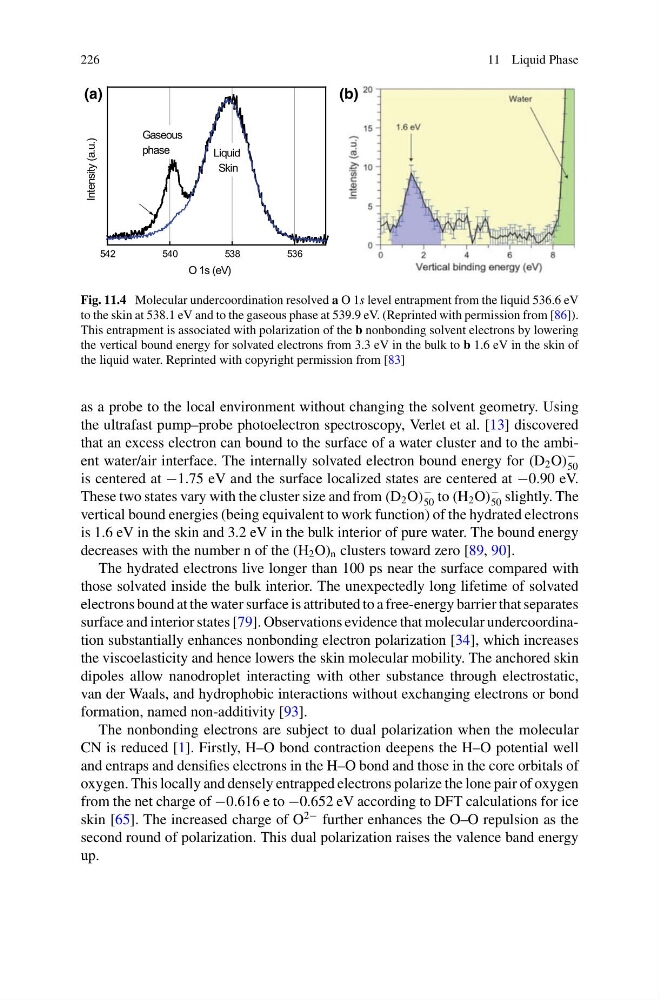
Fig. 11.4 Molecular undercoordination resolved a O 1s level entrapment from the liquid 536.6 eV
to the skin at 538.1 eV and to the gaseous phase at 539.9 eV. (Reprinted with permission from [86]).
This entrapment is associated with polarization of the b nonbonding solvent electrons by lowering
the vertical bound energy for solvated electrons from 3.3 eV in the bulk to b 1.6 eV in the skin of
the liquid water. Reprinted with copyright permission from [83]
as a probe to the local environment without changing the solvent geometry. Using
the ultrafast pump–probe photoelectron spectroscopy, Verlet et al. [13] discovered
that an excess electron can bound to the surface of a water cluster and to the ambient water/air interface. The internally solvated electron bound energy for (D 2 O)
−
50
is centered at −1.75 eV and the surface localized states are centered at −0.90 eV.
These two states vary with the cluster size and from (D 2 O)
−
50 to (H 2 O)
−
50 slightly. The
vertical bound energies (being equivalent to work function) of the hydrated electrons
is 1.6 eV in the skin and 3.2 eV in the bulk interior of pure water. The bound energy
decreases with the number n of the (H 2 O) n clusters toward zero [89, 90].
The hydrated electrons live longer than 100 ps near the surface compared with
those solvated inside the bulk interior. The unexpectedly long lifetime of solvated
electrons bound at the water surface is attributed to a free-energy barrier that separates
surface and interior states [79]. Observations evidence that molecular undercoordination substantially enhances nonbonding electron polarization [34], which increases
the viscoelasticity and hence lowers the skin molecular mobility. The anchored skin
dipoles allow nanodroplet interacting with other substance through electrostatic,
van der Waals, and hydrophobic interactions without exchanging electrons or bond
formation, named non-additivity [93].
The nonbonding electrons are subject to dual polarization when the molecular
CN is reduced [1]. Firstly, H–O bond contraction deepens the H–O potential well
and entraps and densifies electrons in the H–O bond and those in the core orbitals of
oxygen. This locally and densely entrapped electrons polarize the lone pair of oxygen
from the net charge of −0.616 e to −0.652 eV according to DFT calculations for ice
skin [65]. The increased charge of O
2− further enhances the O–O repulsion as the
second round of polarization. This dual polarization raises the valence band energy
up.
11 Liquid Phase
542
540
538
536
Gaseous
phase
Liquid
Skin
O 1s (eV)
Intensity (a.u.)
(a)
(b)
Fig. 11.4 Molecular undercoordination resolved a O 1s level entrapment from the liquid 536.6 eV
to the skin at 538.1 eV and to the gaseous phase at 539.9 eV. (Reprinted with permission from [86]).
This entrapment is associated with polarization of the b nonbonding solvent electrons by lowering
the vertical bound energy for solvated electrons from 3.3 eV in the bulk to b 1.6 eV in the skin of
the liquid water. Reprinted with copyright permission from [83]
as a probe to the local environment without changing the solvent geometry. Using
the ultrafast pump–probe photoelectron spectroscopy, Verlet et al. [13] discovered
that an excess electron can bound to the surface of a water cluster and to the ambient water/air interface. The internally solvated electron bound energy for (D 2 O)
−
50
is centered at −1.75 eV and the surface localized states are centered at −0.90 eV.
These two states vary with the cluster size and from (D 2 O)
−
50 to (H 2 O)
−
50 slightly. The
vertical bound energies (being equivalent to work function) of the hydrated electrons
is 1.6 eV in the skin and 3.2 eV in the bulk interior of pure water. The bound energy
decreases with the number n of the (H 2 O) n clusters toward zero [89, 90].
The hydrated electrons live longer than 100 ps near the surface compared with
those solvated inside the bulk interior. The unexpectedly long lifetime of solvated
electrons bound at the water surface is attributed to a free-energy barrier that separates
surface and interior states [79]. Observations evidence that molecular undercoordination substantially enhances nonbonding electron polarization [34], which increases
the viscoelasticity and hence lowers the skin molecular mobility. The anchored skin
dipoles allow nanodroplet interacting with other substance through electrostatic,
van der Waals, and hydrophobic interactions without exchanging electrons or bond
formation, named non-additivity [93].
The nonbonding electrons are subject to dual polarization when the molecular
CN is reduced [1]. Firstly, H–O bond contraction deepens the H–O potential well
and entraps and densifies electrons in the H–O bond and those in the core orbitals of
oxygen. This locally and densely entrapped electrons polarize the lone pair of oxygen
from the net charge of −0.616 e to −0.652 eV according to DFT calculations for ice
skin [65]. The increased charge of O
2− further enhances the O–O repulsion as the
second round of polarization. This dual polarization raises the valence band energy
up.