

11.2 O:H–O Bond Oscillator Pair
219
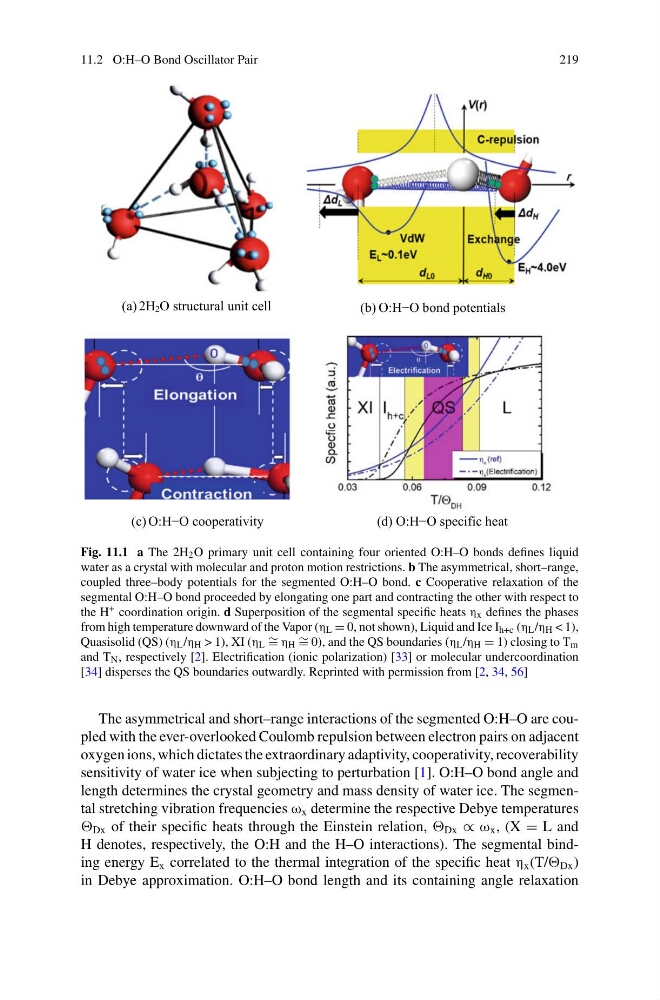
(a) 2H 2 O structural unit cell
(b) O:H−O bond potentials
(c) O:H−O cooperativity
(d) O:H−O specific heat
Fig. 11.1 a The 2H 2 O primary unit cell containing four oriented O:H–O bonds defines liquid
water as a crystal with molecular and proton motion restrictions. b The asymmetrical, short–range,
coupled three–body potentials for the segmented O:H–O bond. c Cooperative relaxation of the
segmental O:H–O bond proceeded by elongating one part and contracting the other with respect to
the H + coordination origin. d Superposition of the segmental specific heats η x defines the phases
from high temperature downward of the Vapor (η L = 0, not shown), Liquid and Ice I h+c (η L /η H < 1),
Quasisolid (QS) (η L /η H > 1), XI (η L ∼ = η H ∼ = 0), and the QS boundaries (η L /η H = 1) closing to T m
and T N , respectively [2]. Electrification (ionic polarization) [33] or molecular undercoordination
[34] disperses the QS boundaries outwardly. Reprinted with permission from [2, 34, 56]
The asymmetrical and short–range interactions of the segmented O:H–O are coupled with the ever-overlooked Coulomb repulsion between electron pairs on adjacent
oxygen ions, which dictates the extraordinary adaptivity, cooperativity, recoverability
sensitivity of water ice when subjecting to perturbation [1]. O:H–O bond angle and
length determines the crystal geometry and mass density of water ice. The segmental stretching vibration frequencies ω x determine the respective Debye temperatures
Dx of their specific heats through the Einstein relation, Dx ∝ ω x , (X = L and
H denotes, respectively, the O:H and the H–O interactions). The segmental binding energy E x correlated to the thermal integration of the specific heat η x (T/ Dx )
in Debye approximation. O:H–O bond length and its containing angle relaxation
219
(a) 2H 2 O structural unit cell
(b) O:H−O bond potentials
(c) O:H−O cooperativity
(d) O:H−O specific heat
Fig. 11.1 a The 2H 2 O primary unit cell containing four oriented O:H–O bonds defines liquid
water as a crystal with molecular and proton motion restrictions. b The asymmetrical, short–range,
coupled three–body potentials for the segmented O:H–O bond. c Cooperative relaxation of the
segmental O:H–O bond proceeded by elongating one part and contracting the other with respect to
the H + coordination origin. d Superposition of the segmental specific heats η x defines the phases
from high temperature downward of the Vapor (η L = 0, not shown), Liquid and Ice I h+c (η L /η H < 1),
Quasisolid (QS) (η L /η H > 1), XI (η L ∼ = η H ∼ = 0), and the QS boundaries (η L /η H = 1) closing to T m
and T N , respectively [2]. Electrification (ionic polarization) [33] or molecular undercoordination
[34] disperses the QS boundaries outwardly. Reprinted with permission from [2, 34, 56]
The asymmetrical and short–range interactions of the segmented O:H–O are coupled with the ever-overlooked Coulomb repulsion between electron pairs on adjacent
oxygen ions, which dictates the extraordinary adaptivity, cooperativity, recoverability
sensitivity of water ice when subjecting to perturbation [1]. O:H–O bond angle and
length determines the crystal geometry and mass density of water ice. The segmental stretching vibration frequencies ω x determine the respective Debye temperatures
Dx of their specific heats through the Einstein relation, Dx ∝ ω x , (X = L and
H denotes, respectively, the O:H and the H–O interactions). The segmental binding energy E x correlated to the thermal integration of the specific heat η x (T/ Dx )
in Debye approximation. O:H–O bond length and its containing angle relaxation