

10.1 Ti(0001) Skin and TiO 2 Nanocrystals
207
10.1.3 ZPS: Defect-Induced Entrapment and Polarization
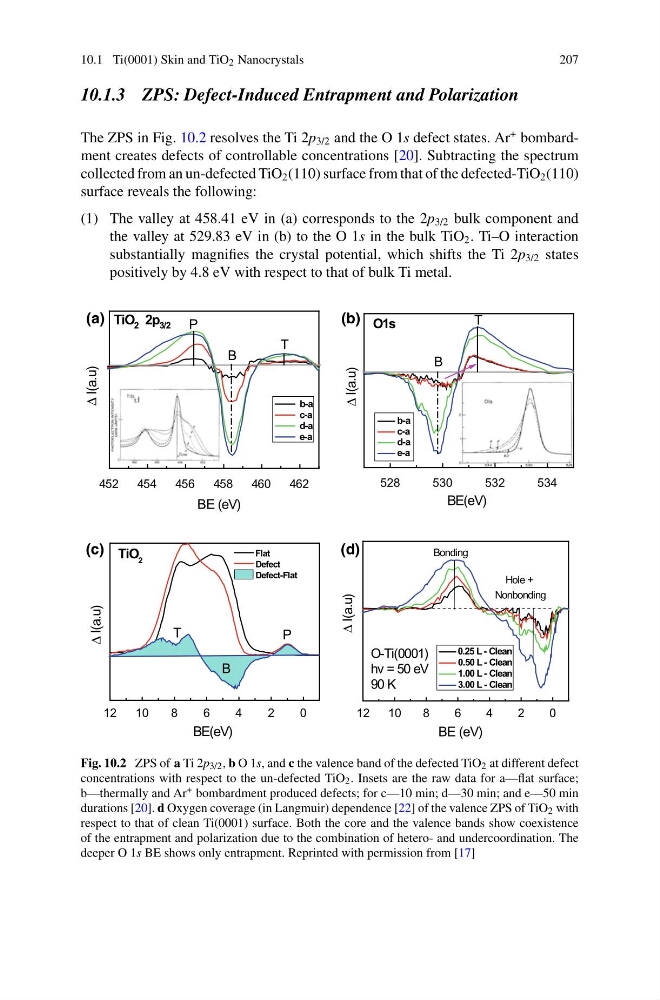
The ZPS in Fig. 10.2 resolves the Ti 2p 3/2 and the O 1s defect states. Ar
+ bombardment creates defects of controllable concentrations [20]. Subtracting the spectrum
collected from an un-defected TiO 2 (110) surface from that of the defected-TiO 2 (110)
surface reveals the following:
(1) The valley at 458.41 eV in (a) corresponds to the 2p 3/2 bulk component and
the valley at 529.83 eV in (b) to the O 1s in the bulk TiO 2 . Ti–O interaction
substantially magnifies the crystal potential, which shifts the Ti 2p 3/2 states
positively by 4.8 eV with respect to that of bulk Ti metal.
452
454
456
458
460
462
T
P
b-a
c-a
d-a
e-a
Δ I(a.u)
BE (eV)
TiO 2 2p 3/2
B
528
530
532
534
Δ I(a.u)
b-a
c-a
d-a
e-a
BE(eV)
O1s
T
B
12
10
8
6
4
2
0
Δ I(a.u)
Flat
Defect
Defect-Flat
BE(eV)
TiO 2
P
T
B
12
10
8
6
4
2
0
Δ I(a.u)
BE (eV)
0.25 L - Clean
0.50 L - Clean
1.00 L - Clean
3.00 L - Clean
O-Ti(0001)
hv = 50 eV
90 K
Bonding
Hole +
Nonbonding
(a)
(b)
(c)
(d)
Fig. 10.2 ZPS of a Ti 2p 3/2 , b O 1s, and c the valence band of the defected TiO 2 at different defect
concentrations with respect to the un-defected TiO 2 . Insets are the raw data for a—flat surface;
b—thermally and Ar + bombardment produced defects; for c—10 min; d—30 min; and e—50 min
durations [20]. d Oxygen coverage (in Langmuir) dependence [22] of the valence ZPS of TiO 2 with
respect to that of clean Ti(0001) surface. Both the core and the valence bands show coexistence
of the entrapment and polarization due to the combination of hetero- and undercoordination. The
deeper O 1s BE shows only entrapment. Reprinted with permission from [17]
207
10.1.3 ZPS: Defect-Induced Entrapment and Polarization
The ZPS in Fig. 10.2 resolves the Ti 2p 3/2 and the O 1s defect states. Ar
+ bombardment creates defects of controllable concentrations [20]. Subtracting the spectrum
collected from an un-defected TiO 2 (110) surface from that of the defected-TiO 2 (110)
surface reveals the following:
(1) The valley at 458.41 eV in (a) corresponds to the 2p 3/2 bulk component and
the valley at 529.83 eV in (b) to the O 1s in the bulk TiO 2 . Ti–O interaction
substantially magnifies the crystal potential, which shifts the Ti 2p 3/2 states
positively by 4.8 eV with respect to that of bulk Ti metal.
452
454
456
458
460
462
T
P
b-a
c-a
d-a
e-a
Δ I(a.u)
BE (eV)
TiO 2 2p 3/2
B
528
530
532
534
Δ I(a.u)
b-a
c-a
d-a
e-a
BE(eV)
O1s
T
B
12
10
8
6
4
2
0
Δ I(a.u)
Flat
Defect
Defect-Flat
BE(eV)
TiO 2
P
T
B
12
10
8
6
4
2
0
Δ I(a.u)
BE (eV)
0.25 L - Clean
0.50 L - Clean
1.00 L - Clean
3.00 L - Clean
O-Ti(0001)
hv = 50 eV
90 K
Bonding
Hole +
Nonbonding
(a)
(b)
(c)
(d)
Fig. 10.2 ZPS of a Ti 2p 3/2 , b O 1s, and c the valence band of the defected TiO 2 at different defect
concentrations with respect to the un-defected TiO 2 . Insets are the raw data for a—flat surface;
b—thermally and Ar + bombardment produced defects; for c—10 min; d—30 min; and e—50 min
durations [20]. d Oxygen coverage (in Langmuir) dependence [22] of the valence ZPS of TiO 2 with
respect to that of clean Ti(0001) surface. Both the core and the valence bands show coexistence
of the entrapment and polarization due to the combination of hetero- and undercoordination. The
deeper O 1s BE shows only entrapment. Reprinted with permission from [17]