

206
10 Hetero- and Under-Coordination Coupling
It has been proposed that the oxygen-derived Ti 3d states located ~0.85 eV below
the E F narrows the band gap [7, 11]. Such Ti 3d states arise from oxygen (O br )
vacancies that bridge two Ti
3+ ions across [12–14]. Two excessive electrons per O br
vacancy transfer to the neighboring Ti atoms in an ionic route. However, based on
their UPS, STM, and DFT investigations of TiO 2 (110) surfaces, Martinez et al. [1]
suggested that the Ti 3d defect states were primarily due to Ti
3+ interstitials in the
near-surface region rather than the surface O br vacancies. The defected black TiO 2
exhibits substantial activity in photocatalytic production of hydrogen from water
under sunlight radiation [15]. Both the valence and the conduction bands of the
black TiO 2 shift upwards because of the defect induced band bending [16].
10.1.2 XPS: Ti(0001) Skin 2p Band Shift
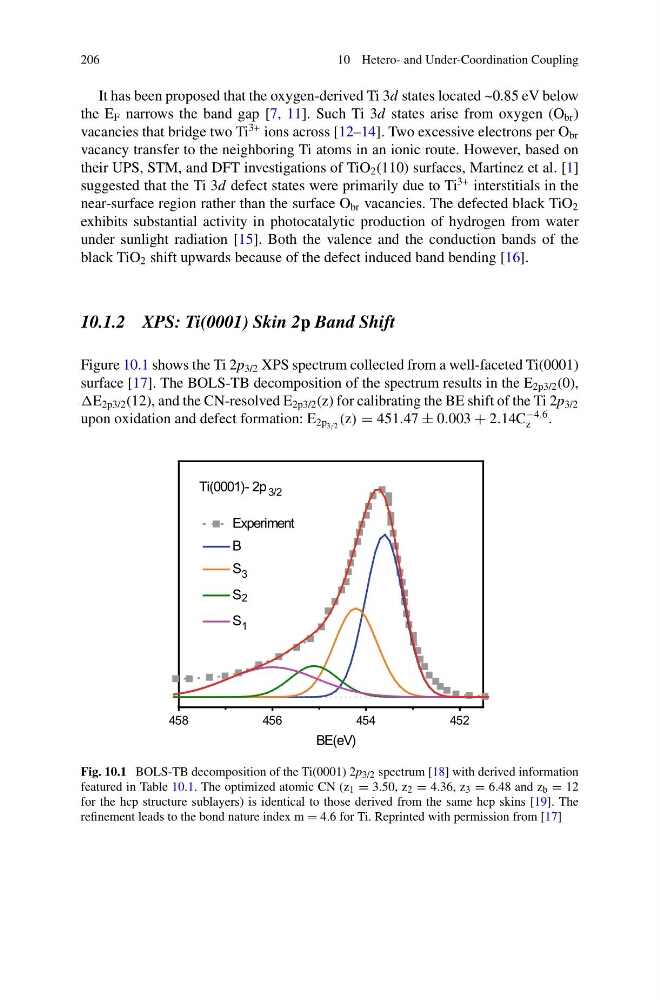
Figure 10.1 shows the Ti 2p 3/2 XPS spectrum collected from a well-faceted Ti(0001)
surface [17]. The BOLS-TB decomposition of the spectrum results in the E 2p3/2 (0),
2p3/2 (12), and the CN-resolved E 2p3/2 (z) for calibrating the BE shift of the Ti 2p 3/2
upon oxidation and defect formation: E 2p 3/2 (z) = 451.47 ± 0.003 + 2.14C
−4.6
z
.
458
456
454
452
Experiment
B
S 3
S 2
S 1
BE(eV)
Ti(0001)- 2p 3/2
Fig. 10.1 BOLS-TB decomposition of the Ti(0001) 2p 3/2 spectrum [18] with derived information
featured in Table 10.1. The optimized atomic CN (z 1 = 3.50, z 2 = 4.36, z 3 = 6.48 and z b = 12
for the hcp structure sublayers) is identical to those derived from the same hcp skins [19]. The
refinement leads to the bond nature index m = 4.6 for Ti. Reprinted with permission from [17]
10 Hetero- and Under-Coordination Coupling
It has been proposed that the oxygen-derived Ti 3d states located ~0.85 eV below
the E F narrows the band gap [7, 11]. Such Ti 3d states arise from oxygen (O br )
vacancies that bridge two Ti
3+ ions across [12–14]. Two excessive electrons per O br
vacancy transfer to the neighboring Ti atoms in an ionic route. However, based on
their UPS, STM, and DFT investigations of TiO 2 (110) surfaces, Martinez et al. [1]
suggested that the Ti 3d defect states were primarily due to Ti
3+ interstitials in the
near-surface region rather than the surface O br vacancies. The defected black TiO 2
exhibits substantial activity in photocatalytic production of hydrogen from water
under sunlight radiation [15]. Both the valence and the conduction bands of the
black TiO 2 shift upwards because of the defect induced band bending [16].
10.1.2 XPS: Ti(0001) Skin 2p Band Shift
Figure 10.1 shows the Ti 2p 3/2 XPS spectrum collected from a well-faceted Ti(0001)
surface [17]. The BOLS-TB decomposition of the spectrum results in the E 2p3/2 (0),
2p3/2 (12), and the CN-resolved E 2p3/2 (z) for calibrating the BE shift of the Ti 2p 3/2
upon oxidation and defect formation: E 2p 3/2 (z) = 451.47 ± 0.003 + 2.14C
−4.6
z
.
458
456
454
452
Experiment
B
S 3
S 2
S 1
BE(eV)
Ti(0001)- 2p 3/2
Fig. 10.1 BOLS-TB decomposition of the Ti(0001) 2p 3/2 spectrum [18] with derived information
featured in Table 10.1. The optimized atomic CN (z 1 = 3.50, z 2 = 4.36, z 3 = 6.48 and z b = 12
for the hcp structure sublayers) is identical to those derived from the same hcp skins [19]. The
refinement leads to the bond nature index m = 4.6 for Ti. Reprinted with permission from [17]