

9.6 Summary
199
9.6 Summary
Electron spectroscopic observations confirm the generality of the creation and evolution dynamics of the valence states during chemisorption and its effect on the
core level shift. In addition to the bonding states, the nonbonding lone pair of the
adsorbate, the antibonding dipole states of the host, and the electron hole of the host
atom can never be neglected, which modify the physical properties of a chemisorbed
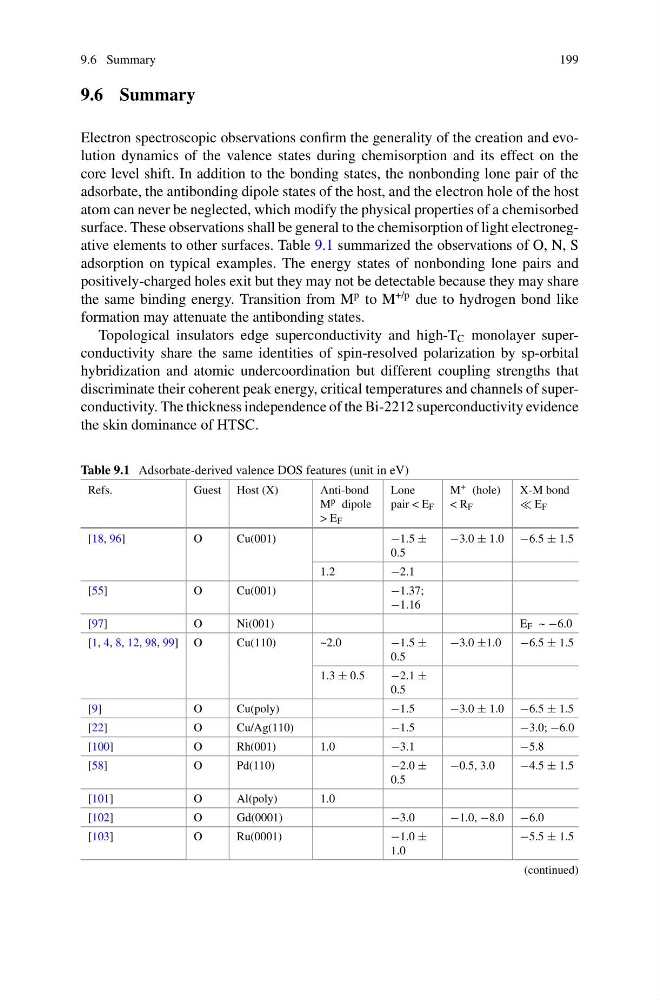
surface. These observations shall be general to the chemisorption of light electronegative elements to other surfaces. Table 9.1 summarized the observations of O, N, S
adsorption on typical examples. The energy states of nonbonding lone pairs and
positively-charged holes exit but they may not be detectable because they may share
the same binding energy. Transition from M
p to M
+/p due to hydrogen bond like
formation may attenuate the antibonding states.
Topological insulators edge superconductivity and high-T C monolayer superconductivity share the same identities of spin-resolved polarization by sp-orbital
hybridization and atomic undercoordination but different coupling strengths that
discriminate their coherent peak energy, critical temperatures and channels of superconductivity. The thickness independence of the Bi-2212 superconductivity evidence
the skin dominance of HTSC.
Table 9.1 Adsorbate-derived valence DOS features (unit in eV)
Refs.
Guest Host (X)
Anti-bond
M p dipole
> E F
Lone
pair < E F
M + (hole)
< R F
X-M bond
E F
[18, 96]
O
Cu(001)
−1.5 ±
0.5
−3.0 ± 1.0 −6.5 ± 1.5
1.2
−2.1
[55]
O
Cu(001)
−1.37;
−1.16
[97]
O
Ni(001)
E F ~ −6.0
[1, 4, 8, 12, 98, 99] O
Cu(110)
~2.0
−1.5 ±
0.5
−3.0 ±1.0
−6.5 ± 1.5
1.3 ± 0.5
−2.1 ±
0.5
[9]
O
Cu(poly)
−1.5
−3.0 ± 1.0 −6.5 ± 1.5
[22]
O
Cu/Ag(110)
−1.5
−3.0; −6.0
[100]
O
Rh(001)
1.0
−3.1
−5.8
[58]
O
Pd(110)
−2.0 ±
0.5
−0.5, 3.0
−4.5 ± 1.5
[101]
O
Al(poly)
1.0
[102]
O
Gd(0001)
−3.0
−1.0, −8.0 −6.0
[103]
O
Ru(0001)
−1.0 ±
1.0
−5.5 ± 1.5
(continued)
199
9.6 Summary
Electron spectroscopic observations confirm the generality of the creation and evolution dynamics of the valence states during chemisorption and its effect on the
core level shift. In addition to the bonding states, the nonbonding lone pair of the
adsorbate, the antibonding dipole states of the host, and the electron hole of the host
atom can never be neglected, which modify the physical properties of a chemisorbed
surface. These observations shall be general to the chemisorption of light electronegative elements to other surfaces. Table 9.1 summarized the observations of O, N, S
adsorption on typical examples. The energy states of nonbonding lone pairs and
positively-charged holes exit but they may not be detectable because they may share
the same binding energy. Transition from M
p to M
+/p due to hydrogen bond like
formation may attenuate the antibonding states.
Topological insulators edge superconductivity and high-T C monolayer superconductivity share the same identities of spin-resolved polarization by sp-orbital
hybridization and atomic undercoordination but different coupling strengths that
discriminate their coherent peak energy, critical temperatures and channels of superconductivity. The thickness independence of the Bi-2212 superconductivity evidence
the skin dominance of HTSC.
Table 9.1 Adsorbate-derived valence DOS features (unit in eV)
Refs.
Guest Host (X)
Anti-bond
M p dipole
> E F
Lone
pair < E F
M + (hole)
< R F
X-M bond
E F
[18, 96]
O
Cu(001)
−1.5 ±
0.5
−3.0 ± 1.0 −6.5 ± 1.5
1.2
−2.1
[55]
O
Cu(001)
−1.37;
−1.16
[97]
O
Ni(001)
E F ~ −6.0
[1, 4, 8, 12, 98, 99] O
Cu(110)
~2.0
−1.5 ±
0.5
−3.0 ±1.0
−6.5 ± 1.5
1.3 ± 0.5
−2.1 ±
0.5
[9]
O
Cu(poly)
−1.5
−3.0 ± 1.0 −6.5 ± 1.5
[22]
O
Cu/Ag(110)
−1.5
−3.0; −6.0
[100]
O
Rh(001)
1.0
−3.1
−5.8
[58]
O
Pd(110)
−2.0 ±
0.5
−0.5, 3.0
−4.5 ± 1.5
[101]
O
Al(poly)
1.0
[102]
O
Gd(0001)
−3.0
−1.0, −8.0 −6.0
[103]
O
Ru(0001)
−1.0 ±
1.0
−5.5 ± 1.5
(continued)