

196
9 Hybridized Bonding
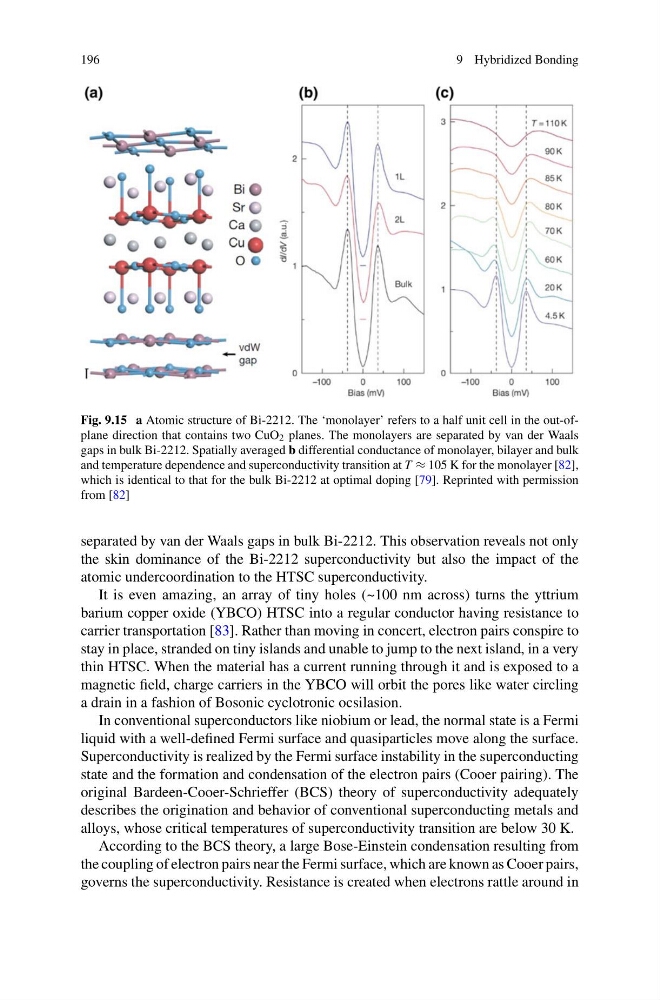
Fig. 9.15 a Atomic structure of Bi-2212. The ‘monolayer’ refers to a half unit cell in the out-ofplane direction that contains two CuO 2 planes. The monolayers are separated by van der Waals
gaps in bulk Bi-2212. Spatially averaged b differential conductance of monolayer, bilayer and bulk
and temperature dependence and superconductivity transition at T ≈ 105 K for the monolayer [82],
which is identical to that for the bulk Bi-2212 at optimal doping [79]. Reprinted with permission
from [82]
separated by van der Waals gaps in bulk Bi-2212. This observation reveals not only
the skin dominance of the Bi-2212 superconductivity but also the impact of the
atomic undercoordination to the HTSC superconductivity.
It is even amazing, an array of tiny holes (~100 nm across) turns the yttrium
barium copper oxide (YBCO) HTSC into a regular conductor having resistance to
carrier transportation [83]. Rather than moving in concert, electron pairs conspire to
stay in place, stranded on tiny islands and unable to jump to the next island, in a very
thin HTSC. When the material has a current running through it and is exposed to a
magnetic field, charge carriers in the YBCO will orbit the pores like water circling
a drain in a fashion of Bosonic cyclotronic ocsilasion.
In conventional superconductors like niobium or lead, the normal state is a Fermi
liquid with a well-defined Fermi surface and quasiparticles move along the surface.
Superconductivity is realized by the Fermi surface instability in the superconducting
state and the formation and condensation of the electron pairs (Cooer pairing). The
original Bardeen-Cooer-Schrieffer (BCS) theory of superconductivity adequately
describes the origination and behavior of conventional superconducting metals and
alloys, whose critical temperatures of superconductivity transition are below 30 K.
According to the BCS theory, a large Bose-Einstein condensation resulting from
the coupling of electron pairs near the Fermi surface, which are known as Cooer pairs,
governs the superconductivity. Resistance is created when electrons rattle around in
9 Hybridized Bonding
Fig. 9.15 a Atomic structure of Bi-2212. The ‘monolayer’ refers to a half unit cell in the out-ofplane direction that contains two CuO 2 planes. The monolayers are separated by van der Waals
gaps in bulk Bi-2212. Spatially averaged b differential conductance of monolayer, bilayer and bulk
and temperature dependence and superconductivity transition at T ≈ 105 K for the monolayer [82],
which is identical to that for the bulk Bi-2212 at optimal doping [79]. Reprinted with permission
from [82]
separated by van der Waals gaps in bulk Bi-2212. This observation reveals not only
the skin dominance of the Bi-2212 superconductivity but also the impact of the
atomic undercoordination to the HTSC superconductivity.
It is even amazing, an array of tiny holes (~100 nm across) turns the yttrium
barium copper oxide (YBCO) HTSC into a regular conductor having resistance to
carrier transportation [83]. Rather than moving in concert, electron pairs conspire to
stay in place, stranded on tiny islands and unable to jump to the next island, in a very
thin HTSC. When the material has a current running through it and is exposed to a
magnetic field, charge carriers in the YBCO will orbit the pores like water circling
a drain in a fashion of Bosonic cyclotronic ocsilasion.
In conventional superconductors like niobium or lead, the normal state is a Fermi
liquid with a well-defined Fermi surface and quasiparticles move along the surface.
Superconductivity is realized by the Fermi surface instability in the superconducting
state and the formation and condensation of the electron pairs (Cooer pairing). The
original Bardeen-Cooer-Schrieffer (BCS) theory of superconductivity adequately
describes the origination and behavior of conventional superconducting metals and
alloys, whose critical temperatures of superconductivity transition are below 30 K.
According to the BCS theory, a large Bose-Einstein condensation resulting from
the coupling of electron pairs near the Fermi surface, which are known as Cooer pairs,
governs the superconductivity. Resistance is created when electrons rattle around in