

9.5 XPS and ZPS: Core Level Entrapment and Polarization
195
pares the ARPES for the FeTe 0.55 Se 0.45 topological insulator [77] and for the ironbased (Ba 0.6 K 0.4 )Fe 2 As 2 superconductor revealed that, while sharp superconducting
coherence peaks emerge in the superconducting state on the hole-like Fermi surface
sheets, no quasiparticle peak presents in the normal state. Its electronic behaviors
deviate strongly from a Fermi liquid system. The superconducting gap of such a
system exhibits an unusual temperature dependence that it is nearly a constant in the
superconducting state and abruptly closes at T C . In the superconducting state, the
superconducting gap is extremely isotropic momentum dependence.
The TI and HTSC showed similar conductance but different T C values or coherent peak energies. The FeTe 0.55 Se 0.45 has a peak at 10 meV with a T C of 38.5 K.
Contrastingly, both the coherent peak energy and T C of the TI are lower than those
for the FeTe 0.55 Se 0.45 , which indicates that the TI and HTSC share the common yet
different extents of interactions characterized by the splitting of the peak cross the
E F energy—Fermi pocket. The T C corresponds to the temperature of the pocket gap
disappearance.
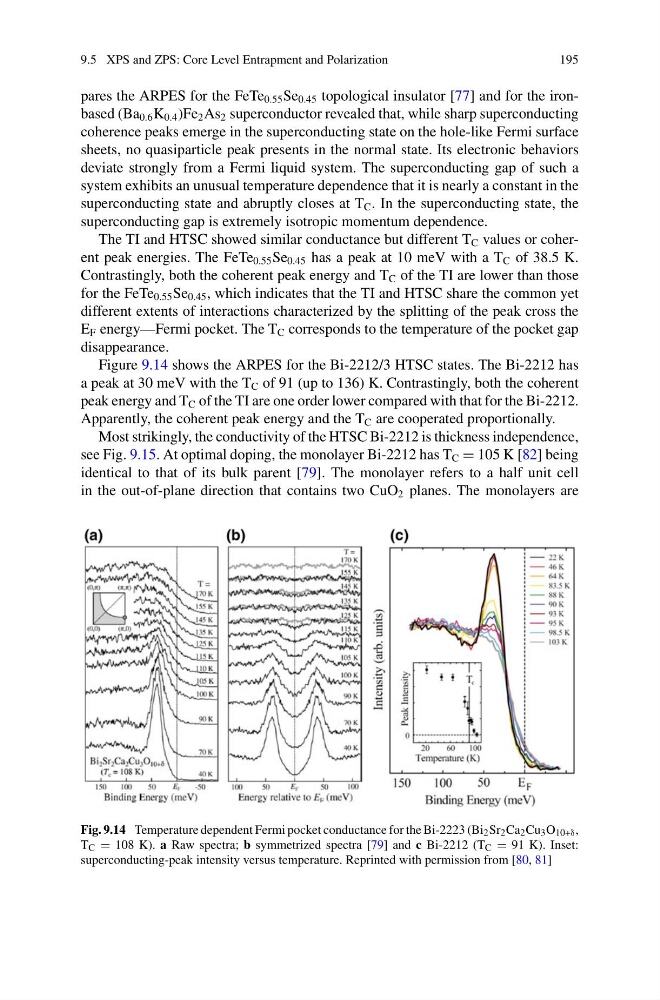
Figure 9.14 shows the ARPES for the Bi-2212/3 HTSC states. The Bi-2212 has
a peak at 30 meV with the T C of 91 (up to 136) K. Contrastingly, both the coherent
peak energy and T C of the TI are one order lower compared with that for the Bi-2212.
Apparently, the coherent peak energy and the T C are cooperated proportionally.
Most strikingly, the conductivity of the HTSC Bi-2212 is thickness independence,
see Fig. 9.15. At optimal doping, the monolayer Bi-2212 has T C = 105 K [82] being
identical to that of its bulk parent [79]. The monolayer refers to a half unit cell
in the out-of-plane direction that contains two CuO 2 planes. The monolayers are
Fig. 9.14 Temperature dependent Fermi pocket conductance for the Bi-2223 (Bi 2 Sr 2 Ca 2 Cu 3 O 10+δ ,
T C = 108 K). a Raw spectra; b symmetrized spectra [79] and c Bi-2212 (T C = 91 K). Inset:
superconducting-peak intensity versus temperature. Reprinted with permission from [80, 81]
195
pares the ARPES for the FeTe 0.55 Se 0.45 topological insulator [77] and for the ironbased (Ba 0.6 K 0.4 )Fe 2 As 2 superconductor revealed that, while sharp superconducting
coherence peaks emerge in the superconducting state on the hole-like Fermi surface
sheets, no quasiparticle peak presents in the normal state. Its electronic behaviors
deviate strongly from a Fermi liquid system. The superconducting gap of such a
system exhibits an unusual temperature dependence that it is nearly a constant in the
superconducting state and abruptly closes at T C . In the superconducting state, the
superconducting gap is extremely isotropic momentum dependence.
The TI and HTSC showed similar conductance but different T C values or coherent peak energies. The FeTe 0.55 Se 0.45 has a peak at 10 meV with a T C of 38.5 K.
Contrastingly, both the coherent peak energy and T C of the TI are lower than those
for the FeTe 0.55 Se 0.45 , which indicates that the TI and HTSC share the common yet
different extents of interactions characterized by the splitting of the peak cross the
E F energy—Fermi pocket. The T C corresponds to the temperature of the pocket gap
disappearance.
Figure 9.14 shows the ARPES for the Bi-2212/3 HTSC states. The Bi-2212 has
a peak at 30 meV with the T C of 91 (up to 136) K. Contrastingly, both the coherent
peak energy and T C of the TI are one order lower compared with that for the Bi-2212.
Apparently, the coherent peak energy and the T C are cooperated proportionally.
Most strikingly, the conductivity of the HTSC Bi-2212 is thickness independence,
see Fig. 9.15. At optimal doping, the monolayer Bi-2212 has T C = 105 K [82] being
identical to that of its bulk parent [79]. The monolayer refers to a half unit cell
in the out-of-plane direction that contains two CuO 2 planes. The monolayers are
Fig. 9.14 Temperature dependent Fermi pocket conductance for the Bi-2223 (Bi 2 Sr 2 Ca 2 Cu 3 O 10+δ ,
T C = 108 K). a Raw spectra; b symmetrized spectra [79] and c Bi-2212 (T C = 91 K). Inset:
superconducting-peak intensity versus temperature. Reprinted with permission from [80, 81]