

186
9 Hybridized Bonding
considering the charge transportation, sp-orbital hybridization, and polarization during chemisorption. This elemental orbital articulation changed completely in 1997
when the H 2 O-like sp-orbital hybridization was firstly adopted for oxidation and nitridation with introduction of the antibonding, hole, nonbonding, and bonding states
[21, 23–49].
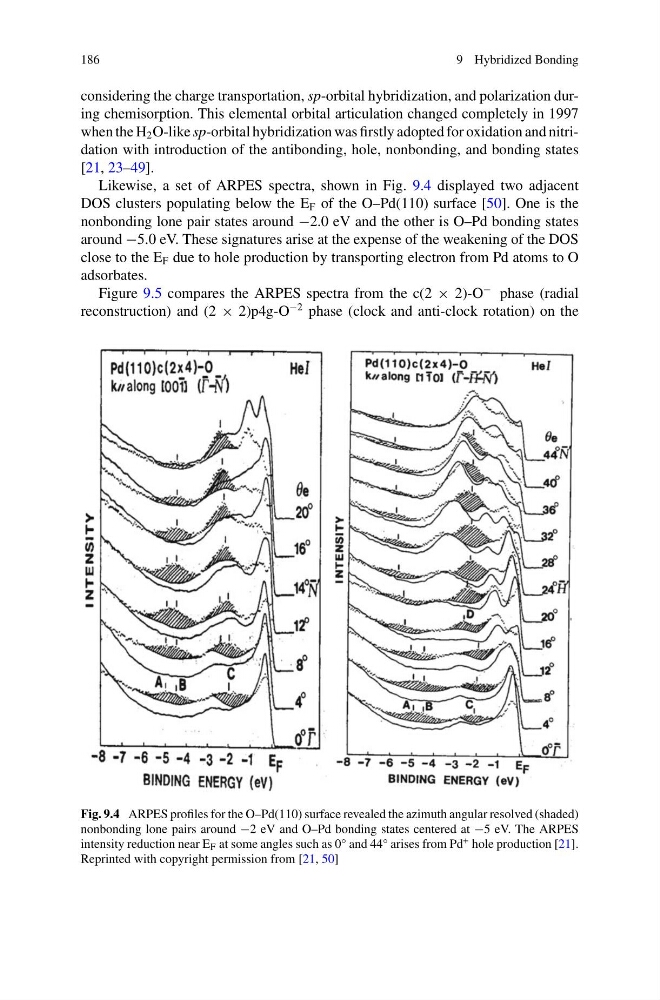
Likewise, a set of ARPES spectra, shown in Fig. 9.4 displayed two adjacent
DOS clusters populating below the E F of the O–Pd(110) surface [50]. One is the
nonbonding lone pair states around −2.0 eV and the other is O–Pd bonding states
around −5.0 eV. These signatures arise at the expense of the weakening of the DOS
close to the E F due to hole production by transporting electron from Pd atoms to O
adsorbates.
Figure 9.5 compares the ARPES spectra from the c(2 × 2)-O
− phase (radial
reconstruction) and (2 × 2)p4g-O
−2 phase (clock and anti-clock rotation) on the
Fig. 9.4 ARPES profiles for the O–Pd(110) surface revealed the azimuth angular resolved (shaded)
nonbonding lone pairs around −2 eV and O–Pd bonding states centered at −5 eV. The ARPES
intensity reduction near E F at some angles such as 0° and 44° arises from Pd + hole production [21].
Reprinted with copyright permission from [21, 50]
9 Hybridized Bonding
considering the charge transportation, sp-orbital hybridization, and polarization during chemisorption. This elemental orbital articulation changed completely in 1997
when the H 2 O-like sp-orbital hybridization was firstly adopted for oxidation and nitridation with introduction of the antibonding, hole, nonbonding, and bonding states
[21, 23–49].
Likewise, a set of ARPES spectra, shown in Fig. 9.4 displayed two adjacent
DOS clusters populating below the E F of the O–Pd(110) surface [50]. One is the
nonbonding lone pair states around −2.0 eV and the other is O–Pd bonding states
around −5.0 eV. These signatures arise at the expense of the weakening of the DOS
close to the E F due to hole production by transporting electron from Pd atoms to O
adsorbates.
Figure 9.5 compares the ARPES spectra from the c(2 × 2)-O
− phase (radial
reconstruction) and (2 × 2)p4g-O
−2 phase (clock and anti-clock rotation) on the
Fig. 9.4 ARPES profiles for the O–Pd(110) surface revealed the azimuth angular resolved (shaded)
nonbonding lone pairs around −2 eV and O–Pd bonding states centered at −5 eV. The ARPES
intensity reduction near E F at some angles such as 0° and 44° arises from Pd + hole production [21].
Reprinted with copyright permission from [21, 50]