

184
9 Hybridized Bonding
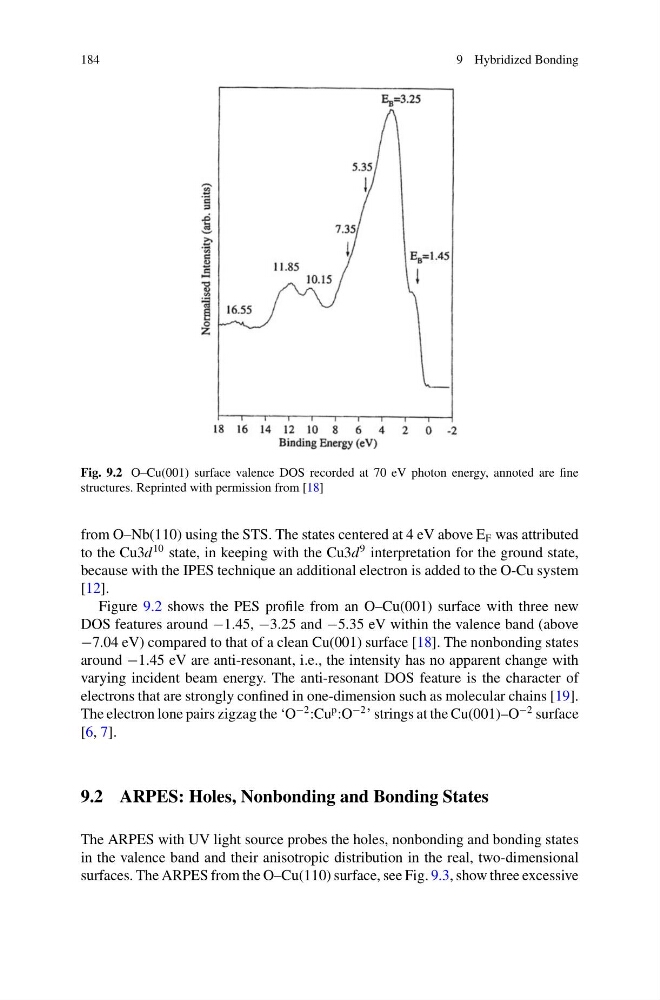
Fig. 9.2 O–Cu(001) surface valence DOS recorded at 70 eV photon energy, annoted are fine
structures. Reprinted with permission from [18]
from O–Nb(110) using the STS. The states centered at 4 eV above E F was attributed
to the Cu3d
10 state, in keeping with the Cu3d
9 interpretation for the ground state,
because with the IPES technique an additional electron is added to the O-Cu system
[12].
Figure 9.2 shows the PES profile from an O–Cu(001) surface with three new
DOS features around −1.45, −3.25 and −5.35 eV within the valence band (above
−7.04 eV) compared to that of a clean Cu(001) surface [18]. The nonbonding states
around −1.45 eV are anti-resonant, i.e., the intensity has no apparent change with
varying incident beam energy. The anti-resonant DOS feature is the character of
electrons that are strongly confined in one-dimension such as molecular chains [19].
The electron lone pairs zigzag the ‘O
−2 :Cu
p :O
−2 ’ strings at the Cu(001)–O
−2 surface
[6, 7].
9.2 ARPES: Holes, Nonbonding and Bonding States
The ARPES with UV light source probes the holes, nonbonding and bonding states
in the valence band and their anisotropic distribution in the real, two-dimensional
surfaces. The ARPES from the O–Cu(110) surface, see Fig. 9.3, show three excessive
9 Hybridized Bonding
Fig. 9.2 O–Cu(001) surface valence DOS recorded at 70 eV photon energy, annoted are fine
structures. Reprinted with permission from [18]
from O–Nb(110) using the STS. The states centered at 4 eV above E F was attributed
to the Cu3d
10 state, in keeping with the Cu3d
9 interpretation for the ground state,
because with the IPES technique an additional electron is added to the O-Cu system
[12].
Figure 9.2 shows the PES profile from an O–Cu(001) surface with three new
DOS features around −1.45, −3.25 and −5.35 eV within the valence band (above
−7.04 eV) compared to that of a clean Cu(001) surface [18]. The nonbonding states
around −1.45 eV are anti-resonant, i.e., the intensity has no apparent change with
varying incident beam energy. The anti-resonant DOS feature is the character of
electrons that are strongly confined in one-dimension such as molecular chains [19].
The electron lone pairs zigzag the ‘O
−2 :Cu
p :O
−2 ’ strings at the Cu(001)–O
−2 surface
[6, 7].
9.2 ARPES: Holes, Nonbonding and Bonding States
The ARPES with UV light source probes the holes, nonbonding and bonding states
in the valence band and their anisotropic distribution in the real, two-dimensional
surfaces. The ARPES from the O–Cu(110) surface, see Fig. 9.3, show three excessive