

8.5 Catalytic Nature, Toxicity, Radiation Protectivity …
175
Si/C
Ge/C
Ge/Si
0
2
4
6
8
10
Interface free energy (J/m
2
)
3.16 J/m
2
5.31 J/m
2
8.21 J/m
2
(a)
Cu/Si
Cu/Sn
0
2
4
6
8
10
8.35 J/m
2
Interface free energy (J/m
2
)
(b)
5.06 J/m
2
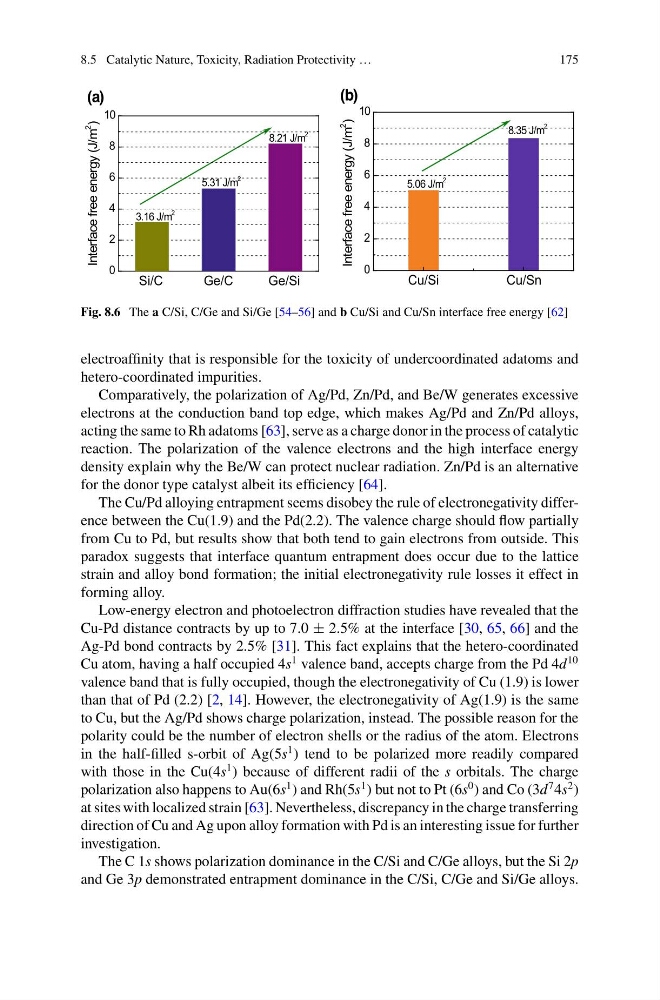
Fig. 8.6 The a C/Si, C/Ge and Si/Ge [54–56] and b Cu/Si and Cu/Sn interface free energy [62]
electroaffinity that is responsible for the toxicity of undercoordinated adatoms and
hetero-coordinated impurities.
Comparatively, the polarization of Ag/Pd, Zn/Pd, and Be/W generates excessive
electrons at the conduction band top edge, which makes Ag/Pd and Zn/Pd alloys,
acting the same to Rh adatoms [63], serve as a charge donor in the process of catalytic
reaction. The polarization of the valence electrons and the high interface energy
density explain why the Be/W can protect nuclear radiation. Zn/Pd is an alternative
for the donor type catalyst albeit its efficiency [64].
The Cu/Pd alloying entrapment seems disobey the rule of electronegativity difference between the Cu(1.9) and the Pd(2.2). The valence charge should flow partially
from Cu to Pd, but results show that both tend to gain electrons from outside. This
paradox suggests that interface quantum entrapment does occur due to the lattice
strain and alloy bond formation; the initial electronegativity rule losses it effect in
forming alloy.
Low-energy electron and photoelectron diffraction studies have revealed that the
Cu-Pd distance contracts by up to 7.0 ± 2.5% at the interface [30, 65, 66] and the
Ag-Pd bond contracts by 2.5% [31]. This fact explains that the hetero-coordinated
Cu atom, having a half occupied 4s
1 valence band, accepts charge from the Pd 4d
10
valence band that is fully occupied, though the electronegativity of Cu (1.9) is lower
than that of Pd (2.2) [2, 14]. However, the electronegativity of Ag(1.9) is the same
to Cu, but the Ag/Pd shows charge polarization, instead. The possible reason for the
polarity could be the number of electron shells or the radius of the atom. Electrons
in the half-filled s-orbit of Ag(5s
1 ) tend to be polarized more readily compared
with those in the Cu(4s
1 ) because of different radii of the s orbitals. The charge
polarization also happens to Au(6s
1 ) and Rh(5s
1 ) but not to Pt (6s
0 ) and Co (3d
7 4s
2 )
at sites with localized strain [63]. Nevertheless, discrepancy in the charge transferring
direction of Cu and Ag upon alloy formation with Pd is an interesting issue for further
investigation.
The C 1s shows polarization dominance in the C/Si and C/Ge alloys, but the Si 2p
and Ge 3p demonstrated entrapment dominance in the C/Si, C/Ge and Si/Ge alloys.
175
Si/C
Ge/C
Ge/Si
0
2
4
6
8
10
Interface free energy (J/m
2
)
3.16 J/m
2
5.31 J/m
2
8.21 J/m
2
(a)
Cu/Si
Cu/Sn
0
2
4
6
8
10
8.35 J/m
2
Interface free energy (J/m
2
)
(b)
5.06 J/m
2
Fig. 8.6 The a C/Si, C/Ge and Si/Ge [54–56] and b Cu/Si and Cu/Sn interface free energy [62]
electroaffinity that is responsible for the toxicity of undercoordinated adatoms and
hetero-coordinated impurities.
Comparatively, the polarization of Ag/Pd, Zn/Pd, and Be/W generates excessive
electrons at the conduction band top edge, which makes Ag/Pd and Zn/Pd alloys,
acting the same to Rh adatoms [63], serve as a charge donor in the process of catalytic
reaction. The polarization of the valence electrons and the high interface energy
density explain why the Be/W can protect nuclear radiation. Zn/Pd is an alternative
for the donor type catalyst albeit its efficiency [64].
The Cu/Pd alloying entrapment seems disobey the rule of electronegativity difference between the Cu(1.9) and the Pd(2.2). The valence charge should flow partially
from Cu to Pd, but results show that both tend to gain electrons from outside. This
paradox suggests that interface quantum entrapment does occur due to the lattice
strain and alloy bond formation; the initial electronegativity rule losses it effect in
forming alloy.
Low-energy electron and photoelectron diffraction studies have revealed that the
Cu-Pd distance contracts by up to 7.0 ± 2.5% at the interface [30, 65, 66] and the
Ag-Pd bond contracts by 2.5% [31]. This fact explains that the hetero-coordinated
Cu atom, having a half occupied 4s
1 valence band, accepts charge from the Pd 4d
10
valence band that is fully occupied, though the electronegativity of Cu (1.9) is lower
than that of Pd (2.2) [2, 14]. However, the electronegativity of Ag(1.9) is the same
to Cu, but the Ag/Pd shows charge polarization, instead. The possible reason for the
polarity could be the number of electron shells or the radius of the atom. Electrons
in the half-filled s-orbit of Ag(5s
1 ) tend to be polarized more readily compared
with those in the Cu(4s
1 ) because of different radii of the s orbitals. The charge
polarization also happens to Au(6s
1 ) and Rh(5s
1 ) but not to Pt (6s
0 ) and Co (3d
7 4s
2 )
at sites with localized strain [63]. Nevertheless, discrepancy in the charge transferring
direction of Cu and Ag upon alloy formation with Pd is an interesting issue for further
investigation.
The C 1s shows polarization dominance in the C/Si and C/Ge alloys, but the Si 2p
and Ge 3p demonstrated entrapment dominance in the C/Si, C/Ge and Si/Ge alloys.