

166
8 Hetero-Coordinated Interfaces
γ I =
E ν (x) − E ν (0)
E ν (12) − E ν (0)
= E I /E B =
> 1 (T )
< 1 (P)
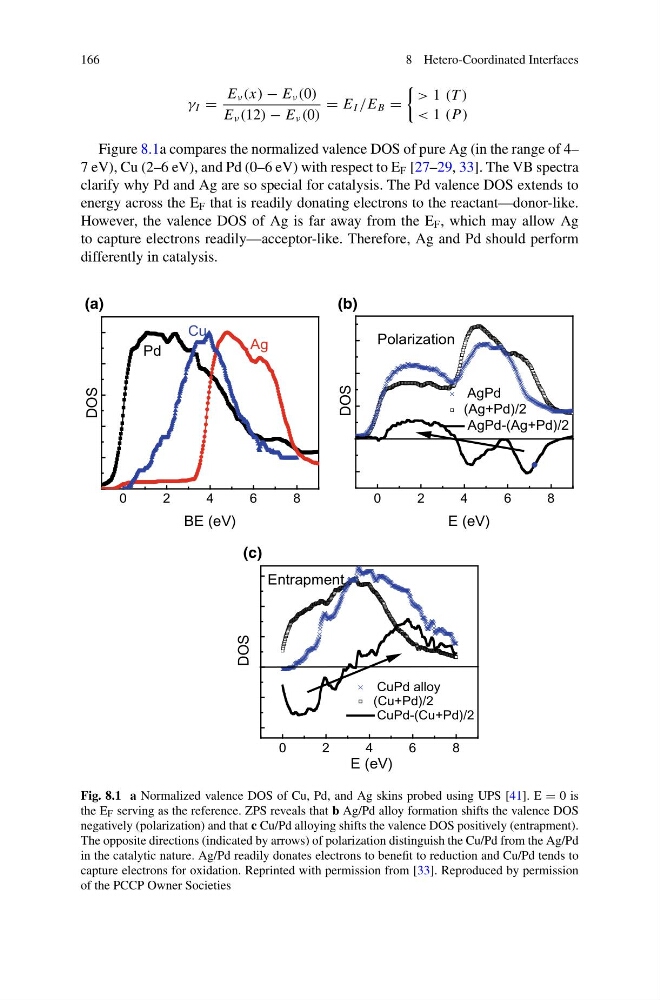
Figure 8.1a compares the normalized valence DOS of pure Ag (in the range of 4–
7 eV), Cu (2–6 eV), and Pd (0–6 eV) with respect to E F [27–29, 33]. The VB spectra
clarify why Pd and Ag are so special for catalysis. The Pd valence DOS extends to
energy across the E F that is readily donating electrons to the reactant—donor-like.
However, the valence DOS of Ag is far away from the E F , which may allow Ag
to capture electrons readily—acceptor-like. Therefore, Ag and Pd should perform
differently in catalysis.
0
2
4
6
8
DOS
BE (eV)
Pd
Cu
Ag
(a)
0
2
4
6
8
DOS
E (eV)
AgPd
(Ag+Pd)/2
AgPd-(Ag+Pd)/2
(b)
Polarization
0
2
4
6
8
DOS
E (eV)
CuPd alloy
(Cu+Pd)/2
CuPd-(Cu+Pd)/2
(c)
Entrapment
Fig. 8.1 a Normalized valence DOS of Cu, Pd, and Ag skins probed using UPS [41]. E = 0 is
the E F serving as the reference. ZPS reveals that b Ag/Pd alloy formation shifts the valence DOS
negatively (polarization) and that c Cu/Pd alloying shifts the valence DOS positively (entrapment).
The opposite directions (indicated by arrows) of polarization distinguish the Cu/Pd from the Ag/Pd
in the catalytic nature. Ag/Pd readily donates electrons to benefit to reduction and Cu/Pd tends to
capture electrons for oxidation. Reprinted with permission from [33]. Reproduced by permission
of the PCCP Owner Societies
8 Hetero-Coordinated Interfaces
γ I =
E ν (x) − E ν (0)
E ν (12) − E ν (0)
= E I /E B =
> 1 (T )
< 1 (P)
Figure 8.1a compares the normalized valence DOS of pure Ag (in the range of 4–
7 eV), Cu (2–6 eV), and Pd (0–6 eV) with respect to E F [27–29, 33]. The VB spectra
clarify why Pd and Ag are so special for catalysis. The Pd valence DOS extends to
energy across the E F that is readily donating electrons to the reactant—donor-like.
However, the valence DOS of Ag is far away from the E F , which may allow Ag
to capture electrons readily—acceptor-like. Therefore, Ag and Pd should perform
differently in catalysis.
0
2
4
6
8
DOS
BE (eV)
Pd
Cu
Ag
(a)
0
2
4
6
8
DOS
E (eV)
AgPd
(Ag+Pd)/2
AgPd-(Ag+Pd)/2
(b)
Polarization
0
2
4
6
8
DOS
E (eV)
CuPd alloy
(Cu+Pd)/2
CuPd-(Cu+Pd)/2
(c)
Entrapment
Fig. 8.1 a Normalized valence DOS of Cu, Pd, and Ag skins probed using UPS [41]. E = 0 is
the E F serving as the reference. ZPS reveals that b Ag/Pd alloy formation shifts the valence DOS
negatively (polarization) and that c Cu/Pd alloying shifts the valence DOS positively (entrapment).
The opposite directions (indicated by arrows) of polarization distinguish the Cu/Pd from the Ag/Pd
in the catalytic nature. Ag/Pd readily donates electrons to benefit to reduction and Cu/Pd tends to
capture electrons for oxidation. Reprinted with permission from [33]. Reproduced by permission
of the PCCP Owner Societies