

116
6 Atomic Chains, Clusters, and Nanocrystals
2
4
6
8
10
12
14
0
10
20
30
40
50
(a)
ΔΕ 2p
3/2
(%)
K
m = 1.00
m = 1.82
Cu/CYCL/Ar
Cu/HOPG/Ar
0
1 0
2 0
3 0
4 0
5 0
0
10
20
30
40
50
(d)
Cu/HOPG/Ar +
κ =1.00; m = 1.00
κ =1.05; m = 1.00
ΔΕ3d
5/2
(%)
ΔΕ 2p 3/2 (%)
2
4
6
8
1 0
10
20
30
40
50
ΔΕ 2p
3/2
(%)
K
m=1.30
m=1.96
Cu/CYCL
Cu/CYCL/N
(b)
0
1 0
2 0
3 0
4 0
5 0
0
10
20
30
40
50
60
(e)
ΔΕ3d
5/2
(%)
ΔΕ 2p 3/2 (%)
- κ = 1.42, m = 1.30
N κ= 2.09, m = 1.96
Ar κ= 1.15, m = 1.82
Cu/CYCL
0
2
4
6
8
0
20
40
60
80
ΔE 2p
3/2
(%)
K
m = 1.27, 80 K
m = 1.94, 300K
80K
300K
(c)
Cu/Al 2 O 3
0
10 20 30 40 50 60 70
0
20
40
60
80
(f)
ΔE 3d
5/2
(%)
ΔE 2p 3/2 (%)
80 K κ = 1.04, m = 1.27
300K κ = 1.23, m = 1.94
Cu/Al 2 O 3
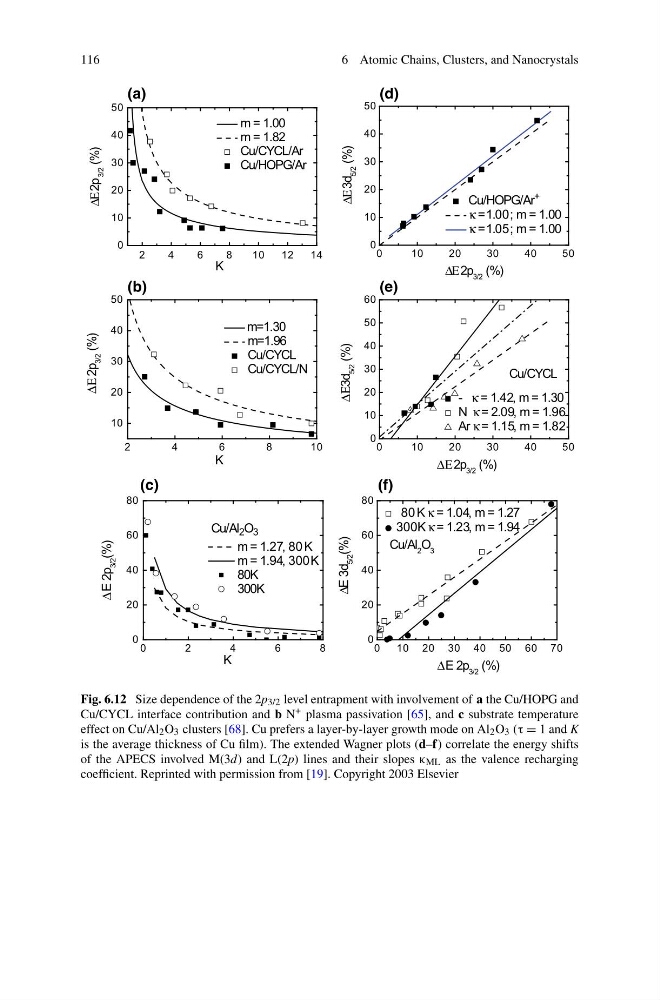
Fig. 6.12 Size dependence of the 2p 3/2 level entrapment with involvement of a the Cu/HOPG and
Cu/CYCL interface contribution and b N + plasma passivation [65], and c substrate temperature
effect on Cu/Al 2 O 3 clusters [68]. Cu prefers a layer-by-layer growth mode on Al 2 O 3 (τ = 1 and K
is the average thickness of Cu film). The extended Wagner plots (d–f) correlate the energy shifts
of the APECS involved M(3d) and L(2p) lines and their slopes κ ML as the valence recharging
coefficient. Reprinted with permission from [19]. Copyright 2003 Elsevier
6 Atomic Chains, Clusters, and Nanocrystals
2
4
6
8
10
12
14
0
10
20
30
40
50
(a)
ΔΕ 2p
3/2
(%)
K
m = 1.00
m = 1.82
Cu/CYCL/Ar
Cu/HOPG/Ar
0
1 0
2 0
3 0
4 0
5 0
0
10
20
30
40
50
(d)
Cu/HOPG/Ar +
κ =1.00; m = 1.00
κ =1.05; m = 1.00
ΔΕ3d
5/2
(%)
ΔΕ 2p 3/2 (%)
2
4
6
8
1 0
10
20
30
40
50
ΔΕ 2p
3/2
(%)
K
m=1.30
m=1.96
Cu/CYCL
Cu/CYCL/N
(b)
0
1 0
2 0
3 0
4 0
5 0
0
10
20
30
40
50
60
(e)
ΔΕ3d
5/2
(%)
ΔΕ 2p 3/2 (%)
- κ = 1.42, m = 1.30
N κ= 2.09, m = 1.96
Ar κ= 1.15, m = 1.82
Cu/CYCL
0
2
4
6
8
0
20
40
60
80
ΔE 2p
3/2
(%)
K
m = 1.27, 80 K
m = 1.94, 300K
80K
300K
(c)
Cu/Al 2 O 3
0
10 20 30 40 50 60 70
0
20
40
60
80
(f)
ΔE 3d
5/2
(%)
ΔE 2p 3/2 (%)
80 K κ = 1.04, m = 1.27
300K κ = 1.23, m = 1.94
Cu/Al 2 O 3
Fig. 6.12 Size dependence of the 2p 3/2 level entrapment with involvement of a the Cu/HOPG and
Cu/CYCL interface contribution and b N + plasma passivation [65], and c substrate temperature
effect on Cu/Al 2 O 3 clusters [68]. Cu prefers a layer-by-layer growth mode on Al 2 O 3 (τ = 1 and K
is the average thickness of Cu film). The extended Wagner plots (d–f) correlate the energy shifts
of the APECS involved M(3d) and L(2p) lines and their slopes κ ML as the valence recharging
coefficient. Reprinted with permission from [19]. Copyright 2003 Elsevier