

6.3 Gold
105
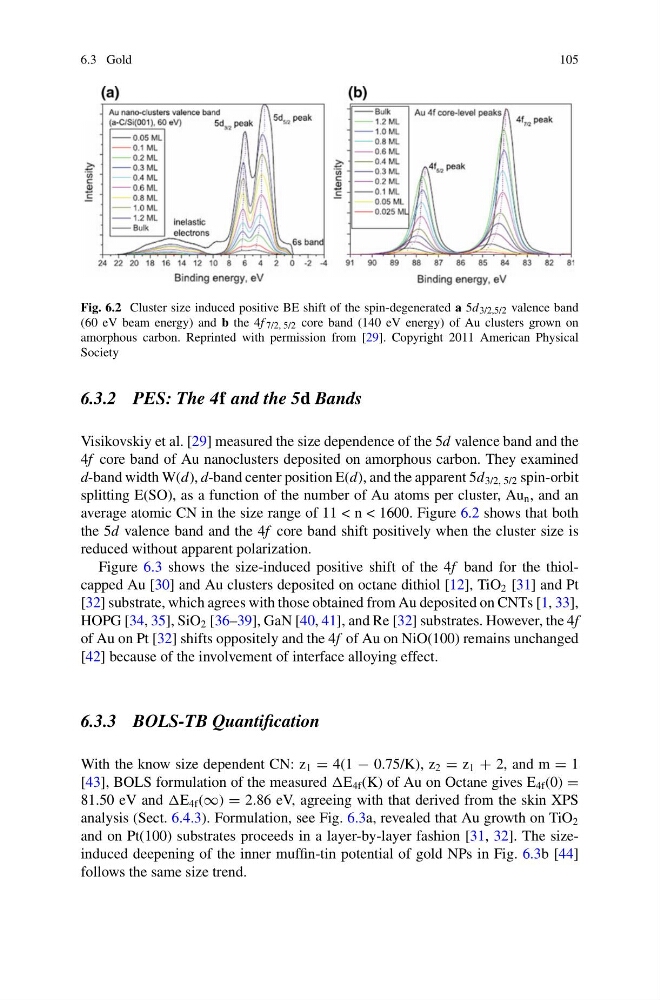
Fig. 6.2 Cluster size induced positive BE shift of the spin-degenerated a 5d 3/2,5/2 valence band
(60 eV beam energy) and b the 4f 7/2, 5/2 core band (140 eV energy) of Au clusters grown on
amorphous carbon. Reprinted with permission from [29]. Copyright 2011 American Physical
Society
6.3.2 PES: The 4f and the 5d Bands
Visikovskiy et al. [29] measured the size dependence of the 5d valence band and the
4f core band of Au nanoclusters deposited on amorphous carbon. They examined
d-band width W(d), d-band center position E(d), and the apparent 5d 3/2, 5/2 spin-orbit
splitting E(SO), as a function of the number of Au atoms per cluster, Au n , and an
average atomic CN in the size range of 11 < n < 1600. Figure 6.2 shows that both
the 5d valence band and the 4f core band shift positively when the cluster size is
reduced without apparent polarization.
Figure 6.3 shows the size-induced positive shift of the 4f band for the thiolcapped Au [30] and Au clusters deposited on octane dithiol [12], TiO 2 [31] and Pt
[32] substrate, which agrees with those obtained from Au deposited on CNTs [1, 33],
HOPG [34, 35], SiO 2 [36–39], GaN [40, 41], and Re [32] substrates. However, the 4f
of Au on Pt [32] shifts oppositely and the 4f of Au on NiO(100) remains unchanged
[42] because of the involvement of interface alloying effect.
6.3.3 BOLS-TB Quantification
With the know size dependent CN: z 1 = 4(1 − 0.75/K), z 2 = z 1 + 2, and m = 1
[43], BOLS formulation of the measured E 4f (K) of Au on Octane gives E 4f (0) =
81.50 eV and E 4f (∞) = 2.86 eV, agreeing with that derived from the skin XPS
analysis (Sect. 6.4.3). Formulation, see Fig. 6.3a, revealed that Au growth on TiO 2
and on Pt(100) substrates proceeds in a layer-by-layer fashion [31, 32]. The sizeinduced deepening of the inner muffin-tin potential of gold NPs in Fig. 6.3b [44]
follows the same size trend.
105
Fig. 6.2 Cluster size induced positive BE shift of the spin-degenerated a 5d 3/2,5/2 valence band
(60 eV beam energy) and b the 4f 7/2, 5/2 core band (140 eV energy) of Au clusters grown on
amorphous carbon. Reprinted with permission from [29]. Copyright 2011 American Physical
Society
6.3.2 PES: The 4f and the 5d Bands
Visikovskiy et al. [29] measured the size dependence of the 5d valence band and the
4f core band of Au nanoclusters deposited on amorphous carbon. They examined
d-band width W(d), d-band center position E(d), and the apparent 5d 3/2, 5/2 spin-orbit
splitting E(SO), as a function of the number of Au atoms per cluster, Au n , and an
average atomic CN in the size range of 11 < n < 1600. Figure 6.2 shows that both
the 5d valence band and the 4f core band shift positively when the cluster size is
reduced without apparent polarization.
Figure 6.3 shows the size-induced positive shift of the 4f band for the thiolcapped Au [30] and Au clusters deposited on octane dithiol [12], TiO 2 [31] and Pt
[32] substrate, which agrees with those obtained from Au deposited on CNTs [1, 33],
HOPG [34, 35], SiO 2 [36–39], GaN [40, 41], and Re [32] substrates. However, the 4f
of Au on Pt [32] shifts oppositely and the 4f of Au on NiO(100) remains unchanged
[42] because of the involvement of interface alloying effect.
6.3.3 BOLS-TB Quantification
With the know size dependent CN: z 1 = 4(1 − 0.75/K), z 2 = z 1 + 2, and m = 1
[43], BOLS formulation of the measured E 4f (K) of Au on Octane gives E 4f (0) =
81.50 eV and E 4f (∞) = 2.86 eV, agreeing with that derived from the skin XPS
analysis (Sect. 6.4.3). Formulation, see Fig. 6.3a, revealed that Au growth on TiO 2
and on Pt(100) substrates proceeds in a layer-by-layer fashion [31, 32]. The sizeinduced deepening of the inner muffin-tin potential of gold NPs in Fig. 6.3b [44]
follows the same size trend.