

96
5 Adatoms, Defects, and Kink Edges
Table 5.2 (continued)
Energy levels
Site
z
C z
d z ( ´
Å)
E z /eV
E ν (z)/eV
Adatom
3.15
0.83
2.20
0.5935
71.18
Re (12 ¯
31)
4f 5/2 [27]
Atom
0
40.014
Bulk
12
1.00
2.75
0.67
42.643
S 1
3.6
0.86
2.35
0.78
43.088
Kink
2.8
0.80
2.19
0.84
43.310
Re (12 ¯
31)
4f 7/2 [27]
S 1
3.6
0.86
2.35
0.78
40.30
O-(12 ¯
31) S 1
O sits between the outermost two
atomic layers
40.65
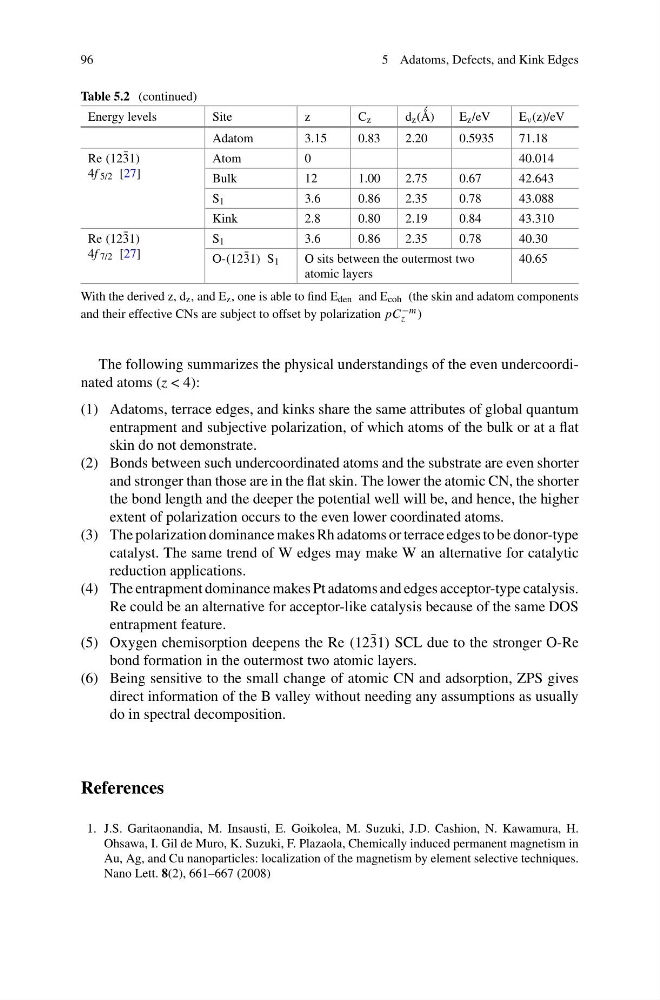
With the derived z, d z , and E z , one is able to find E den and E coh (the skin and adatom components
and their effective CNs are subject to offset by polarization pC −m
z )
The following summarizes the physical understandings of the even undercoordinated atoms (z < 4):
(1) Adatoms, terrace edges, and kinks share the same attributes of global quantum
entrapment and subjective polarization, of which atoms of the bulk or at a flat
skin do not demonstrate.
(2) Bonds between such undercoordinated atoms and the substrate are even shorter
and stronger than those are in the flat skin. The lower the atomic CN, the shorter
the bond length and the deeper the potential well will be, and hence, the higher
extent of polarization occurs to the even lower coordinated atoms.
(3) The polarization dominance makes Rh adatoms or terrace edges to be donor-type
catalyst. The same trend of W edges may make W an alternative for catalytic
reduction applications.
(4) The entrapment dominance makes Pt adatoms and edges acceptor-type catalysis.
Re could be an alternative for acceptor-like catalysis because of the same DOS
entrapment feature.
(5) Oxygen chemisorption deepens the Re (12 ¯
31) SCL due to the stronger O-Re
bond formation in the outermost two atomic layers.
(6) Being sensitive to the small change of atomic CN and adsorption, ZPS gives
direct information of the B valley without needing any assumptions as usually
do in spectral decomposition.
References
1. J.S. Garitaonandia, M. Insausti, E. Goikolea, M. Suzuki, J.D. Cashion, N. Kawamura, H.
Ohsawa, I. Gil de Muro, K. Suzuki, F. Plazaola, Chemically induced permanent magnetism in
Au, Ag, and Cu nanoparticles: localization of the magnetism by element selective techniques.
Nano Lett. 8(2), 661–667 (2008)
5 Adatoms, Defects, and Kink Edges
Table 5.2 (continued)
Energy levels
Site
z
C z
d z ( ´
Å)
E z /eV
E ν (z)/eV
Adatom
3.15
0.83
2.20
0.5935
71.18
Re (12 ¯
31)
4f 5/2 [27]
Atom
0
40.014
Bulk
12
1.00
2.75
0.67
42.643
S 1
3.6
0.86
2.35
0.78
43.088
Kink
2.8
0.80
2.19
0.84
43.310
Re (12 ¯
31)
4f 7/2 [27]
S 1
3.6
0.86
2.35
0.78
40.30
O-(12 ¯
31) S 1
O sits between the outermost two
atomic layers
40.65
With the derived z, d z , and E z , one is able to find E den and E coh (the skin and adatom components
and their effective CNs are subject to offset by polarization pC −m
z )
The following summarizes the physical understandings of the even undercoordinated atoms (z < 4):
(1) Adatoms, terrace edges, and kinks share the same attributes of global quantum
entrapment and subjective polarization, of which atoms of the bulk or at a flat
skin do not demonstrate.
(2) Bonds between such undercoordinated atoms and the substrate are even shorter
and stronger than those are in the flat skin. The lower the atomic CN, the shorter
the bond length and the deeper the potential well will be, and hence, the higher
extent of polarization occurs to the even lower coordinated atoms.
(3) The polarization dominance makes Rh adatoms or terrace edges to be donor-type
catalyst. The same trend of W edges may make W an alternative for catalytic
reduction applications.
(4) The entrapment dominance makes Pt adatoms and edges acceptor-type catalysis.
Re could be an alternative for acceptor-like catalysis because of the same DOS
entrapment feature.
(5) Oxygen chemisorption deepens the Re (12 ¯
31) SCL due to the stronger O-Re
bond formation in the outermost two atomic layers.
(6) Being sensitive to the small change of atomic CN and adsorption, ZPS gives
direct information of the B valley without needing any assumptions as usually
do in spectral decomposition.
References
1. J.S. Garitaonandia, M. Insausti, E. Goikolea, M. Suzuki, J.D. Cashion, N. Kawamura, H.
Ohsawa, I. Gil de Muro, K. Suzuki, F. Plazaola, Chemically induced permanent magnetism in
Au, Ag, and Cu nanoparticles: localization of the magnetism by element selective techniques.
Nano Lett. 8(2), 661–667 (2008)