

94
5 Adatoms, Defects, and Kink Edges
39.5
40.0
40.5
41.0
41.5
42.0
0
5
10
15
20
25
30
Re(12-31)
hv = 90 eV
I (a.u.)
Re 4f 7/2 (eV)
Re 4f 7/2 (eV)
Measurement
Fitting
B
S 4
S 3
S 2
S 1
(a)
39.5
40.0
40.5
41.0
41.5
42.0
10
20
30
I(a.u.)
Measurement
Fitting
B
5p 3/2
ReO
I II
III
(b)
O- Re(12-31)
hv = 90eV
39.5
40.0
40.5
41.0
41.5
42.0
-0.6
-0.4
-0.2
0.0
0.2
0.4
ΔI (a.u.)
Re 4f 7/2 (eV)
75
0
-0
0
oxidized -clean
B
B O
(c)
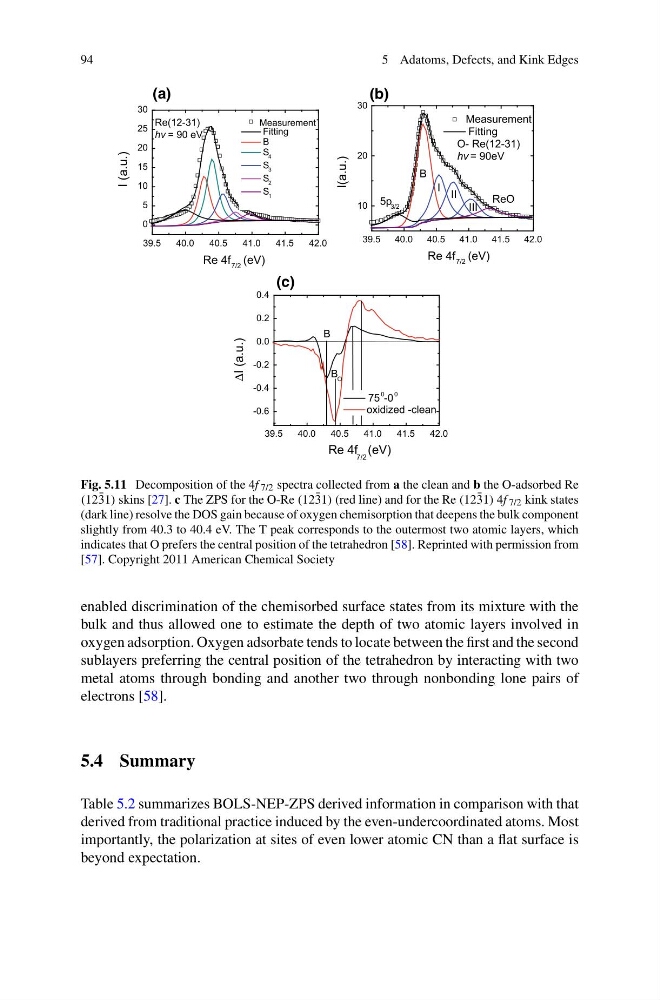
Fig. 5.11 Decomposition of the 4f 7/2 spectra collected from a the clean and b the O-adsorbed Re
(12 ¯
31) skins [27]. c The ZPS for the O-Re (12 ¯
31) (red line) and for the Re (12 ¯
31) 4f 7/2 kink states
(dark line) resolve the DOS gain because of oxygen chemisorption that deepens the bulk component
slightly from 40.3 to 40.4 eV. The T peak corresponds to the outermost two atomic layers, which
indicates that O prefers the central position of the tetrahedron [58]. Reprinted with permission from
[57]. Copyright 2011 American Chemical Society
enabled discrimination of the chemisorbed surface states from its mixture with the
bulk and thus allowed one to estimate the depth of two atomic layers involved in
oxygen adsorption. Oxygen adsorbate tends to locate between the first and the second
sublayers preferring the central position of the tetrahedron by interacting with two
metal atoms through bonding and another two through nonbonding lone pairs of
electrons [58].
5.4 Summary
Table 5.2 summarizes BOLS-NEP-ZPS derived information in comparison with that
derived from traditional practice induced by the even-undercoordinated atoms. Most
importantly, the polarization at sites of even lower atomic CN than a flat surface is
beyond expectation.
5 Adatoms, Defects, and Kink Edges
39.5
40.0
40.5
41.0
41.5
42.0
0
5
10
15
20
25
30
Re(12-31)
hv = 90 eV
I (a.u.)
Re 4f 7/2 (eV)
Re 4f 7/2 (eV)
Measurement
Fitting
B
S 4
S 3
S 2
S 1
(a)
39.5
40.0
40.5
41.0
41.5
42.0
10
20
30
I(a.u.)
Measurement
Fitting
B
5p 3/2
ReO
I II
III
(b)
O- Re(12-31)
hv = 90eV
39.5
40.0
40.5
41.0
41.5
42.0
-0.6
-0.4
-0.2
0.0
0.2
0.4
ΔI (a.u.)
Re 4f 7/2 (eV)
75
0
-0
0
oxidized -clean
B
B O
(c)
Fig. 5.11 Decomposition of the 4f 7/2 spectra collected from a the clean and b the O-adsorbed Re
(12 ¯
31) skins [27]. c The ZPS for the O-Re (12 ¯
31) (red line) and for the Re (12 ¯
31) 4f 7/2 kink states
(dark line) resolve the DOS gain because of oxygen chemisorption that deepens the bulk component
slightly from 40.3 to 40.4 eV. The T peak corresponds to the outermost two atomic layers, which
indicates that O prefers the central position of the tetrahedron [58]. Reprinted with permission from
[57]. Copyright 2011 American Chemical Society
enabled discrimination of the chemisorbed surface states from its mixture with the
bulk and thus allowed one to estimate the depth of two atomic layers involved in
oxygen adsorption. Oxygen adsorbate tends to locate between the first and the second
sublayers preferring the central position of the tetrahedron by interacting with two
metal atoms through bonding and another two through nonbonding lone pairs of
electrons [58].
5.4 Summary
Table 5.2 summarizes BOLS-NEP-ZPS derived information in comparison with that
derived from traditional practice induced by the even-undercoordinated atoms. Most
importantly, the polarization at sites of even lower atomic CN than a flat surface is
beyond expectation.