

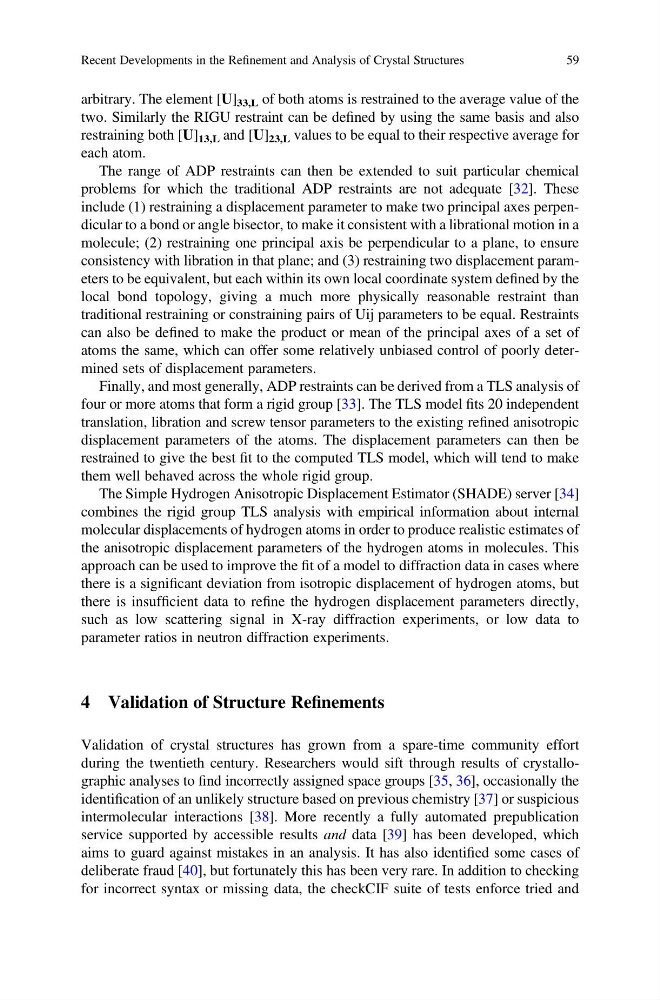
arbitrary. The element [U] 33,L of both atoms is restrained to the average value of the
two. Similarly the RIGU restraint can be defined by using the same basis and also
restraining both [U] 13,L and [U] 23,L values to be equal to their respective average for
each atom.
The range of ADP restraints can then be extended to suit particular chemical
problems for which the traditional ADP restraints are not adequate [32]. These
include (1) restraining a displacement parameter to make two principal axes perpendicular to a bond or angle bisector, to make it consistent with a librational motion in a
molecule; (2) restraining one principal axis be perpendicular to a plane, to ensure
consistency with libration in that plane; and (3) restraining two displacement parameters to be equivalent, but each within its own local coordinate system defined by the
local bond topology, giving a much more physically reasonable restraint than
traditional restraining or constraining pairs of Uij parameters to be equal. Restraints
can also be defined to make the product or mean of the principal axes of a set of
atoms the same, which can offer some relatively unbiased control of poorly determined sets of displacement parameters.
Finally, and most generally, ADP restraints can be derived from a TLS analysis of
four or more atoms that form a rigid group [33]. The TLS model fits 20 independent
translation, libration and screw tensor parameters to the existing refined anisotropic
displacement parameters of the atoms. The displacement parameters can then be
restrained to give the best fit to the computed TLS model, which will tend to make
them well behaved across the whole rigid group.
The Simple Hydrogen Anisotropic Displacement Estimator (SHADE) server [34]
combines the rigid group TLS analysis with empirical information about internal
molecular displacements of hydrogen atoms in order to produce realistic estimates of
the anisotropic displacement parameters of the hydrogen atoms in molecules. This
approach can be used to improve the fit of a model to diffraction data in cases where
there is a significant deviation from isotropic displacement of hydrogen atoms, but
there is insufficient data to refine the hydrogen displacement parameters directly,
such as low scattering signal in X-ray diffraction experiments, or low data to
parameter ratios in neutron diffraction experiments.
4 Validation of Structure Refinements
Validation of crystal structures has grown from a spare-time community effort
during the twentieth century. Researchers would sift through results of crystallographic analyses to find incorrectly assigned space groups [35, 36], occasionally the
identification of an unlikely structure based on previous chemistry [37] or suspicious
intermolecular interactions [38]. More recently a fully automated prepublication
service supported by accessible results and data [39] has been developed, which
aims to guard against mistakes in an analysis. It has also identified some cases of
deliberate fraud [40], but fortunately this has been very rare. In addition to checking
for incorrect syntax or missing data, the checkCIF suite of tests enforce tried and
Recent Developments in the Refinement and Analysis of Crystal Structures
59
two. Similarly the RIGU restraint can be defined by using the same basis and also
restraining both [U] 13,L and [U] 23,L values to be equal to their respective average for
each atom.
The range of ADP restraints can then be extended to suit particular chemical
problems for which the traditional ADP restraints are not adequate [32]. These
include (1) restraining a displacement parameter to make two principal axes perpendicular to a bond or angle bisector, to make it consistent with a librational motion in a
molecule; (2) restraining one principal axis be perpendicular to a plane, to ensure
consistency with libration in that plane; and (3) restraining two displacement parameters to be equivalent, but each within its own local coordinate system defined by the
local bond topology, giving a much more physically reasonable restraint than
traditional restraining or constraining pairs of Uij parameters to be equal. Restraints
can also be defined to make the product or mean of the principal axes of a set of
atoms the same, which can offer some relatively unbiased control of poorly determined sets of displacement parameters.
Finally, and most generally, ADP restraints can be derived from a TLS analysis of
four or more atoms that form a rigid group [33]. The TLS model fits 20 independent
translation, libration and screw tensor parameters to the existing refined anisotropic
displacement parameters of the atoms. The displacement parameters can then be
restrained to give the best fit to the computed TLS model, which will tend to make
them well behaved across the whole rigid group.
The Simple Hydrogen Anisotropic Displacement Estimator (SHADE) server [34]
combines the rigid group TLS analysis with empirical information about internal
molecular displacements of hydrogen atoms in order to produce realistic estimates of
the anisotropic displacement parameters of the hydrogen atoms in molecules. This
approach can be used to improve the fit of a model to diffraction data in cases where
there is a significant deviation from isotropic displacement of hydrogen atoms, but
there is insufficient data to refine the hydrogen displacement parameters directly,
such as low scattering signal in X-ray diffraction experiments, or low data to
parameter ratios in neutron diffraction experiments.
4 Validation of Structure Refinements
Validation of crystal structures has grown from a spare-time community effort
during the twentieth century. Researchers would sift through results of crystallographic analyses to find incorrectly assigned space groups [35, 36], occasionally the
identification of an unlikely structure based on previous chemistry [37] or suspicious
intermolecular interactions [38]. More recently a fully automated prepublication
service supported by accessible results and data [39] has been developed, which
aims to guard against mistakes in an analysis. It has also identified some cases of
deliberate fraud [40], but fortunately this has been very rare. In addition to checking
for incorrect syntax or missing data, the checkCIF suite of tests enforce tried and
Recent Developments in the Refinement and Analysis of Crystal Structures
59