

the anisotropic variance-covariance matrix U, which is aligned with crystallographic
reciprocal axes, but has units of Å
2 , into a local Cartesian basis L aligned with local
geometry:
U
½ L ¼ TUT
T
The operation T can be broken down into three sequential operations, T ¼ RAN.
The first is a scaling matrix N, with reciprocal cell lengths on the diagonal – this
converts the crystallographic U matrix into a dimensionless matrix. Second is an
orthogonalization matrix A, which transforms the basis into an arbitrary but welldefined Cartesian coordinate system, and finally a pure rotation matrix R which
relates the arbitrary Cartesian system to a local Cartesian system of interest.
Restraints can be defined which relate the components of [U] L . For example, to
force one of the principal axes of the distribution to align with the X direction in the
local coordinate system, there should be no covariance between the displacements
along the X direction and either of Y or Z directions; thus, [U] 12,L ¼ 0 and [U] 13,
L ¼ 0. The 1,2 and 1,3 elements of the derivative of the [U] L matrix with respect to
each of the crystallographic Uij parameters can be obtained by considering the effect
of the transformation T on the relevant elements of the Uij matrix. This will reveal a
linear combination of the crystallographic parameters that will be restrained to zero.
The relative contributions depend only on the transformation, T.
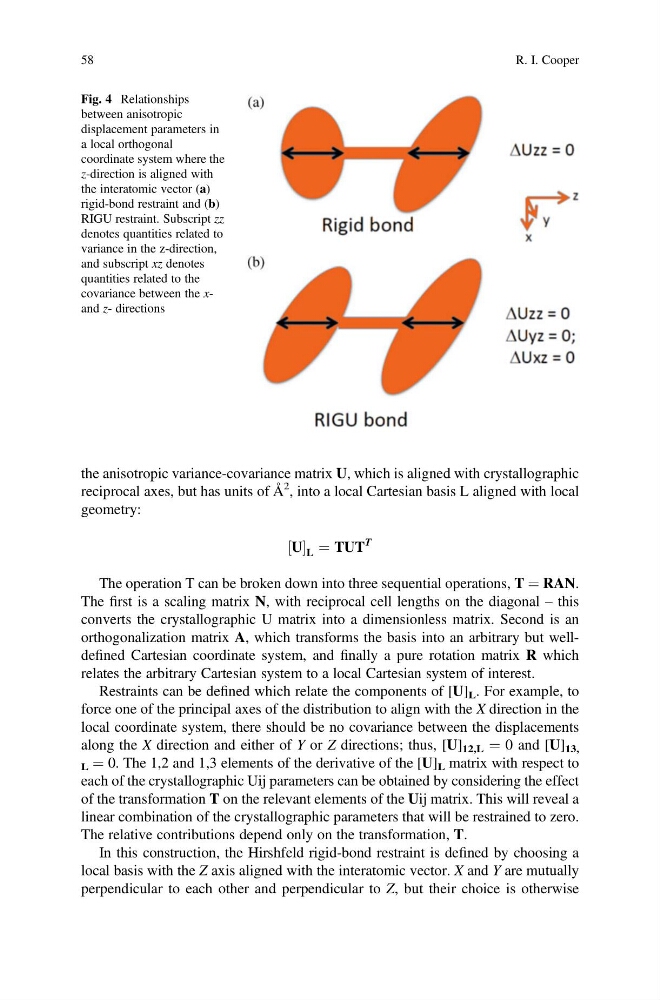
In this construction, the Hirshfeld rigid-bond restraint is defined by choosing a
local basis with the Z axis aligned with the interatomic vector. X and Y are mutually
perpendicular to each other and perpendicular to Z, but their choice is otherwise
Fig. 4 Relationships
between anisotropic
displacement parameters in
a local orthogonal
coordinate system where the
z-direction is aligned with
the interatomic vector (a)
rigid-bond restraint and (b)
RIGU restraint. Subscript zz
denotes quantities related to
variance in the z-direction,
and subscript xz denotes
quantities related to the
covariance between the xand z- directions
58
R. I. Cooper
reciprocal axes, but has units of Å
2 , into a local Cartesian basis L aligned with local
geometry:
U
½ L ¼ TUT
T
The operation T can be broken down into three sequential operations, T ¼ RAN.
The first is a scaling matrix N, with reciprocal cell lengths on the diagonal – this
converts the crystallographic U matrix into a dimensionless matrix. Second is an
orthogonalization matrix A, which transforms the basis into an arbitrary but welldefined Cartesian coordinate system, and finally a pure rotation matrix R which
relates the arbitrary Cartesian system to a local Cartesian system of interest.
Restraints can be defined which relate the components of [U] L . For example, to
force one of the principal axes of the distribution to align with the X direction in the
local coordinate system, there should be no covariance between the displacements
along the X direction and either of Y or Z directions; thus, [U] 12,L ¼ 0 and [U] 13,
L ¼ 0. The 1,2 and 1,3 elements of the derivative of the [U] L matrix with respect to
each of the crystallographic Uij parameters can be obtained by considering the effect
of the transformation T on the relevant elements of the Uij matrix. This will reveal a
linear combination of the crystallographic parameters that will be restrained to zero.
The relative contributions depend only on the transformation, T.
In this construction, the Hirshfeld rigid-bond restraint is defined by choosing a
local basis with the Z axis aligned with the interatomic vector. X and Y are mutually
perpendicular to each other and perpendicular to Z, but their choice is otherwise
Fig. 4 Relationships
between anisotropic
displacement parameters in
a local orthogonal
coordinate system where the
z-direction is aligned with
the interatomic vector (a)
rigid-bond restraint and (b)
RIGU restraint. Subscript zz
denotes quantities related to
variance in the z-direction,
and subscript xz denotes
quantities related to the
covariance between the xand z- directions
58
R. I. Cooper