

The first formal use of the space group classifications was made by Nishigawa in
1915 [49], and Niggli’s “Geometrische Kristallographie des Diskontinuum” was
widely used at this early stage of X-ray crystallography as an introductory guide
[50]. In 1935 International Tables for the Solution of Crystal Structures edited by
Hermann-Mauguin [51] and related publications IUCr proved to be invaluable for
those entering the field. The crystals of common organic compounds provided
arrangements of atoms, and their locations could be defined by X-ray diffraction
which had profound and less easily surmountable problems because they belonged
to primitive and monoclinic space groups, and consequently their diffraction patterns
did not have the high symmetries observed for cubic and hexagonal crystals. The
monoclinic space groups P2 1 /c and C2/c are statistically very prevalent in the
structural chemistry of organic, organometallic and co-ordination chemistry.
The scattering abilities of carbon, hydrogen, oxygen and nitrogen, the common
constituents of organic compounds, mean that they do not diffract as effectively as
the atoms with higher atomic numbers. In addition, since each lattice point was
associated with a molecule rather than an atom, the number of variables required to
solve the structure increased rather rapidly as a function of the number of atoms. The
structures of the first benzene derivatives were not reported until the late 1920s [52]
(see Table 3). These showed that the C–C bonds in the benzene ring were all equal
and shorter than those in diamond confirming Kekulé’s model. The structure of
[NH 4 ] 2 [PtCl 6 ] established the octahedral geometry around platinum, and it provided
the first structural confirmation of Werner’s theory of co-ordination compounds and
encouraged the development of the dative bond notation in such compounds
[53, 54].
5 Basic Physics
The basic physics underlying the scattering of X-rays was developed mainly by
Darwin and Ewald around 1914 [55]. Initially Darwin established the mathematics
associated with scattering by a single atom which was not affected by other
neighbouring atoms and subsequently extended to scattering by successive planes
of atoms which yielded results which Ewald had derived in his dynamic theory of
N
CH 2
N
C
H 2 N
C
H 2
H 2 C
CH 2
CH 2
N
Hexamethylenetetramine
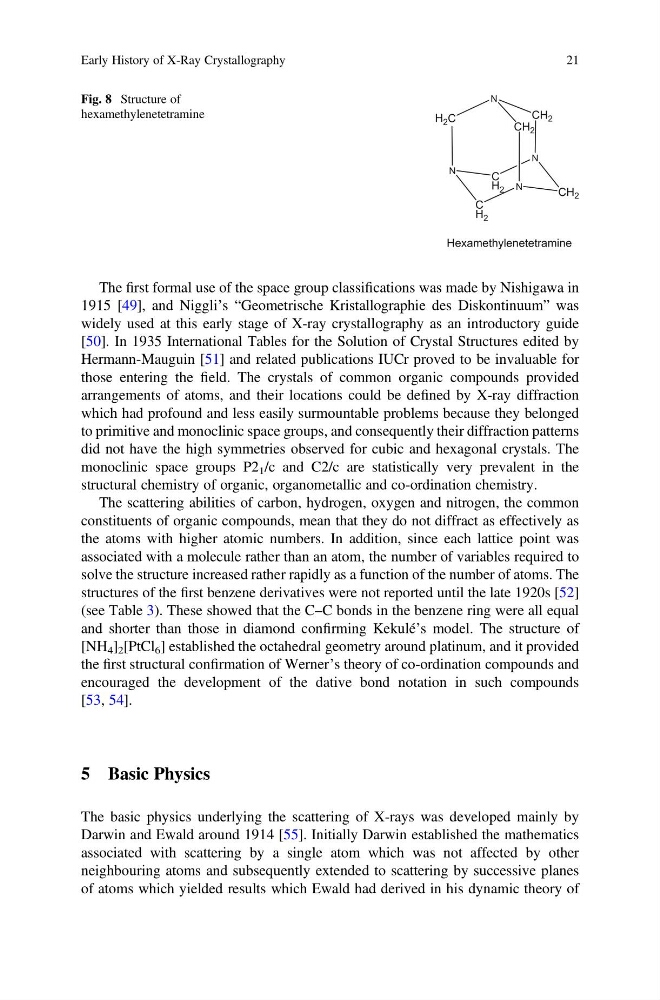
Fig. 8 Structure of
hexamethylenetetramine
Early History of X-Ray Crystallography
21
1915 [49], and Niggli’s “Geometrische Kristallographie des Diskontinuum” was
widely used at this early stage of X-ray crystallography as an introductory guide
[50]. In 1935 International Tables for the Solution of Crystal Structures edited by
Hermann-Mauguin [51] and related publications IUCr proved to be invaluable for
those entering the field. The crystals of common organic compounds provided
arrangements of atoms, and their locations could be defined by X-ray diffraction
which had profound and less easily surmountable problems because they belonged
to primitive and monoclinic space groups, and consequently their diffraction patterns
did not have the high symmetries observed for cubic and hexagonal crystals. The
monoclinic space groups P2 1 /c and C2/c are statistically very prevalent in the
structural chemistry of organic, organometallic and co-ordination chemistry.
The scattering abilities of carbon, hydrogen, oxygen and nitrogen, the common
constituents of organic compounds, mean that they do not diffract as effectively as
the atoms with higher atomic numbers. In addition, since each lattice point was
associated with a molecule rather than an atom, the number of variables required to
solve the structure increased rather rapidly as a function of the number of atoms. The
structures of the first benzene derivatives were not reported until the late 1920s [52]
(see Table 3). These showed that the C–C bonds in the benzene ring were all equal
and shorter than those in diamond confirming Kekulé’s model. The structure of
[NH 4 ] 2 [PtCl 6 ] established the octahedral geometry around platinum, and it provided
the first structural confirmation of Werner’s theory of co-ordination compounds and
encouraged the development of the dative bond notation in such compounds
[53, 54].
5 Basic Physics
The basic physics underlying the scattering of X-rays was developed mainly by
Darwin and Ewald around 1914 [55]. Initially Darwin established the mathematics
associated with scattering by a single atom which was not affected by other
neighbouring atoms and subsequently extended to scattering by successive planes
of atoms which yielded results which Ewald had derived in his dynamic theory of
N
CH 2
N
C
H 2 N
C
H 2
H 2 C
CH 2
CH 2
N
Hexamethylenetetramine
Fig. 8 Structure of
hexamethylenetetramine
Early History of X-Ray Crystallography
21