

recognised, and it has been described as Bragg’s law ever since [19, 20, 23]. Bragg
used the equation to reinterpret Laue’s published results and specifically for zinc
blende, ZnS, which Laue had assumed belonged to a simple cubic lattice. Barlow
and Pope’s previous optical work in developing the valence volume theory had
shown it belonged to a face-centred cubic lattice. Bragg obtained a perfect fit
between the observed and calculated diffraction spots for a face-centred cubic lattice,
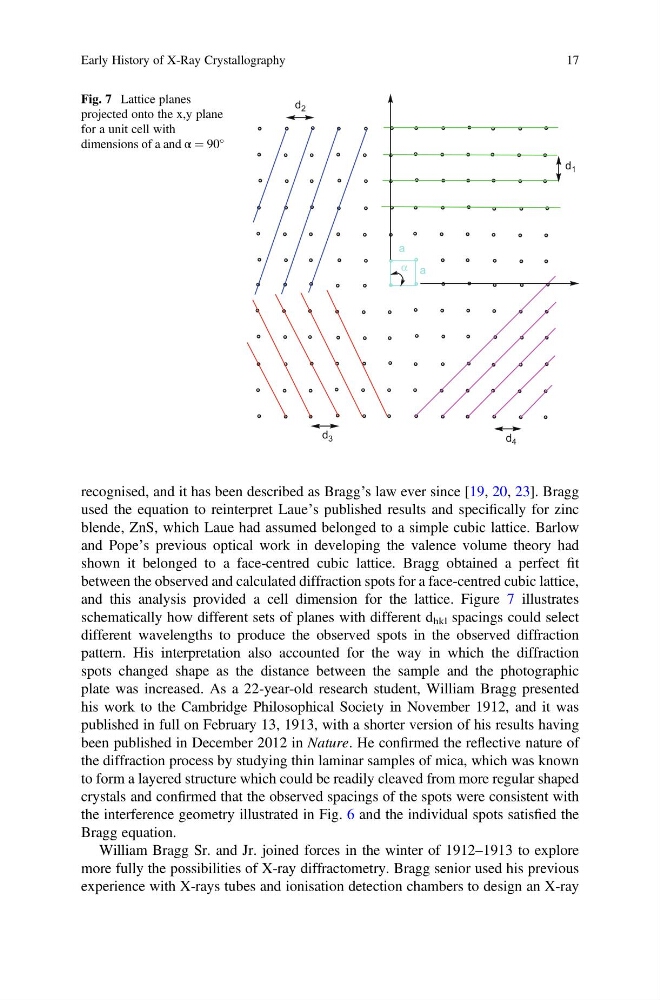
and this analysis provided a cell dimension for the lattice. Figure 7 illustrates
schematically how different sets of planes with different d hkl spacings could select
different wavelengths to produce the observed spots in the observed diffraction
pattern. His interpretation also accounted for the way in which the diffraction
spots changed shape as the distance between the sample and the photographic
plate was increased. As a 22-year-old research student, William Bragg presented
his work to the Cambridge Philosophical Society in November 1912, and it was
published in full on February 13, 1913, with a shorter version of his results having
been published in December 2012 in Nature. He confirmed the reflective nature of
the diffraction process by studying thin laminar samples of mica, which was known
to form a layered structure which could be readily cleaved from more regular shaped
crystals and confirmed that the observed spacings of the spots were consistent with
the interference geometry illustrated in Fig. 6 and the individual spots satisfied the
Bragg equation.
William Bragg Sr. and Jr. joined forces in the winter of 1912–1913 to explore
more fully the possibilities of X-ray diffractometry. Bragg senior used his previous
experience with X-rays tubes and ionisation detection chambers to design an X-ray
d 1
d 2
d 3
d 4
a
a
Fig. 7 Lattice planes
projected onto the x,y plane
for a unit cell with
dimensions of a and α ¼ 90
Early History of X-Ray Crystallography
17
used the equation to reinterpret Laue’s published results and specifically for zinc
blende, ZnS, which Laue had assumed belonged to a simple cubic lattice. Barlow
and Pope’s previous optical work in developing the valence volume theory had
shown it belonged to a face-centred cubic lattice. Bragg obtained a perfect fit
between the observed and calculated diffraction spots for a face-centred cubic lattice,
and this analysis provided a cell dimension for the lattice. Figure 7 illustrates
schematically how different sets of planes with different d hkl spacings could select
different wavelengths to produce the observed spots in the observed diffraction
pattern. His interpretation also accounted for the way in which the diffraction
spots changed shape as the distance between the sample and the photographic
plate was increased. As a 22-year-old research student, William Bragg presented
his work to the Cambridge Philosophical Society in November 1912, and it was
published in full on February 13, 1913, with a shorter version of his results having
been published in December 2012 in Nature. He confirmed the reflective nature of
the diffraction process by studying thin laminar samples of mica, which was known
to form a layered structure which could be readily cleaved from more regular shaped
crystals and confirmed that the observed spacings of the spots were consistent with
the interference geometry illustrated in Fig. 6 and the individual spots satisfied the
Bragg equation.
William Bragg Sr. and Jr. joined forces in the winter of 1912–1913 to explore
more fully the possibilities of X-ray diffractometry. Bragg senior used his previous
experience with X-rays tubes and ionisation detection chambers to design an X-ray
d 1
d 2
d 3
d 4
a
a
Fig. 7 Lattice planes
projected onto the x,y plane
for a unit cell with
dimensions of a and α ¼ 90
Early History of X-Ray Crystallography
17