

essential basic physical and mathematical procedures for accurately and reproducibly solving structures of ever increasing size and complexity.
Bragg Jr.’s undergraduate courses at Cambridge included theoretical and experimental optics given by C.T.R. Wilson [21]. Wilson’s use of amplitude phase
diagrams to illustrate diffraction and interference would prove to be a particularly
important component of Bragg’s breakthrough. He had been made aware that when
white light fell on a diffraction grating, either it can be regarded as composed of all
light of all colours which are sorted out by the grating into a spectrum or it can be
regarded it as a regular pulse from which the grating manufactures a train of waves
which are concentrated by interference effects. Whilst at Cambridge he also become
familiar with the work of Pope and Barlow on the theory of crystal morphologies.
As he started his research project with Professor J.J. Thomson on the theory of
X-rays, he had a flash of inspiration. “As I was walking along the “Backs” by St
John’s College, I had a brainwave. X-ray diffraction could be considered in the same
way as the diffraction of light by a diffraction grating, with the sheets of atoms
playing the roles of the lines of a grating. As Authier has noted in his excellent book,
Early Days of X-ray Crystallography [21], Bragg repeated Laue’s calculation of the
indices h 1 , h 2 , and h 3 of the spots on the published photograph using five different
wavelengths for the X-rays, but he found that there were other sets of three integers
which satisfied the interference requirement. Since this direction proved to be
fruitless, he made the alternative assumption that the incident beam was composed
of a wide range of wavelengths. If a pulse forms on a number of particles distributed
over a plane, these particles act as centres of disturbance, and the secondary waves
from them build up a wavefront, as if part of the pulse had been reflected from the
plane as in Huygens’ construction. Even if a minute part of the energy of a pulse is
reflected by each plane in succession, this could lead to a significant interference
maximum, because of the large number of parallel planes within the crystal [38–
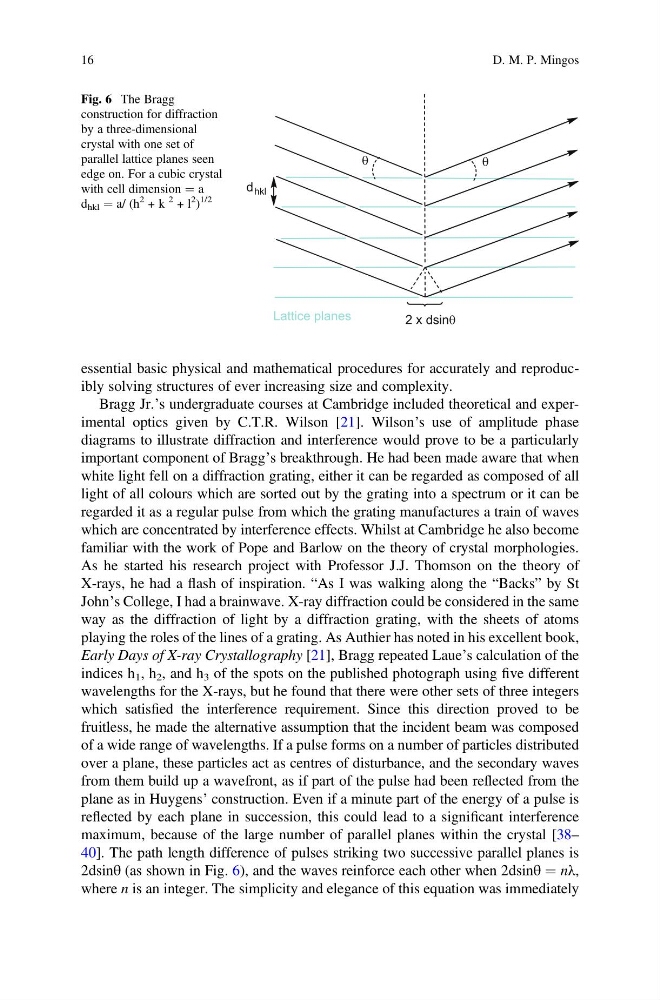
40]. The path length difference of pulses striking two successive parallel planes is
2dsinθ (as shown in Fig. 6), and the waves reinforce each other when 2dsinθ ¼ nλ,
where n is an integer. The simplicity and elegance of this equation was immediately
d hkl
2 x dsin
Lattice planes
Fig. 6 The Bragg
construction for diffraction
by a three-dimensional
crystal with one set of
parallel lattice planes seen
edge on. For a cubic crystal
with cell dimension ¼ a
d hkl ¼ a/ (h
2 + k
2 + l
2
)
1/2
16
D. M. P. Mingos
Bragg Jr.’s undergraduate courses at Cambridge included theoretical and experimental optics given by C.T.R. Wilson [21]. Wilson’s use of amplitude phase
diagrams to illustrate diffraction and interference would prove to be a particularly
important component of Bragg’s breakthrough. He had been made aware that when
white light fell on a diffraction grating, either it can be regarded as composed of all
light of all colours which are sorted out by the grating into a spectrum or it can be
regarded it as a regular pulse from which the grating manufactures a train of waves
which are concentrated by interference effects. Whilst at Cambridge he also become
familiar with the work of Pope and Barlow on the theory of crystal morphologies.
As he started his research project with Professor J.J. Thomson on the theory of
X-rays, he had a flash of inspiration. “As I was walking along the “Backs” by St
John’s College, I had a brainwave. X-ray diffraction could be considered in the same
way as the diffraction of light by a diffraction grating, with the sheets of atoms
playing the roles of the lines of a grating. As Authier has noted in his excellent book,
Early Days of X-ray Crystallography [21], Bragg repeated Laue’s calculation of the
indices h 1 , h 2 , and h 3 of the spots on the published photograph using five different
wavelengths for the X-rays, but he found that there were other sets of three integers
which satisfied the interference requirement. Since this direction proved to be
fruitless, he made the alternative assumption that the incident beam was composed
of a wide range of wavelengths. If a pulse forms on a number of particles distributed
over a plane, these particles act as centres of disturbance, and the secondary waves
from them build up a wavefront, as if part of the pulse had been reflected from the
plane as in Huygens’ construction. Even if a minute part of the energy of a pulse is
reflected by each plane in succession, this could lead to a significant interference
maximum, because of the large number of parallel planes within the crystal [38–
40]. The path length difference of pulses striking two successive parallel planes is
2dsinθ (as shown in Fig. 6), and the waves reinforce each other when 2dsinθ ¼ nλ,
where n is an integer. The simplicity and elegance of this equation was immediately
d hkl
2 x dsin
Lattice planes
Fig. 6 The Bragg
construction for diffraction
by a three-dimensional
crystal with one set of
parallel lattice planes seen
edge on. For a cubic crystal
with cell dimension ¼ a
d hkl ¼ a/ (h
2 + k
2 + l
2
)
1/2
16
D. M. P. Mingos