

different responses were to be expected resulting from the interaction of the
photoactive species with the surrounding lattice, with far greater distortions
predicted in the free molecule than those observed experimentally in the solid
state. For both this and the study on [Rh 2 (μ-PNP) 2 (PNP) 2 ][BPh 4 ], the experimental
standard deviations for data collected by the Laue method are much improved
compared to those seen with monochromatic time-resolved techniques. These
improvements highlight the greater accuracy of time-resolved diffraction data collected by Laue methods for short lifetime species, which is mainly attributed to
reduced levels of laser heating when adopting the single-shot approach [133].
The use of pink-beam Laue diffraction has also been applied to the time-resolved
photocrystallographic study of mixed metal polynuclear complexes. The triplet excited
state of the tetranuclear d
10
-d
10 complex Ag 2 Cu 2 L 4 (L ¼ 2-diphenylphosphino-3methylindole) has been investigated with a Laue pump-probe technique with an
80 ps time resolution at 90 K [134]. The lifetime of 1 μs is accompanied by significant
changes in the metal framework, with an Ag. . .Cu distance shortening by 0.59(3) Å,
which suggests an increase in the argentophilic interactions (Fig. 10). The
photocrystallographic study was accompanied by theoretical calculations which confirm that the strengthening of the Ag. . .Ag interaction is caused by ligand-to-metal
charge transfer (LMCT).
Most recently, the luminescent properties of a tetranuclear Cu(I) benzoate
complex have been investigated by a combination of time-resolved spectroscopy
and crystallography. The complex [Cu 4 (PhCO 2 ) 4 ] displays luminescent thermochromism, with red phosphorescence at room temperature that turns green on
lowering the temperature to 90 K [135]. The low-energy triplet state has been
assigned to a cluster-centred triplet state, and the emission from this state matches
the experimental red band observed at 660–715 nm. The computed next highest
triplet excited state occurs close to the experimental value at 545 nm. The two
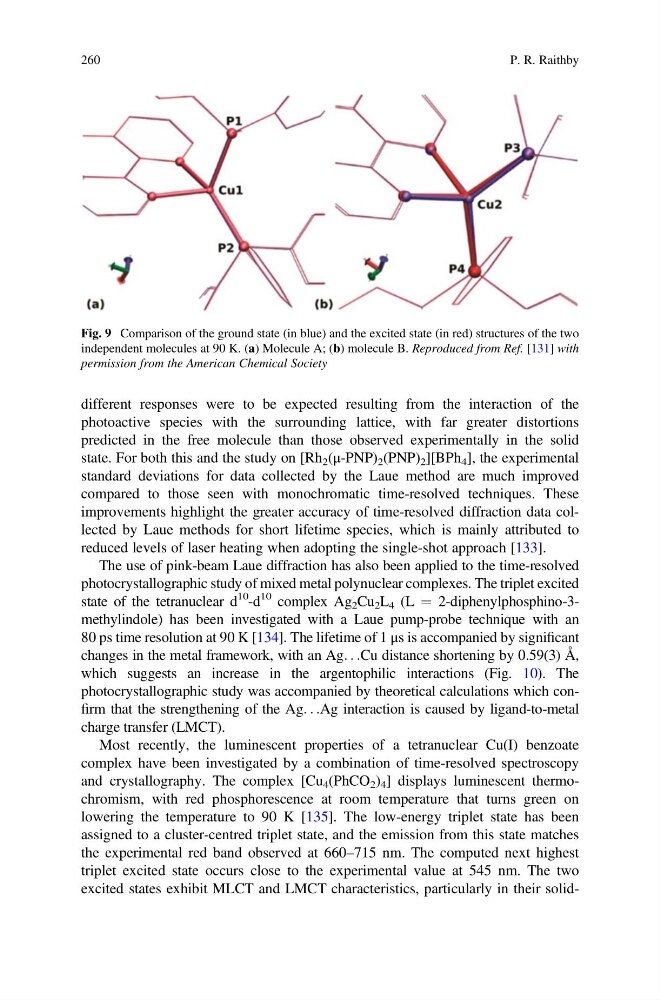
excited states exhibit MLCT and LMCT characteristics, particularly in their solidFig. 9 Comparison of the ground state (in blue) and the excited state (in red) structures of the two
independent molecules at 90 K. (a) Molecule A; (b) molecule B. Reproduced from Ref. [131] with
permission from the American Chemical Society
260
P. R. Raithby
photoactive species with the surrounding lattice, with far greater distortions
predicted in the free molecule than those observed experimentally in the solid
state. For both this and the study on [Rh 2 (μ-PNP) 2 (PNP) 2 ][BPh 4 ], the experimental
standard deviations for data collected by the Laue method are much improved
compared to those seen with monochromatic time-resolved techniques. These
improvements highlight the greater accuracy of time-resolved diffraction data collected by Laue methods for short lifetime species, which is mainly attributed to
reduced levels of laser heating when adopting the single-shot approach [133].
The use of pink-beam Laue diffraction has also been applied to the time-resolved
photocrystallographic study of mixed metal polynuclear complexes. The triplet excited
state of the tetranuclear d
10
-d
10 complex Ag 2 Cu 2 L 4 (L ¼ 2-diphenylphosphino-3methylindole) has been investigated with a Laue pump-probe technique with an
80 ps time resolution at 90 K [134]. The lifetime of 1 μs is accompanied by significant
changes in the metal framework, with an Ag. . .Cu distance shortening by 0.59(3) Å,
which suggests an increase in the argentophilic interactions (Fig. 10). The
photocrystallographic study was accompanied by theoretical calculations which confirm that the strengthening of the Ag. . .Ag interaction is caused by ligand-to-metal
charge transfer (LMCT).
Most recently, the luminescent properties of a tetranuclear Cu(I) benzoate
complex have been investigated by a combination of time-resolved spectroscopy
and crystallography. The complex [Cu 4 (PhCO 2 ) 4 ] displays luminescent thermochromism, with red phosphorescence at room temperature that turns green on
lowering the temperature to 90 K [135]. The low-energy triplet state has been
assigned to a cluster-centred triplet state, and the emission from this state matches
the experimental red band observed at 660–715 nm. The computed next highest
triplet excited state occurs close to the experimental value at 545 nm. The two
excited states exhibit MLCT and LMCT characteristics, particularly in their solidFig. 9 Comparison of the ground state (in blue) and the excited state (in red) structures of the two
independent molecules at 90 K. (a) Molecule A; (b) molecule B. Reproduced from Ref. [131] with
permission from the American Chemical Society
260
P. R. Raithby