

complexes have been embedded as guests into arrays and framework materials. It is
of importance that the host frameworks should be inert to photoactivation but
effectively dilute the concentration of the photoactive species in the material. The
host-guest arrangement has significant advantages for promoting the retention of
crystal integrity during the process and provides greater freedom for the guest to
rearrange without resulting in steric clashes with adjacent molecules in the pure
material. Additionally, the dilution of the photoactive species reduces the number of
photons that are required to maximise excitation, leading to more efficient
photoactivation and, hopefully, increased conversion percentages [119]. It should
also be noted that this approach has the effect of isolating the photoactive molecules
from one another, producing quite a different environment to that experienced in
crystals of the guest molecule, so differences in the physical properties of the pure
compound and of the host-guest complex should be expected. Coppens et al. have
investigated a number of species by this approach, via both static and dynamic
photocrystallographic techniques [94, 119–121].
There have been a number of other studies using “crystal engineering” techniques
involving the use of molecular cages and flasks [122] and metal organic frameworks
(MOFs) to trap transient and highly reactive species [123]. Kawano et al. used
synchrotron X-ray radiation to identify the coordinatively unsaturated “η
5 -
(C 5 H 4 Me)Mn(CO) 2 ” moiety in a designed self-assembled coordination cage
[124]. Photoirradiation of a [η
5 -(C 5 H 4 Me)Mn(CO) 3 ] guest molecule, within a single
crystal, at 100 K, using 365 nm light, resulted in the dissociation of a carbonyl ligand
remarkably without loss of crystallinity, and peaks in the electron density difference
map could be attributed to free carbon monoxide. The crystallographic results were
supported by a solid-state IR study. The same group has subsequently gone on to
identify an unstable imine [125] and a transient hemiaminal [126], both trapped in
pre-designed porous networks. They have also demonstrated the suppression of
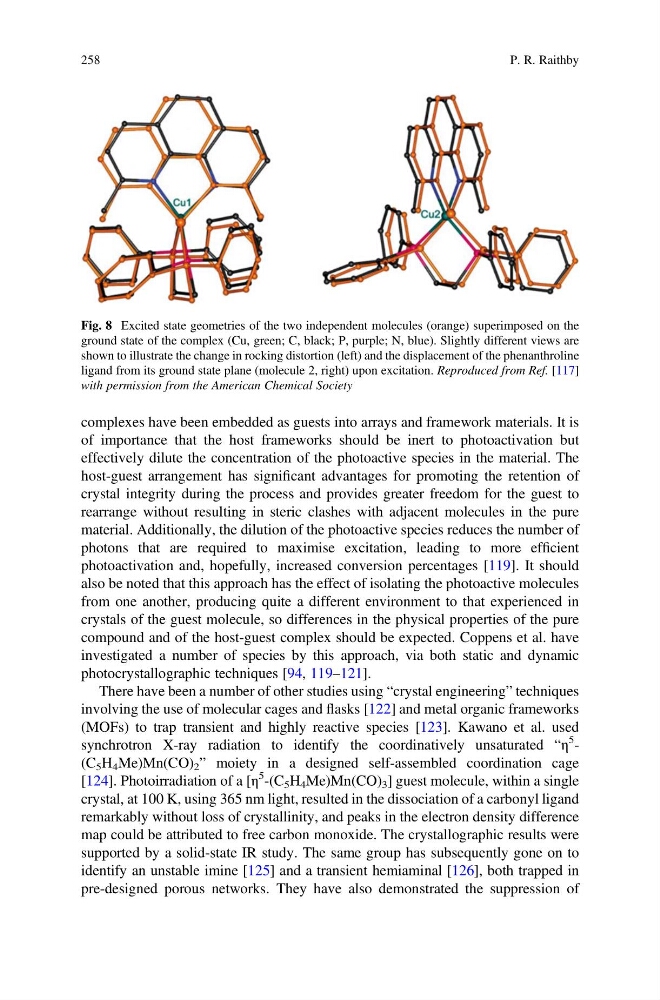
Fig. 8 Excited state geometries of the two independent molecules (orange) superimposed on the
ground state of the complex (Cu, green; C, black; P, purple; N, blue). Slightly different views are
shown to illustrate the change in rocking distortion (left) and the displacement of the phenanthroline
ligand from its ground state plane (molecule 2, right) upon excitation. Reproduced from Ref. [117]
with permission from the American Chemical Society
258
P. R. Raithby
of importance that the host frameworks should be inert to photoactivation but
effectively dilute the concentration of the photoactive species in the material. The
host-guest arrangement has significant advantages for promoting the retention of
crystal integrity during the process and provides greater freedom for the guest to
rearrange without resulting in steric clashes with adjacent molecules in the pure
material. Additionally, the dilution of the photoactive species reduces the number of
photons that are required to maximise excitation, leading to more efficient
photoactivation and, hopefully, increased conversion percentages [119]. It should
also be noted that this approach has the effect of isolating the photoactive molecules
from one another, producing quite a different environment to that experienced in
crystals of the guest molecule, so differences in the physical properties of the pure
compound and of the host-guest complex should be expected. Coppens et al. have
investigated a number of species by this approach, via both static and dynamic
photocrystallographic techniques [94, 119–121].
There have been a number of other studies using “crystal engineering” techniques
involving the use of molecular cages and flasks [122] and metal organic frameworks
(MOFs) to trap transient and highly reactive species [123]. Kawano et al. used
synchrotron X-ray radiation to identify the coordinatively unsaturated “η
5 -
(C 5 H 4 Me)Mn(CO) 2 ” moiety in a designed self-assembled coordination cage
[124]. Photoirradiation of a [η
5 -(C 5 H 4 Me)Mn(CO) 3 ] guest molecule, within a single
crystal, at 100 K, using 365 nm light, resulted in the dissociation of a carbonyl ligand
remarkably without loss of crystallinity, and peaks in the electron density difference
map could be attributed to free carbon monoxide. The crystallographic results were
supported by a solid-state IR study. The same group has subsequently gone on to
identify an unstable imine [125] and a transient hemiaminal [126], both trapped in
pre-designed porous networks. They have also demonstrated the suppression of
Fig. 8 Excited state geometries of the two independent molecules (orange) superimposed on the
ground state of the complex (Cu, green; C, black; P, purple; N, blue). Slightly different views are
shown to illustrate the change in rocking distortion (left) and the displacement of the phenanthroline
ligand from its ground state plane (molecule 2, right) upon excitation. Reproduced from Ref. [117]
with permission from the American Chemical Society
258
P. R. Raithby