

upon photoactivation at 23 K using 335 nm laser pulses. The maximum level of
excitation reached was 2.5%, and the Rh–Rh bond length reduction was a remarkable
0.86 Å and a bond rotation of ca. 13
[82]. Previous spectroscopic studies on the cation
had indicated a lifetime of ca. 11 μs for the triplet excited state species [115] which is
in excellent agreement with the experimental value of 11.7 μs at 23 K. DFT calculations conducted at the same time as the photocrystallography experiment proposed a
slightly greater decrease in the Rh–Rh distance upon excitation as illustrated in Fig. 7.
The difference between the experimental and theoretical results may indicate that the
steric effects from the crystalline environment may modify the structural response to
the excitation process.
Further photocrystallographic studies employing stroboscopic methods were
reported by Coppens et al. including an investigation of photoinduced structural
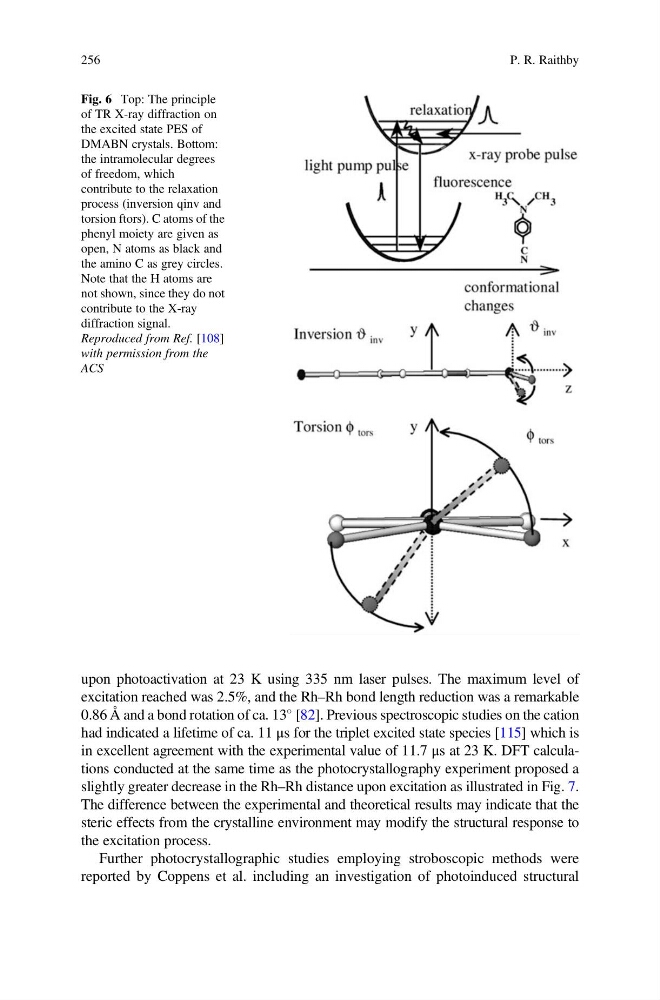
Fig. 6 Top: The principle
of TR X-ray diffraction on
the excited state PES of
DMABN crystals. Bottom:
the intramolecular degrees
of freedom, which
contribute to the relaxation
process (inversion qinv and
torsion ftors). C atoms of the
phenyl moiety are given as
open, N atoms as black and
the amino C as grey circles.
Note that the H atoms are
not shown, since they do not
contribute to the X-ray
diffraction signal.
Reproduced from Ref. [108]
with permission from the
ACS
256
P. R. Raithby
excitation reached was 2.5%, and the Rh–Rh bond length reduction was a remarkable
0.86 Å and a bond rotation of ca. 13
[82]. Previous spectroscopic studies on the cation
had indicated a lifetime of ca. 11 μs for the triplet excited state species [115] which is
in excellent agreement with the experimental value of 11.7 μs at 23 K. DFT calculations conducted at the same time as the photocrystallography experiment proposed a
slightly greater decrease in the Rh–Rh distance upon excitation as illustrated in Fig. 7.
The difference between the experimental and theoretical results may indicate that the
steric effects from the crystalline environment may modify the structural response to
the excitation process.
Further photocrystallographic studies employing stroboscopic methods were
reported by Coppens et al. including an investigation of photoinduced structural
Fig. 6 Top: The principle
of TR X-ray diffraction on
the excited state PES of
DMABN crystals. Bottom:
the intramolecular degrees
of freedom, which
contribute to the relaxation
process (inversion qinv and
torsion ftors). C atoms of the
phenyl moiety are given as
open, N atoms as black and
the amino C as grey circles.
Note that the H atoms are
not shown, since they do not
contribute to the X-ray
diffraction signal.
Reproduced from Ref. [108]
with permission from the
ACS
256
P. R. Raithby