

crystalline sample is irradiated throughout the data collection to maintain a constant
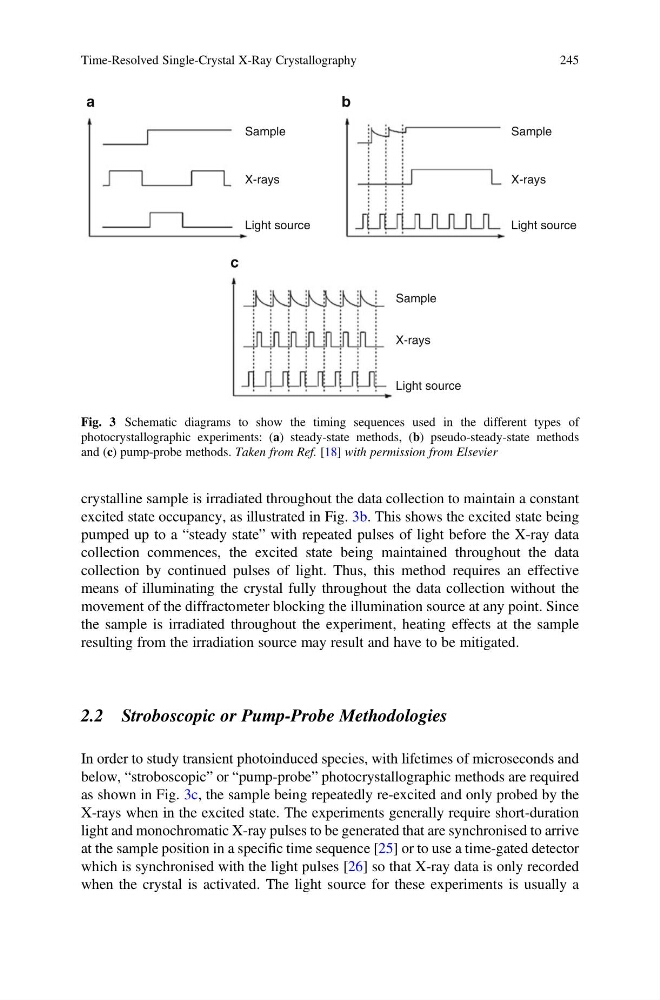
excited state occupancy, as illustrated in Fig. 3b. This shows the excited state being
pumped up to a “steady state” with repeated pulses of light before the X-ray data
collection commences, the excited state being maintained throughout the data
collection by continued pulses of light. Thus, this method requires an effective
means of illuminating the crystal fully throughout the data collection without the
movement of the diffractometer blocking the illumination source at any point. Since
the sample is irradiated throughout the experiment, heating effects at the sample
resulting from the irradiation source may result and have to be mitigated.
2.2 Stroboscopic or Pump-Probe Methodologies
In order to study transient photoinduced species, with lifetimes of microseconds and
below, “stroboscopic” or “pump-probe” photocrystallographic methods are required
as shown in Fig. 3c, the sample being repeatedly re-excited and only probed by the
X-rays when in the excited state. The experiments generally require short-duration
light and monochromatic X-ray pulses to be generated that are synchronised to arrive
at the sample position in a specific time sequence [25] or to use a time-gated detector
which is synchronised with the light pulses [26] so that X-ray data is only recorded
when the crystal is activated. The light source for these experiments is usually a
Sample
X-rays
Light source
a
Sample
X-rays
Light source
b
Sample
X-rays
Light source
c
Fig. 3 Schematic diagrams to show the timing sequences used in the different types of
photocrystallographic experiments: (a) steady-state methods, (b) pseudo-steady-state methods
and (c) pump-probe methods. Taken from Ref. [18] with permission from Elsevier
Time-Resolved Single-Crystal X-Ray Crystallography
245
excited state occupancy, as illustrated in Fig. 3b. This shows the excited state being
pumped up to a “steady state” with repeated pulses of light before the X-ray data
collection commences, the excited state being maintained throughout the data
collection by continued pulses of light. Thus, this method requires an effective
means of illuminating the crystal fully throughout the data collection without the
movement of the diffractometer blocking the illumination source at any point. Since
the sample is irradiated throughout the experiment, heating effects at the sample
resulting from the irradiation source may result and have to be mitigated.
2.2 Stroboscopic or Pump-Probe Methodologies
In order to study transient photoinduced species, with lifetimes of microseconds and
below, “stroboscopic” or “pump-probe” photocrystallographic methods are required
as shown in Fig. 3c, the sample being repeatedly re-excited and only probed by the
X-rays when in the excited state. The experiments generally require short-duration
light and monochromatic X-ray pulses to be generated that are synchronised to arrive
at the sample position in a specific time sequence [25] or to use a time-gated detector
which is synchronised with the light pulses [26] so that X-ray data is only recorded
when the crystal is activated. The light source for these experiments is usually a
Sample
X-rays
Light source
a
Sample
X-rays
Light source
b
Sample
X-rays
Light source
c
Fig. 3 Schematic diagrams to show the timing sequences used in the different types of
photocrystallographic experiments: (a) steady-state methods, (b) pseudo-steady-state methods
and (c) pump-probe methods. Taken from Ref. [18] with permission from Elsevier
Time-Resolved Single-Crystal X-Ray Crystallography
245