

exp Àk t 1=2
À Á n
Â
à ¼ 0:5 ! t 1=2 ¼ À
1
k
ln 0:5
h
i 1
n
ð8Þ
In the case of n ¼ 1, t 1/2 can be equated to the kinetic half-life, meaning that a
population α at a time t will fall to α/2 at t ¼ t + t 1/2 , α/4 at t ¼ t + 2t 1/2 , etc. t 1/2 thus
provides a useful quantitative measure of the excited-state lifetime. Its temperature
dependence can be expressed in terms of the Arrhenius parameters A and E A by
substituting for the rate constant k as follows:
t 1=2 T
ð Þ ¼ À ln 0:5 Â
1
A
 exp
E A
RT
h
i 1
n
ð9Þ
This expression makes three important points concerning the excited-state lifetime:
(1) the lifetime increases with the activation energy; (2) the lifetime decreases with
the attempt frequency; and (3) the lifetime decreases as the inverse power of the
JMAK exponent n. The first two points are straightforwardly understood from the
Arrhenius model. The third point may not be as immediately intuitive, but indicates
that any cooperativity in the decay process should be expected to decrease the
excited-state lifetime.
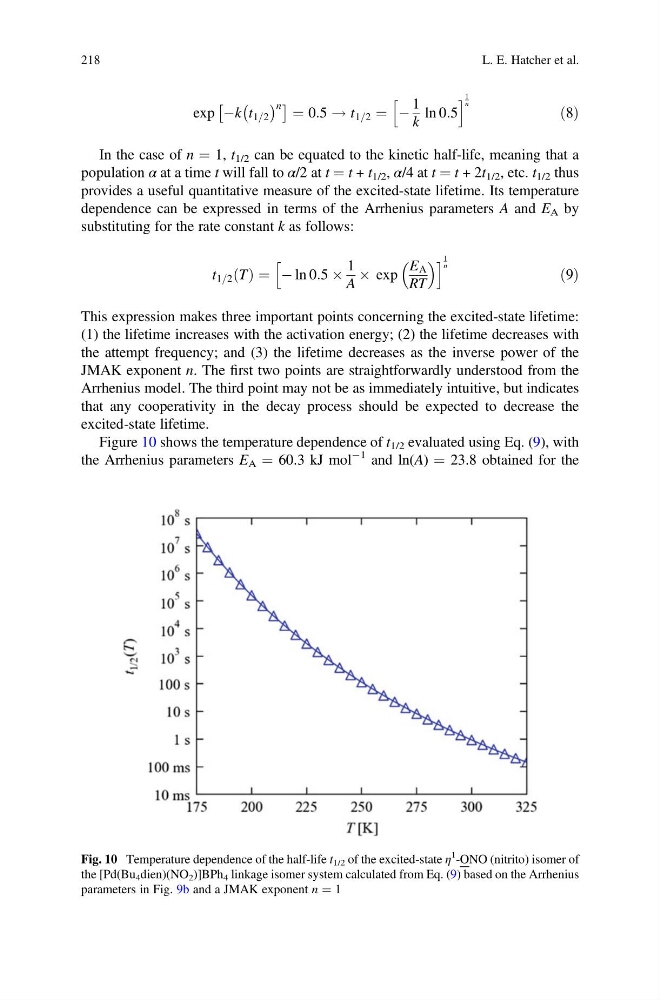
Figure 10 shows the temperature dependence of t 1/2 evaluated using Eq. (9), with
the Arrhenius parameters E A ¼ 60.3 kJ mol
À1 and ln(A) ¼ 23.8 obtained for the
Fig. 10 Temperature dependence of the half-life t 1/2 of the excited-state η
1
-ONO (nitrito) isomer of
the [Pd(Bu 4 dien)(NO 2 )]BPh 4 linkage isomer system calculated from Eq. (9) based on the Arrhenius
parameters in Fig. 9b and a JMAK exponent n ¼ 1
218
L. E. Hatcher et al.
À Á n
Â
à ¼ 0:5 ! t 1=2 ¼ À
1
k
ln 0:5
h
i 1
n
ð8Þ
In the case of n ¼ 1, t 1/2 can be equated to the kinetic half-life, meaning that a
population α at a time t will fall to α/2 at t ¼ t + t 1/2 , α/4 at t ¼ t + 2t 1/2 , etc. t 1/2 thus
provides a useful quantitative measure of the excited-state lifetime. Its temperature
dependence can be expressed in terms of the Arrhenius parameters A and E A by
substituting for the rate constant k as follows:
t 1=2 T
ð Þ ¼ À ln 0:5 Â
1
A
 exp
E A
RT
h
i 1
n
ð9Þ
This expression makes three important points concerning the excited-state lifetime:
(1) the lifetime increases with the activation energy; (2) the lifetime decreases with
the attempt frequency; and (3) the lifetime decreases as the inverse power of the
JMAK exponent n. The first two points are straightforwardly understood from the
Arrhenius model. The third point may not be as immediately intuitive, but indicates
that any cooperativity in the decay process should be expected to decrease the
excited-state lifetime.
Figure 10 shows the temperature dependence of t 1/2 evaluated using Eq. (9), with
the Arrhenius parameters E A ¼ 60.3 kJ mol
À1 and ln(A) ¼ 23.8 obtained for the
Fig. 10 Temperature dependence of the half-life t 1/2 of the excited-state η
1
-ONO (nitrito) isomer of
the [Pd(Bu 4 dien)(NO 2 )]BPh 4 linkage isomer system calculated from Eq. (9) based on the Arrhenius
parameters in Fig. 9b and a JMAK exponent n ¼ 1
218
L. E. Hatcher et al.