

22
2 A Little Bit of Quantum Mechanics
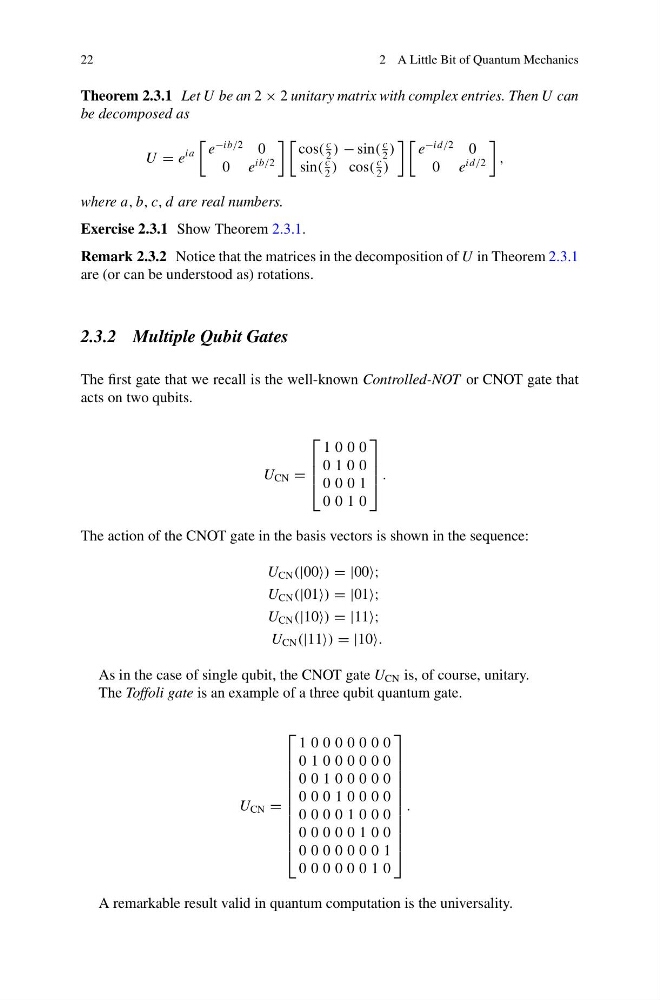
Theorem 2.3.1 Let U be an 2 × 2 unitary matrix with complex entries. Then U can
be decomposed as
U = e
ia
e
−ib/2 0
0 e
ib/2
cos(
c
2
) − sin(
c
2
)
sin(
c
2
) cos(
c
2
)
e
−id/2 0
0 e
id/2
,
where a, b, c, d are real numbers.
Exercise 2.3.1 Show Theorem 2.3.1.
Remark 2.3.2 Notice that the matrices in the decomposition of U in Theorem 2.3.1
are (or can be understood as) rotations.
2.3.2 Multiple Qubit Gates
The first gate that we recall is the well-known Controlled-NOT or CNOT gate that
acts on two qubits.
U CN =
⎡
⎢
⎢
⎣
1 0 0 0
0 1 0 0
0 0 0 1
0 0 1 0
⎤
⎥
⎥
⎦ .
The action of the CNOT gate in the basis vectors is shown in the sequence:
U CN (|00) = |00;
U CN (|01) = |01;
U CN (|10) = |11;
U CN (|11) = |10.
As in the case of single qubit, the CNOT gate U CN is, of course, unitary.
The Toffoli gate is an example of a three qubit quantum gate.
U CN =
⎡
⎢
⎢
⎢
⎢
⎢
⎢
⎢
⎢
⎢
⎢
⎣
1 0 0 0 0 0 0 0
0 1 0 0 0 0 0 0
0 0 1 0 0 0 0 0
0 0 0 1 0 0 0 0
0 0 0 0 1 0 0 0
0 0 0 0 0 1 0 0
0 0 0 0 0 0 0 1
0 0 0 0 0 0 1 0
⎤
⎥
⎥
⎥
⎥
⎥
⎥
⎥
⎥
⎥
⎥
⎦
.
A remarkable result valid in quantum computation is the universality.
2 A Little Bit of Quantum Mechanics
Theorem 2.3.1 Let U be an 2 × 2 unitary matrix with complex entries. Then U can
be decomposed as
U = e
ia
e
−ib/2 0
0 e
ib/2
cos(
c
2
) − sin(
c
2
)
sin(
c
2
) cos(
c
2
)
e
−id/2 0
0 e
id/2
,
where a, b, c, d are real numbers.
Exercise 2.3.1 Show Theorem 2.3.1.
Remark 2.3.2 Notice that the matrices in the decomposition of U in Theorem 2.3.1
are (or can be understood as) rotations.
2.3.2 Multiple Qubit Gates
The first gate that we recall is the well-known Controlled-NOT or CNOT gate that
acts on two qubits.
U CN =
⎡
⎢
⎢
⎣
1 0 0 0
0 1 0 0
0 0 0 1
0 0 1 0
⎤
⎥
⎥
⎦ .
The action of the CNOT gate in the basis vectors is shown in the sequence:
U CN (|00) = |00;
U CN (|01) = |01;
U CN (|10) = |11;
U CN (|11) = |10.
As in the case of single qubit, the CNOT gate U CN is, of course, unitary.
The Toffoli gate is an example of a three qubit quantum gate.
U CN =
⎡
⎢
⎢
⎢
⎢
⎢
⎢
⎢
⎢
⎢
⎢
⎣
1 0 0 0 0 0 0 0
0 1 0 0 0 0 0 0
0 0 1 0 0 0 0 0
0 0 0 1 0 0 0 0
0 0 0 0 1 0 0 0
0 0 0 0 0 1 0 0
0 0 0 0 0 0 0 1
0 0 0 0 0 0 1 0
⎤
⎥
⎥
⎥
⎥
⎥
⎥
⎥
⎥
⎥
⎥
⎦
.
A remarkable result valid in quantum computation is the universality.