

2.3 Universal Quantum Gates
21
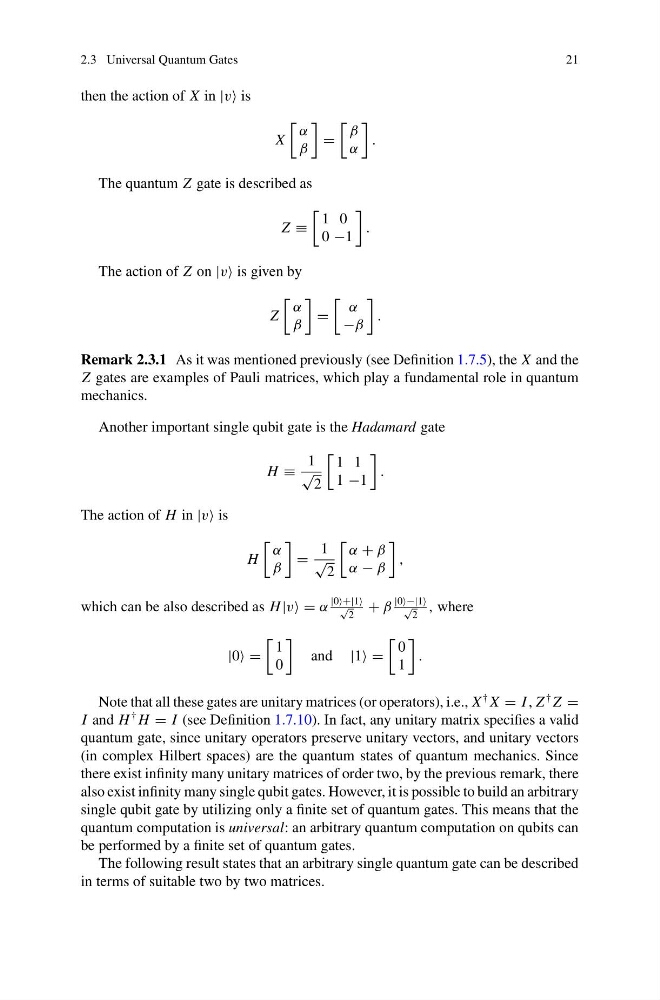
then the action of X in |v is
X
α
β
=
β
α
.
The quantum Z gate is described as
Z ≡
1 0
0 −1
.
The action of Z on |v is given by
Z
α
β
=
α
−β
.
Remark 2.3.1 As it was mentioned previously (see Definition 1.7.5), the X and the
Z gates are examples of Pauli matrices, which play a fundamental role in quantum
mechanics.
Another important single qubit gate is the Hadamard gate
H ≡
1
√
2
1 1
1 −1
.
The action of H in |v is
H
α
β
=
1
√
2
α + β
α − β
,
which can be also described as H |v = α
|0+|1 √
2
+ β
|0−|1 √
2
, where
|0 =
1
0
and |1 =
0
1
.
Note that all these gates are unitary matrices (or operators), i.e., X
† X = I , Z
† Z =
I and H
† H = I (see Definition 1.7.10). In fact, any unitary matrix specifies a valid
quantum gate, since unitary operators preserve unitary vectors, and unitary vectors
(in complex Hilbert spaces) are the quantum states of quantum mechanics. Since
there exist infinity many unitary matrices of order two, by the previous remark, there
also exist infinity many single qubit gates. However, it is possible to build an arbitrary
single qubit gate by utilizing only a finite set of quantum gates. This means that the
quantum computation is universal: an arbitrary quantum computation on qubits can
be performed by a finite set of quantum gates.
The following result states that an arbitrary single quantum gate can be described
in terms of suitable two by two matrices.
21
then the action of X in |v is
X
α
β
=
β
α
.
The quantum Z gate is described as
Z ≡
1 0
0 −1
.
The action of Z on |v is given by
Z
α
β
=
α
−β
.
Remark 2.3.1 As it was mentioned previously (see Definition 1.7.5), the X and the
Z gates are examples of Pauli matrices, which play a fundamental role in quantum
mechanics.
Another important single qubit gate is the Hadamard gate
H ≡
1
√
2
1 1
1 −1
.
The action of H in |v is
H
α
β
=
1
√
2
α + β
α − β
,
which can be also described as H |v = α
|0+|1 √
2
+ β
|0−|1 √
2
, where
|0 =
1
0
and |1 =
0
1
.
Note that all these gates are unitary matrices (or operators), i.e., X
† X = I , Z
† Z =
I and H
† H = I (see Definition 1.7.10). In fact, any unitary matrix specifies a valid
quantum gate, since unitary operators preserve unitary vectors, and unitary vectors
(in complex Hilbert spaces) are the quantum states of quantum mechanics. Since
there exist infinity many unitary matrices of order two, by the previous remark, there
also exist infinity many single qubit gates. However, it is possible to build an arbitrary
single qubit gate by utilizing only a finite set of quantum gates. This means that the
quantum computation is universal: an arbitrary quantum computation on qubits can
be performed by a finite set of quantum gates.
The following result states that an arbitrary single quantum gate can be described
in terms of suitable two by two matrices.