

7.6 QCCs from AG Codes
197
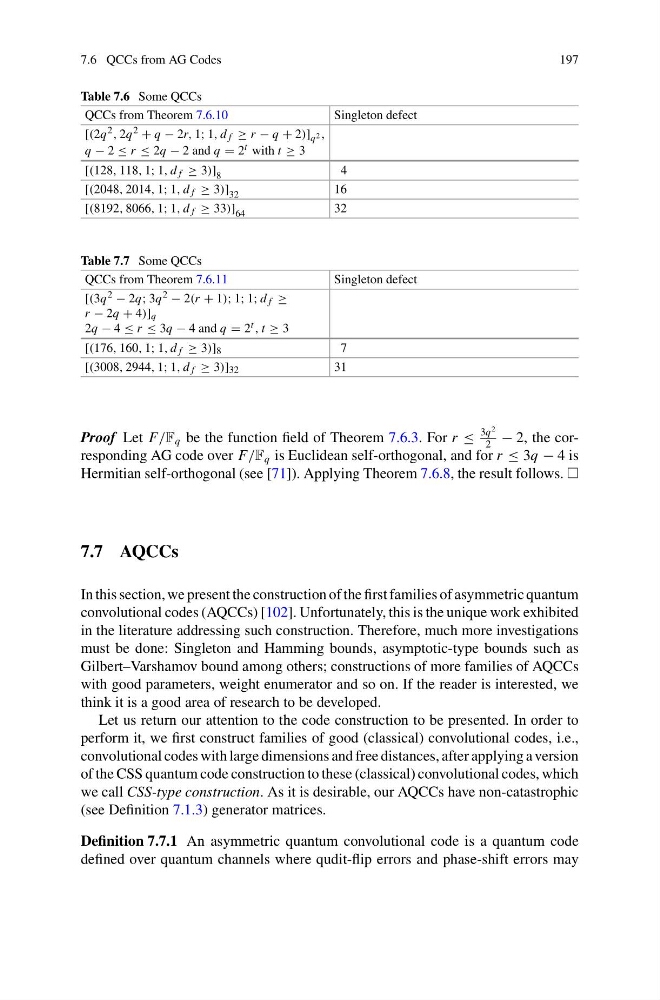
Table 7.6 Some QCCs
QCCs from Theorem 7.6.10
Singleton defect
[(2q 2 , 2q 2 + q − 2r, 1; 1, d f ≥ r − q + 2)] q 2 ,
q − 2 ≤ r ≤ 2q − 2 and q = 2 t with t ≥ 3
[(128, 118, 1; 1, d f ≥ 3)] 8
4
[(2048, 2014, 1; 1, d f ≥ 3)] 32
16
[(8192, 8066, 1; 1, d f ≥ 33)] 64
32
Table 7.7 Some QCCs
QCCs from Theorem 7.6.11
Singleton defect
[(3q 2 − 2q; 3q 2 − 2(r + 1); 1; 1; d f ≥
r − 2q + 4)] q
2q − 4 ≤ r ≤ 3q − 4 and q = 2 t , t ≥ 3
[(176, 160, 1; 1, d f ≥ 3)] 8
7
[(3008, 2944, 1; 1, d f ≥ 3)] 32
31
Proof Let F/F q be the function field of Theorem 7.6.3. For r ≤
3q
2
2
− 2, the corresponding AG code over F/F q is Euclidean self-orthogonal, and for r ≤ 3q − 4 is
Hermitian self-orthogonal (see [71]). Applying Theorem 7.6.8, the result follows.
7.7 AQCCs
In this section, we present the construction of the first families of asymmetric quantum
convolutional codes (AQCCs) [102]. Unfortunately, this is the unique work exhibited
in the literature addressing such construction. Therefore, much more investigations
must be done: Singleton and Hamming bounds, asymptotic-type bounds such as
Gilbert–Varshamov bound among others; constructions of more families of AQCCs
with good parameters, weight enumerator and so on. If the reader is interested, we
think it is a good area of research to be developed.
Let us return our attention to the code construction to be presented. In order to
perform it, we first construct families of good (classical) convolutional codes, i.e.,
convolutional codes with large dimensions and free distances, after applying a version
of the CSS quantum code construction to these (classical) convolutional codes, which
we call CSS-type construction. As it is desirable, our AQCCs have non-catastrophic
(see Definition 7.1.3) generator matrices.
Definition 7.7.1 An asymmetric quantum convolutional code is a quantum code
defined over quantum channels where qudit-flip errors and phase-shift errors may
197
Table 7.6 Some QCCs
QCCs from Theorem 7.6.10
Singleton defect
[(2q 2 , 2q 2 + q − 2r, 1; 1, d f ≥ r − q + 2)] q 2 ,
q − 2 ≤ r ≤ 2q − 2 and q = 2 t with t ≥ 3
[(128, 118, 1; 1, d f ≥ 3)] 8
4
[(2048, 2014, 1; 1, d f ≥ 3)] 32
16
[(8192, 8066, 1; 1, d f ≥ 33)] 64
32
Table 7.7 Some QCCs
QCCs from Theorem 7.6.11
Singleton defect
[(3q 2 − 2q; 3q 2 − 2(r + 1); 1; 1; d f ≥
r − 2q + 4)] q
2q − 4 ≤ r ≤ 3q − 4 and q = 2 t , t ≥ 3
[(176, 160, 1; 1, d f ≥ 3)] 8
7
[(3008, 2944, 1; 1, d f ≥ 3)] 32
31
Proof Let F/F q be the function field of Theorem 7.6.3. For r ≤
3q
2
2
− 2, the corresponding AG code over F/F q is Euclidean self-orthogonal, and for r ≤ 3q − 4 is
Hermitian self-orthogonal (see [71]). Applying Theorem 7.6.8, the result follows.
7.7 AQCCs
In this section, we present the construction of the first families of asymmetric quantum
convolutional codes (AQCCs) [102]. Unfortunately, this is the unique work exhibited
in the literature addressing such construction. Therefore, much more investigations
must be done: Singleton and Hamming bounds, asymptotic-type bounds such as
Gilbert–Varshamov bound among others; constructions of more families of AQCCs
with good parameters, weight enumerator and so on. If the reader is interested, we
think it is a good area of research to be developed.
Let us return our attention to the code construction to be presented. In order to
perform it, we first construct families of good (classical) convolutional codes, i.e.,
convolutional codes with large dimensions and free distances, after applying a version
of the CSS quantum code construction to these (classical) convolutional codes, which
we call CSS-type construction. As it is desirable, our AQCCs have non-catastrophic
(see Definition 7.1.3) generator matrices.
Definition 7.7.1 An asymmetric quantum convolutional code is a quantum code
defined over quantum channels where qudit-flip errors and phase-shift errors may