

196
7 Constructions of QCCs
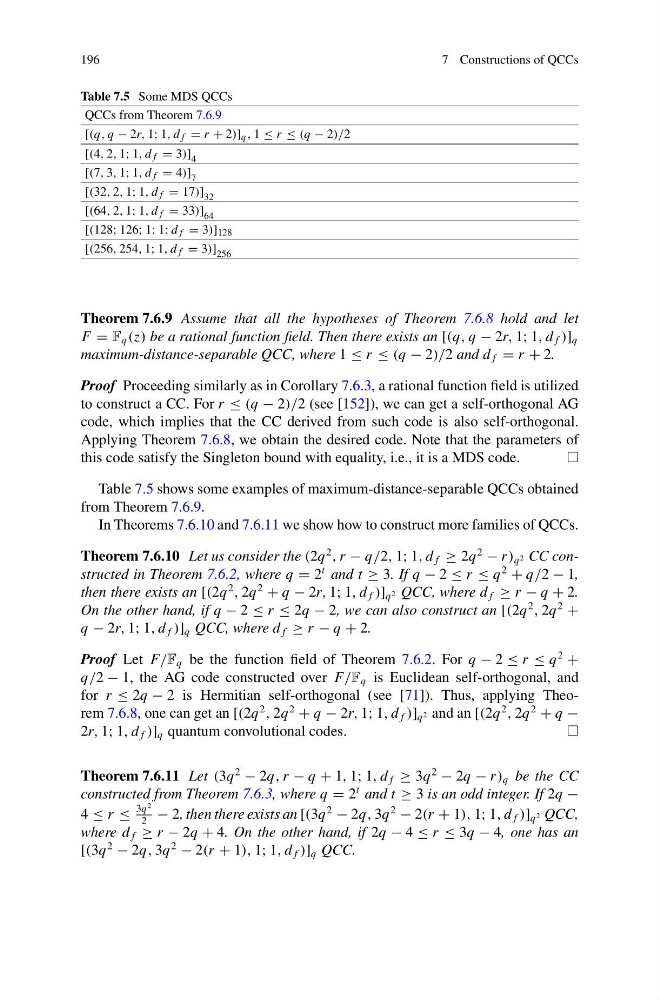
Table 7.5 Some MDS QCCs
QCCs from Theorem 7.6.9
[(q, q − 2r, 1; 1, d f = r + 2)] q , 1 ≤ r ≤ (q − 2)/2
[(4, 2, 1; 1, d f = 3)] 4
[(7, 3, 1; 1, d f = 4)] 7
[(32, 2, 1; 1, d f = 17)] 32
[(64, 2, 1; 1, d f = 33)] 64
[(128; 126; 1; 1; d f = 3)] 128
[(256, 254, 1; 1, d f = 3)] 256
Theorem 7.6.9 Assume that all the hypotheses of Theorem 7.6.8 hold and let
F = F q (z) be a rational function field. Then there exists an [(q, q − 2r, 1; 1, d f )] q
maximum-distance-separable QCC, where 1 ≤ r ≤ (q − 2)/2 and d f = r + 2.
Proof Proceeding similarly as in Corollary 7.6.3, a rational function field is utilized
to construct a CC. For r ≤ (q − 2)/2 (see [152]), we can get a self-orthogonal AG
code, which implies that the CC derived from such code is also self-orthogonal.
Applying Theorem 7.6.8, we obtain the desired code. Note that the parameters of
this code satisfy the Singleton bound with equality, i.e., it is a MDS code.
Table 7.5 shows some examples of maximum-distance-separable QCCs obtained
from Theorem 7.6.9.
In Theorems 7.6.10 and 7.6.11 we show how to construct more families of QCCs.
Theorem 7.6.10 Let us consider the (2q
2
, r − q/2, 1; 1, d f ≥ 2q
2
− r ) q 2 CC constructed in Theorem 7.6.2, where q = 2
t and t ≥ 3. If q − 2 ≤ r ≤ q
2
+ q/2 − 1,
then there exists an [(2q
2
, 2q
2
+ q − 2r, 1; 1, d f )] q 2 QCC, where d f ≥ r − q + 2.
On the other hand, if q − 2 ≤ r ≤ 2q − 2, we can also construct an [(2q
2
, 2q
2
+
q − 2r, 1; 1, d f )] q QCC, where d f ≥ r − q + 2.
Proof Let F/F q be the function field of Theorem 7.6.2. For q − 2 ≤ r ≤ q
2
+
q/2 − 1, the AG code constructed over F/F q is Euclidean self-orthogonal, and
for r ≤ 2q − 2 is Hermitian self-orthogonal (see [71]). Thus, applying Theorem 7.6.8, one can get an [(2q
2
, 2q
2
+ q − 2r, 1; 1, d f )] q 2 and an [(2q
2
, 2q
2
+ q −
2r, 1; 1, d f )] q quantum convolutional codes.
Theorem 7.6.11 Let (3q
2
− 2q, r − q + 1, 1; 1, d f ≥ 3q
2
− 2q − r ) q be the CC
constructed from Theorem 7.6.3, where q = 2
t and t ≥ 3 is an odd integer. If 2q −
4 ≤ r ≤
3q
2
2
− 2, then there exists an [(3q
2
− 2q, 3q
2
− 2(r + 1), 1; 1, d f )] q 2 QCC,
where d f ≥ r − 2q + 4. On the other hand, if 2q − 4 ≤ r ≤ 3q − 4, one has an
[(3q
2
− 2q, 3q
2
− 2(r + 1), 1; 1, d f )] q QCC.
7 Constructions of QCCs
Table 7.5 Some MDS QCCs
QCCs from Theorem 7.6.9
[(q, q − 2r, 1; 1, d f = r + 2)] q , 1 ≤ r ≤ (q − 2)/2
[(4, 2, 1; 1, d f = 3)] 4
[(7, 3, 1; 1, d f = 4)] 7
[(32, 2, 1; 1, d f = 17)] 32
[(64, 2, 1; 1, d f = 33)] 64
[(128; 126; 1; 1; d f = 3)] 128
[(256, 254, 1; 1, d f = 3)] 256
Theorem 7.6.9 Assume that all the hypotheses of Theorem 7.6.8 hold and let
F = F q (z) be a rational function field. Then there exists an [(q, q − 2r, 1; 1, d f )] q
maximum-distance-separable QCC, where 1 ≤ r ≤ (q − 2)/2 and d f = r + 2.
Proof Proceeding similarly as in Corollary 7.6.3, a rational function field is utilized
to construct a CC. For r ≤ (q − 2)/2 (see [152]), we can get a self-orthogonal AG
code, which implies that the CC derived from such code is also self-orthogonal.
Applying Theorem 7.6.8, we obtain the desired code. Note that the parameters of
this code satisfy the Singleton bound with equality, i.e., it is a MDS code.
Table 7.5 shows some examples of maximum-distance-separable QCCs obtained
from Theorem 7.6.9.
In Theorems 7.6.10 and 7.6.11 we show how to construct more families of QCCs.
Theorem 7.6.10 Let us consider the (2q
2
, r − q/2, 1; 1, d f ≥ 2q
2
− r ) q 2 CC constructed in Theorem 7.6.2, where q = 2
t and t ≥ 3. If q − 2 ≤ r ≤ q
2
+ q/2 − 1,
then there exists an [(2q
2
, 2q
2
+ q − 2r, 1; 1, d f )] q 2 QCC, where d f ≥ r − q + 2.
On the other hand, if q − 2 ≤ r ≤ 2q − 2, we can also construct an [(2q
2
, 2q
2
+
q − 2r, 1; 1, d f )] q QCC, where d f ≥ r − q + 2.
Proof Let F/F q be the function field of Theorem 7.6.2. For q − 2 ≤ r ≤ q
2
+
q/2 − 1, the AG code constructed over F/F q is Euclidean self-orthogonal, and
for r ≤ 2q − 2 is Hermitian self-orthogonal (see [71]). Thus, applying Theorem 7.6.8, one can get an [(2q
2
, 2q
2
+ q − 2r, 1; 1, d f )] q 2 and an [(2q
2
, 2q
2
+ q −
2r, 1; 1, d f )] q quantum convolutional codes.
Theorem 7.6.11 Let (3q
2
− 2q, r − q + 1, 1; 1, d f ≥ 3q
2
− 2q − r ) q be the CC
constructed from Theorem 7.6.3, where q = 2
t and t ≥ 3 is an odd integer. If 2q −
4 ≤ r ≤
3q
2
2
− 2, then there exists an [(3q
2
− 2q, 3q
2
− 2(r + 1), 1; 1, d f )] q 2 QCC,
where d f ≥ r − 2q + 4. On the other hand, if 2q − 4 ≤ r ≤ 3q − 4, one has an
[(3q
2
− 2q, 3q
2
− 2(r + 1), 1; 1, d f )] q QCC.